Culinary Explorer
A cooking platform built around craft, culture, and the stories behind what we eat.
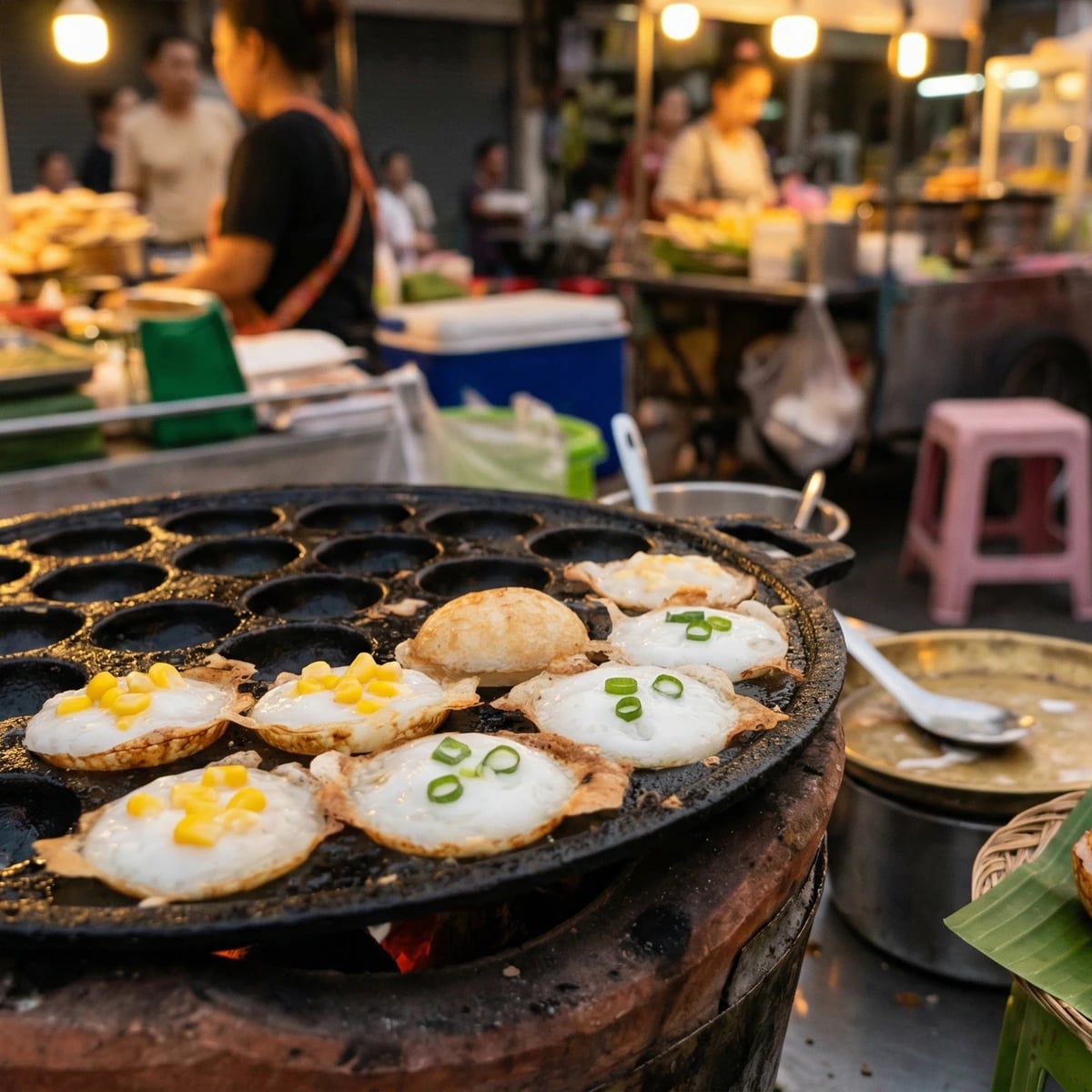
Coconut Rice Pancakes (Khanom Krok)
Created by Chef Fai
Two batters, one principle: the sweet pillar of Thai cuisine runs on palm sugar and coconut cream, never white sugar, never dairy. These little half-moons from a cast-iron mold prove the system governs even dessert.
Thai sweets follow the same governing principles as every other Thai dish. That's the thing people miss. They think khanom (ขนม, Thai sweets) exist in some separate world where the rules don't apply. Wrong. Palm sugar for sweetness. Coconut cream for richness. Pandan for fragrance. Salt to anchor the whole thing. The four pillars don't disappear just because you're making dessert. They shift. The sweet pillar steps forward, the salty recedes to a supporting role, sour and spice step out entirely. But the system is still running.
Khanom krok is two batters meeting in a cast-iron mold. The bottom batter is rice flour (khao jao, regular rice flour, not glutinous) mixed with coconut milk, palm sugar, and a pinch of salt. It goes in first, fills the mold halfway, and starts to set against the hot iron. Then the top batter: thick coconut cream with a touch of rice flour and salt. It sits on top like a cap, staying soft and custardy while the bottom crisps. When you pop one out of the mold, you get a half-moon with a golden, crunchy shell on the outside and a creamy, barely-set center. That contrast is the entire point.
Ajarn always said the kreung tam is the foundation of Thai cooking, but with sweets, the foundation shifts to the batter. The batter IS the kreung tam of khanom. The quality of your coconut cream determines everything. Fresh-pressed from grated coconut meat is a completely different product than what comes out of a can. The fat content is higher, the flavor is cleaner, and it sets differently when heated. Can you use canned? You can. But you'll taste the difference, and once you've had the real thing, you won't go back.
I learned to make khanom krok at a temple fair in Nonthaburi when I was maybe ten years old. A woman had been making them for thirty years on the same cart with the same cast-iron pan, blackened and seasoned beyond recognition. She poured with one hand and topped with the other, never measuring, never looking at a recipe. Hundreds of perfect khanom krok a day. That's what principle-based cooking looks like. She didn't need instructions. She understood the ratios in her hands.
Ingredients
rice flour (paeng khao jao)
Quantity
1 cup
regular rice flour, not glutinous
cooked jasmine rice
Quantity
1/2 cup
coconut milk (hua ka thi, thin)
Quantity
1 cup
| Ingredient | Quantity |
|---|---|
| rice flour (paeng khao jao)regular rice flour, not glutinous | 1 cup |
| cooked jasmine rice | 1/2 cup |
| coconut milk (hua ka thi, thin) | 1 cup |
Where cooking meets culture.
Culinary guides, cultural storytelling, and the editorial depth that makes cooking meaningful.
Discover Culinary Explorer