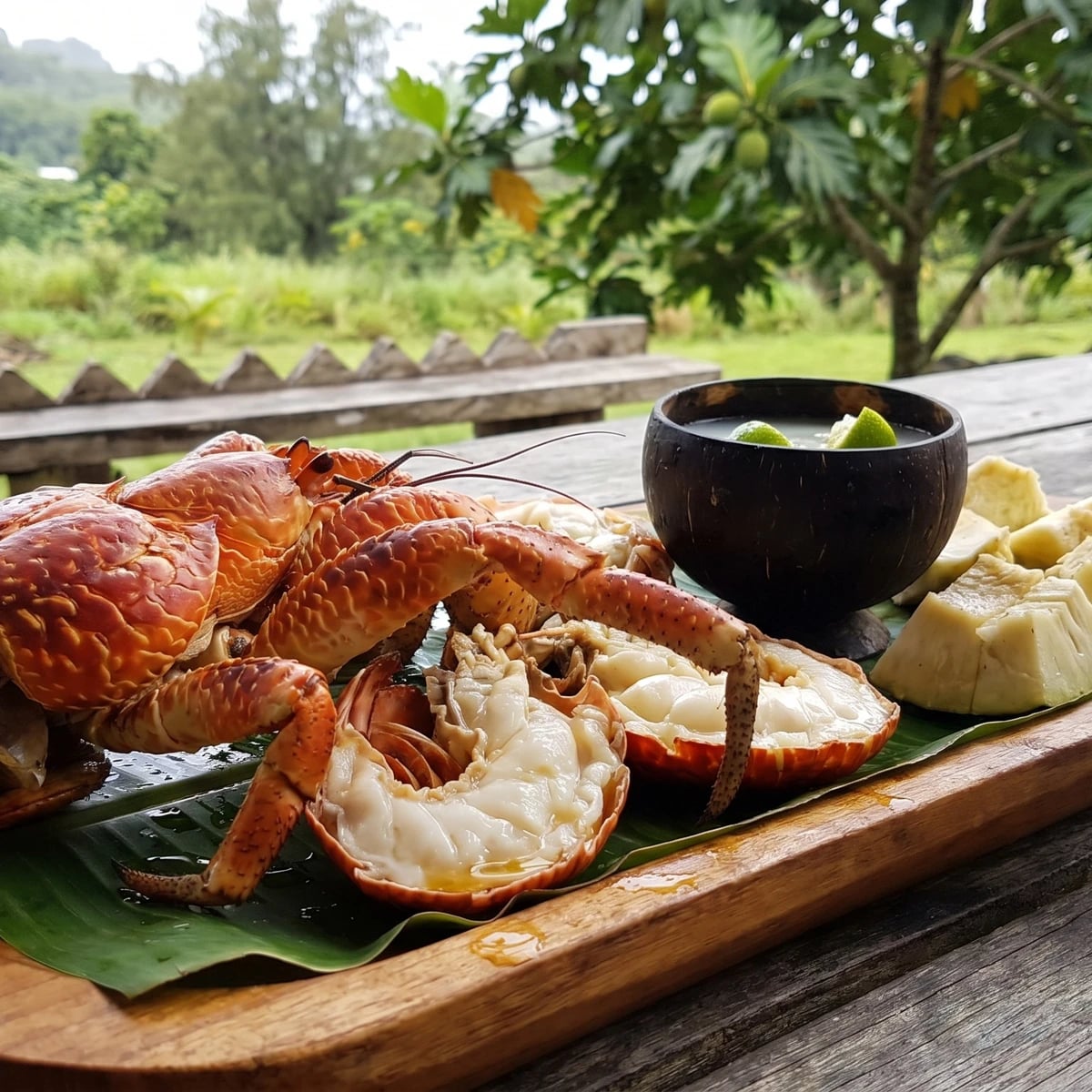
Kaveu (Marquesan Boiled Coconut Crab from Henua ʻEnana)
Created by
The Marquesas, Henua ʻEnana, gives kaveu with a careful hand: coconut crab boiled simply in sea-salt water, shell glowing orange, sweet meat served with fresh miti haari.
Main Dishes
Polynesian
Special Occasion
Celebration
Outdoor Dining
25 min
Active Time
25 min cook•50 min total
Yield4 servings
In the Marquesas, Henua ʻEnana, the land rises hard from the sea, all green valley and black rock, no soft lagoon ring to make the place easy. That kind of island teaches you respect. The kaveu, the coconut crab, climbs the palms and feeds on the coconut, slow-growing, strong, tasting faintly of the tree it lives with. This is Marquesan food, not Tahitian, not a nameless island plate. Name the hand that feeds you.
I learned this kind of dish by sitting quiet while somebody else's elder did the talking. Back home in Hawaiʻi, crab might come from the reef or the market, and our deep table leans on kalo, Hāloa, our elder brother. In Henua ʻEnana, the belly of the old foodway leans hard on mei, breadfruit, and the crab belongs to that rugged valley table. One ocean, one canoe, one root, yes, but each island keeps its own hand.
The method is plain because the animal is not. Salt water, a careful boil, no heavy sauce, no showing off. The shell turns orange, the meat tightens sweet and clean, and the miti haari, fresh coconut sauce, sits beside it like a cousin, not a blanket. If you can't get kaveu legally and respectfully, eat what you have. Use a good crab from your own waters and leave the protected one walking.
For the deep parts of Marquesan gathering, the Festival des Marquises, the umu kai, the old protocols around who catches and who serves, I send you to Marquesan elders. They should tell their own story. I can cook this open-handed and still know when to step back.
Kaveu, the coconut crab, has long been a prized food in the Marquesas, Henua ʻEnana, where high volcanic islands and breadfruit valleys shape a different table from Tahiti's lagoon world. Coconut crabs grow slowly, live on land, and are protected or regulated across much of the Pacific today, so the old abundance now comes with legal seasons, size limits, and a duty not to take breeding animals. The dish sits beside the broader Polynesian food grammar of salt water, coconut, breadfruit, and earth-oven feasting, but it remains specifically Marquesan.
The technique, the tradition, and the story behind every dish.
legally harvested coconut crab (kaveu)humanely dispatched and cleaned
1 (3 to 4 pounds)
wateror enough to cover the crab
6 quarts
coarse sea saltplus more to taste
1/2 cup
mature coconutsgrated, or 2 cups unsweetened grated coconut
2
warm waterfor squeezing coconut cream
1/2 cup
limescut into wedges
2
cooked mei or ʻuru (breadfruit) (optional)
for serving
Equipment Needed
•Heavy 10-quart stockpot with tight lid
•Long tongs or a spider strainer
•Crab crackers or a small wooden mallet
•Clean cloth for squeezing coconut cream
Instructions
1
Check the kaveu
Start with a kaveu that is legal, mature, and not carrying eggs. If you did not catch it with Marquesan guidance and proper permission, buy it from somebody who can tell you where it came from and why it can be taken. This animal grows slow. Respect comes before appetite.
If kaveu is protected where you live, do not substitute wishful thinking for permission. Use Dungeness, mud crab, or another legal local crab and keep the Marquesan name for the Marquesan animal.
2
Make miti haari
Work the grated mature coconut with the warm water, then squeeze hard through clean cloth until you have thick, rich miti haari, fresh coconut sauce. It should look white and glossy, with enough body to cling to a spoon. Season it with a small pinch of sea salt and keep it cool near the table.
Fresh is the point here. Canned coconut cream can help on a weeknight, but for this dish the fresh squeeze carries the clean sweetness beside the crab.
3
Salt the water
Bring the water to a strong boil in a wide pot and stir in the sea salt. Taste a cooled spoonful. It should taste like clean seawater, salty but not bitter. No need add aromatics. The crab and the salt can speak for themselves.
4
Boil the crab
Lower the cleaned kaveu into the boiling water, cover, and boil gently until the shell glows deep orange and the meat is firm and sweet, about 18 to 25 minutes depending on size. Keep the boil steady, not violent. You want the meat set clean, not beaten tough.
For food safety, the thickest meat should reach 145F. If you are cooking a different crab, follow the timing for that crab instead of forcing it to act like kaveu.
5
Rest and crack
Lift the crab out and let it rest a few minutes until you can handle it. Crack the claws and legs, open the body, and keep the rich juices with the meat. The shell should be bright, the meat pearly and glossy, and the smell clean, sweet, and ocean-salty.
6
Serve for sharing
Lay the cracked kaveu on banana leaf with lime wedges, the fresh miti haari, and cooked mei, the Marquesan breadfruit heart of the meal. Spoon a little coconut sauce over the meat or dip as you eat. This is not fancy food. It is careful food. Put it in the middle and feed the table.
Chef Tips
•Kaveu is slow-growing and protected in many islands. Take only where legal, only mature animals, never egg-bearing females, and follow local Marquesan or French Polynesian regulations.
•Coconut crab can carry risk from what it has eaten. Source from people who know the ground and the animal. When in doubt, no eat it.
•The Marquesas are breadfruit country. Serve this with boiled or roasted mei or ʻuru, not as a lonely crab on a plate.
•If you are outside Henua ʻEnana, a legal local crab keeps the spirit of the method without pretending it is kaveu. Same ocean family, different bowl.
Advance Preparation
•Check regulations and source the kaveu before you plan the meal; this is not a last-minute market grab.
•Grate the coconut a few hours ahead, but squeeze the miti haari close to serving so it stays fresh and sweet.
•Cook the mei or ʻuru before the crab goes in the pot, so the crab can be cracked and eaten while the meat is still glossy and tender.
Frequently Asked Questions
Nutrition Information
1 serving (about 290g)
Calories
335 calories
Total Fat
13 g
Saturated Fat
10 g
Trans Fat
0 g
Unsaturated Fat
2 g
Cholesterol
80 mg
Sodium
1050 mg
Total Carbohydrates
31 g
Dietary Fiber
6 g
Sugars
12 g
Protein
24 g
Where cooking meets culture.
Culinary guides, cultural storytelling, and the editorial depth that makes cooking meaningful.