
Chef Elsa
Eiersalat (Austrian Egg Salad)
Cool, creamy Austrian egg salad with sour gherkins and tart apple in a mustard-yogurt dressing, the kind of honest Jause food that tastes like an Austrian Easter table and works beautifully all year round.
A cooking platform built around craft, culture, and the stories behind what we eat.
Created by
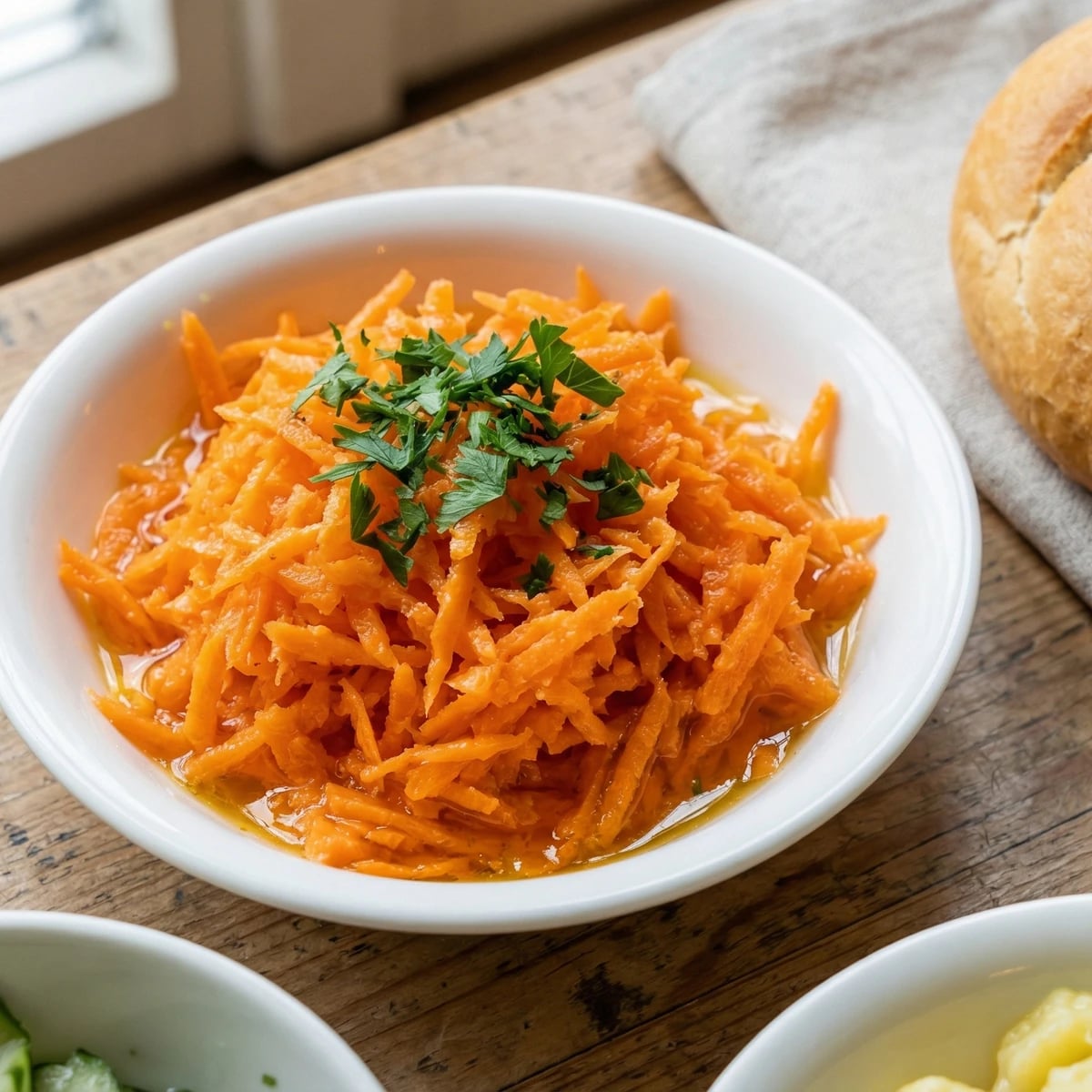
Bright raw grated carrots dressed simply with lemon, sugar, and oil. The little salad that quietly holds its own on every Austrian Gemischter Salat plate, year-round and without apology.
Every Gemischter Salat plate in Austria has one. Tucked between the Gurkensalat and the Erdäpfelsalat, there it sits: a small mound of grated carrots, bright orange, glistening with lemon juice. Nobody orders it on its own. Nobody talks about it. And yet if it were missing, the whole plate would feel wrong.
I remember Gretel picking through the carrots at a farm shop on one of our trips to the Salzkammergut. She squeezed them with her thumb, checking for firmness, and told me something I've never forgotten: a carrot that bends is a carrot that's given up. You want them rigid, snapping clean when you break one in half. That snap means the sugars are still there, and the sugar in a good carrot is what makes Karottensalat work. The lemon wakes it up. The pinch of granulated sugar coaxes it forward. The oil rounds everything out. Three ingredients doing the job of twenty because the carrot itself is doing the heavy lifting.
This is the kind of Austrian cooking I love most. Nothing to hide behind. No complicated technique, no long ingredient list. Just a vegetable treated with respect and dressed with a light hand. If your carrots are good, this salad is good. If your carrots are old and bendy and sad, make something else. That's honest cooking.
Karottensalat belongs to Austria's Salatplatte tradition, where a selection of simply dressed vegetable salads is served together as a Gemischter Salat (mixed salad plate) alongside meat dishes. This tradition grew from the Bürgerlich kitchen of the 19th century, where a proper meal always included a composed salad course. The Austrian preference for dressing raw vegetables with a Marinade of acid, sugar, and oil rather than creamy dressings reflects the influence of the empire's lighter southern cuisines, particularly Italian and Hungarian, on everyday Viennese cooking.
Quantity
500g
firm and sweet
Quantity
3 tablespoons
about 1 large lemon
Quantity
2 tablespoons
Quantity
1 teaspoon
Quantity
1/2 teaspoon
Quantity
1 tablespoon
finely chopped
| Ingredient | Quantity |
|---|---|
| fresh carrotsfirm and sweet | 500g |
| fresh lemon juiceabout 1 large lemon | 3 tablespoons |
| sunflower oil or mild rapeseed oil | 2 tablespoons |
| granulated sugar | 1 teaspoon |
| fine salt | 1/2 teaspoon |
| fresh flat-leaf parsley (optional)finely chopped | 1 tablespoon |
Pick carrots that feel heavy and rigid. When you snap one in half it should break clean with an audible crack. Peel them with a vegetable peeler, removing just the thin outer skin. Don't scrub them raw and call it done. The peel on a carrot is bitter, and bitterness has no place in this salad.
Use the coarse side of a box grater. Not the fine side, not a Microplane, not a food processor. The coarse holes give you long, sturdy shreds that hold their texture and catch the Marinade in all the right places. Fine grating turns carrots into mush. You want pieces with enough body that they feel alive in your mouth, a little resistance, a little crunch. Grate directly into a mixing bowl.
In a small bowl, whisk together the lemon juice, oil, sugar, and salt until the sugar dissolves. Taste it. The Marinade should be bright and tart with just enough sweetness to soften the lemon's edge. If your lemons are very sharp, add another half teaspoon of sugar. If they're mild and sweet, hold back. You're balancing two kinds of sweetness here, the carrot's and the lemon's, and the sugar is the bridge between them.
Pour the Marinade over the grated carrots and toss everything together with your hands or two forks until every shred is coated. Let the salad sit for at least ten minutes at room temperature before serving. This resting time is not optional. The salt draws moisture from the carrots, the lemon juice softens them just slightly, and the flavors come together into something more than the sum of their parts. Five minutes won't do it. Ten is the minimum. Thirty is better.
Give the salad a final toss and mound it into a small bowl or onto your Gemischter Salat plate. Scatter a little chopped parsley over the top if you like, though plenty of Austrian kitchens skip it and let the carrot speak for itself. Serve at cool room temperature, never ice cold from the fridge. You want the flavors open and forward, not muted by chill. Mahlzeit!
1 serving (about 145g)
Culinary guides, cultural storytelling, and the editorial depth that makes cooking meaningful.
Discover Culinary Explorer
Chef Elsa
Cool, creamy Austrian egg salad with sour gherkins and tart apple in a mustard-yogurt dressing, the kind of honest Jause food that tastes like an Austrian Easter table and works beautifully all year round.

Chef Elsa
Bitter curly endive wilted just so by a warm dressing of rendered Speck, sharp vinegar, and a touch of mustard, the kind of salad that makes a roast pork dinner feel complete.

Chef Elsa
Warm broth-soaked potatoes and crispy Speck over tender Vogerlsalat, finished with a drizzle of dark Steirisches Kürbiskernöl and a soft-boiled egg that ties the whole bowl together.

Chef Elsa
Tender Austrian green beans dressed in warm Marinade the moment they leave the pot, absorbing every drop of vinegar and oil while they cool into something far greater than the sum of their parts.