Chef Zohra
Boushnikha
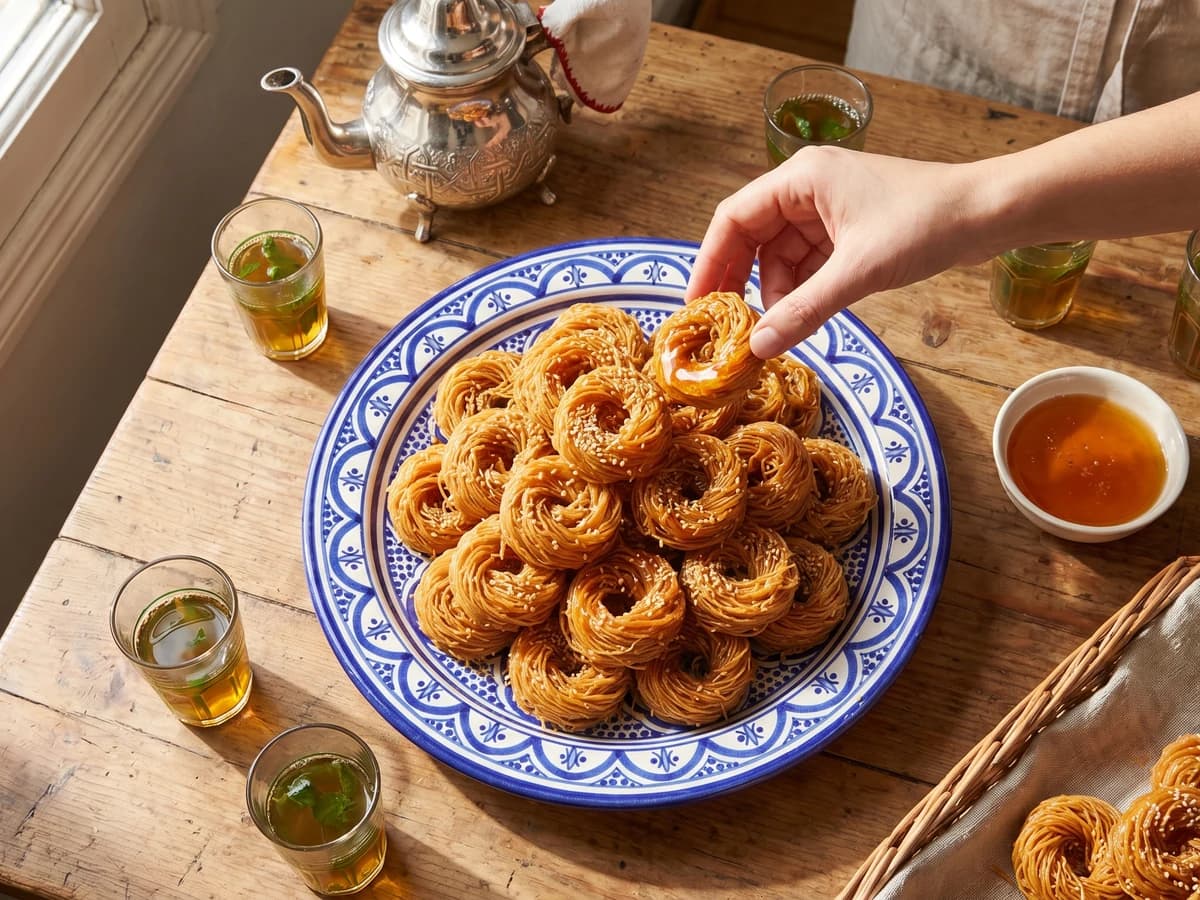
A Ramadan sweet lighter than chebakia: fine milk dough drawn into threads, fried until crisp, then bathed in orange-blossom honey and shared from a generous plate.
A cooking platform built around craft, culture, and the stories behind what we eat.
Created by
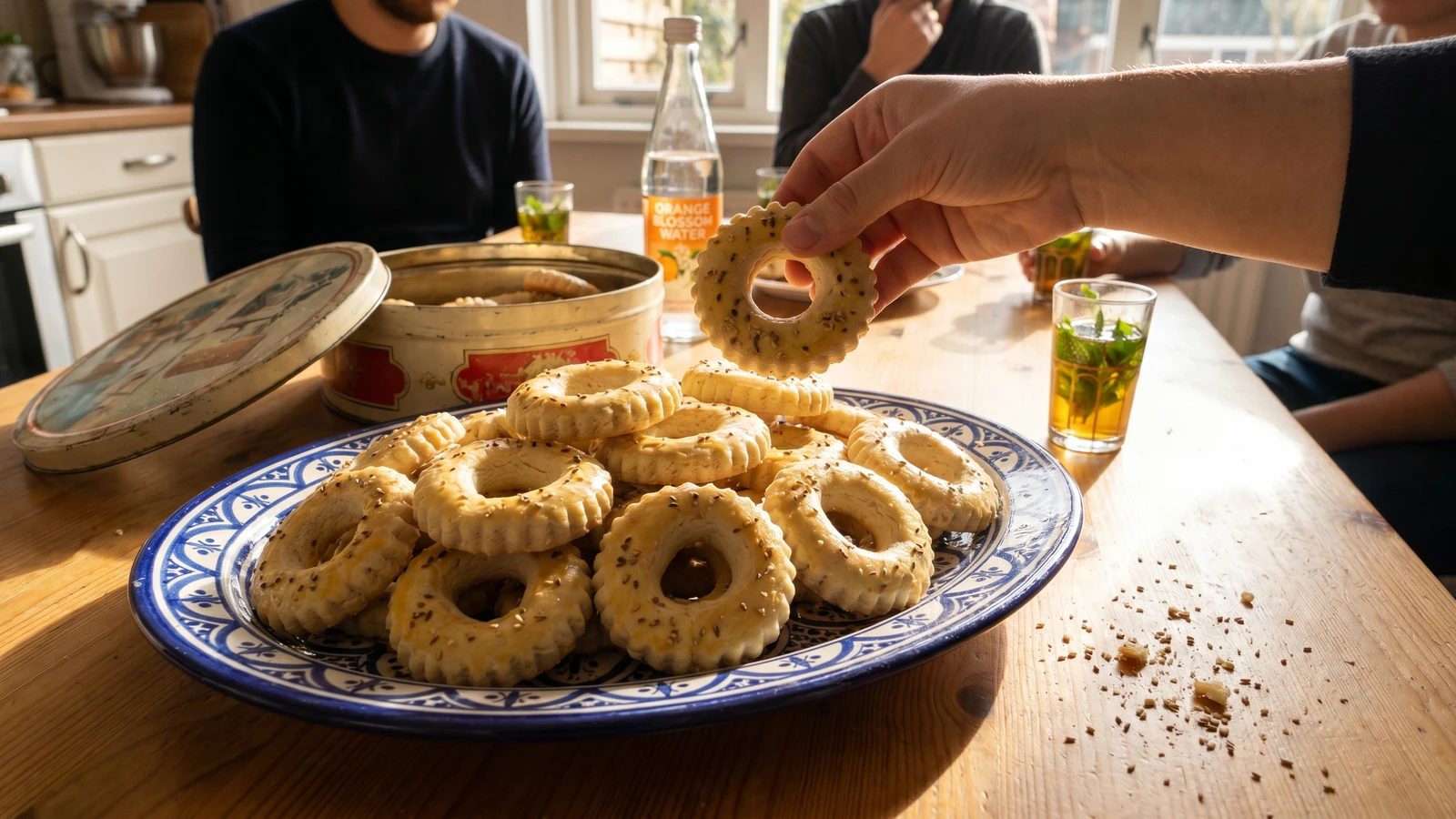
My eastern frontier's ring biscuit, fragrant with anise, sesame, and orange blossom, pinched into a dentelled circle and baked firm enough to keep by the tin for Eid callers.
The dentelled ring is the whole gesture. You roll a cord, close it with the heel of your hand, then nick the edge all around so the biscuit comes out with that little lace that tells an Oujda child what is in the tin before the lid is fully open. Keep the dough firm and let it rest: firm dough holds the cut, resting lets the flour drink, and the rings won't crack when you bend them.
This is eastern Morocco in the mouth: anise, sesame, orange blossom water, and a little meska horra if your spice merchant has it. There isn't one Moroccan cuisine, but des cuisines marocaines, and kaak d'Oujda belongs to the frontier, close in accent to Tlemcen and the old road as much as to the rest of Morocco.
Make a full tin. These biscuits are made ahead because they keep their welcome: for Eid morning, for a neighbor who knocks, for tea poured when nobody planned a visit. Une table, c'est une porte qu'on laisse ouverte, a table is a door you leave open, and a ring biscuit knows how to wait by the door.
Kaak d'Oujda belongs to Morocco's eastern corridor, where Oujda faced Tlemcen and the routes linking Fez, Algeria, and the Mediterranean long before the French Protectorate border hardened movement in 1912. The word kaak is older and wider than Morocco, used across Arabic-speaking regions for ring breads and biscuits, but the Oujdi version is marked by anise, sesame, orange blossom water, and a dentelled edge cut by hand. Frontier families tell the story of travelers hiding coins or gold in the ring for crossings; the dating is hard to prove, but the dry keeping quality fits a biscuit made for the road.
Quantity
1 kg
Quantity
180g
Quantity
2 tbsp
lightly toasted
Quantity
2 tbsp
lightly crushed
Quantity
1 tbsp
lightly crushed
Quantity
2 tsp
Quantity
1 tsp
Quantity
1/2 tsp
Quantity
1/2 tsp
pounded with 1 tsp sugar
Quantity
150ml
Quantity
100g
melted and cooled
Quantity
120ml
Quantity
180 to 220ml
as needed
Quantity
1 yolk plus 1 tbsp milk
for brushing
| Ingredient | Quantity |
|---|---|
| plain flour | 1 kg |
| granulated sugar | 180g |
| sesame seedslightly toasted | 2 tbsp |
| anise seedslightly crushed | 2 tbsp |
| fennel seedslightly crushed | 1 tbsp |
| baking powder | 2 tsp |
| instant yeast | 1 tsp |
| fine sea salt | 1/2 tsp |
| meska horra (gum arabic) (optional)pounded with 1 tsp sugar | 1/2 tsp |
| neutral oil | 150ml |
| unsalted buttermelted and cooled | 100g |
| orange blossom water | 120ml |
| warm wateras needed | 180 to 220ml |
| egg yolk mixed with milkfor brushing | 1 yolk plus 1 tbsp milk |
Toast the sesame in a dry pan just until it smells nutty and turns a shade deeper, then tip it out at once. Lightly crush the anise and fennel between your palms or in a mortar. Don't grind them to dust; the little seeds should still show in the biscuit and release their perfume when you bite.
In a wide bowl, mix the flour, sugar, sesame, anise, fennel, baking powder, yeast, salt, and pounded meska horra if using. Pour in the oil and melted butter, then rub everything through your fingers until the flour feels like damp sand. This matters: the fat coats the flour first, so the kaak breaks cleanly under the teeth instead of eating like bread.
Pour in the orange blossom water, then add warm water little by little, mixing with your hand until a firm dough gathers. Knead for 5 to 7 minutes, only until smooth and pliable. The dough should feel firm but not dry, soft enough to roll without splitting, strong enough to hold a cut. La balance est dans les yeux, the scale is in the eyes, because each flour drinks differently.
Cover the dough and let it rest for 30 minutes. This is not a big bread rise; it is time for the flour to drink and the dough to relax. If you rush it, the cords fight your hands and the rings crack where they should bend.
Heat the oven to 180C or 350F and line baking sheets with parchment. Pinch off walnut-sized pieces of dough and roll each one into a cord about 14cm long and as thick as your little finger. Join the ends firmly, pressing the seam closed, then set the seam underneath. With a kaak cutter, nakkach, or small scissors, nick the outside edge all around to make the dentelled border.
Set the rings on the trays with a little room between them. Brush lightly with the egg yolk and milk, not so much that the cuts fill in. Bake for 18 to 25 minutes, rotating the tray once, until the kaak is pale gold on top and a little deeper underneath. Take them out before they go dark; the anise should stay fragrant, not bitter.
Cool the kaak completely on a rack before storing. Warm biscuits in a closed tin soften from their own trapped moisture, and we made them to keep their bite. Serve with mint tea, coffee, or a glass of milk for children, and put the tin back on the table when one more hand reaches.
1 serving (about 43g)
Culinary guides, cultural storytelling, and the editorial depth that makes cooking meaningful.
Discover Culinary ExplorerChef Zohra
A Ramadan sweet lighter than chebakia: fine milk dough drawn into threads, fried until crisp, then bathed in orange-blossom honey and shared from a generous plate.

Chef Zohra
Tissue-thin warqa folded into small triangles around orange-blossom almond paste, fried until gold, then dipped warm into honey. This is the sweet Fassi briouat that makes tea feel like a feast.
Chef Zohra
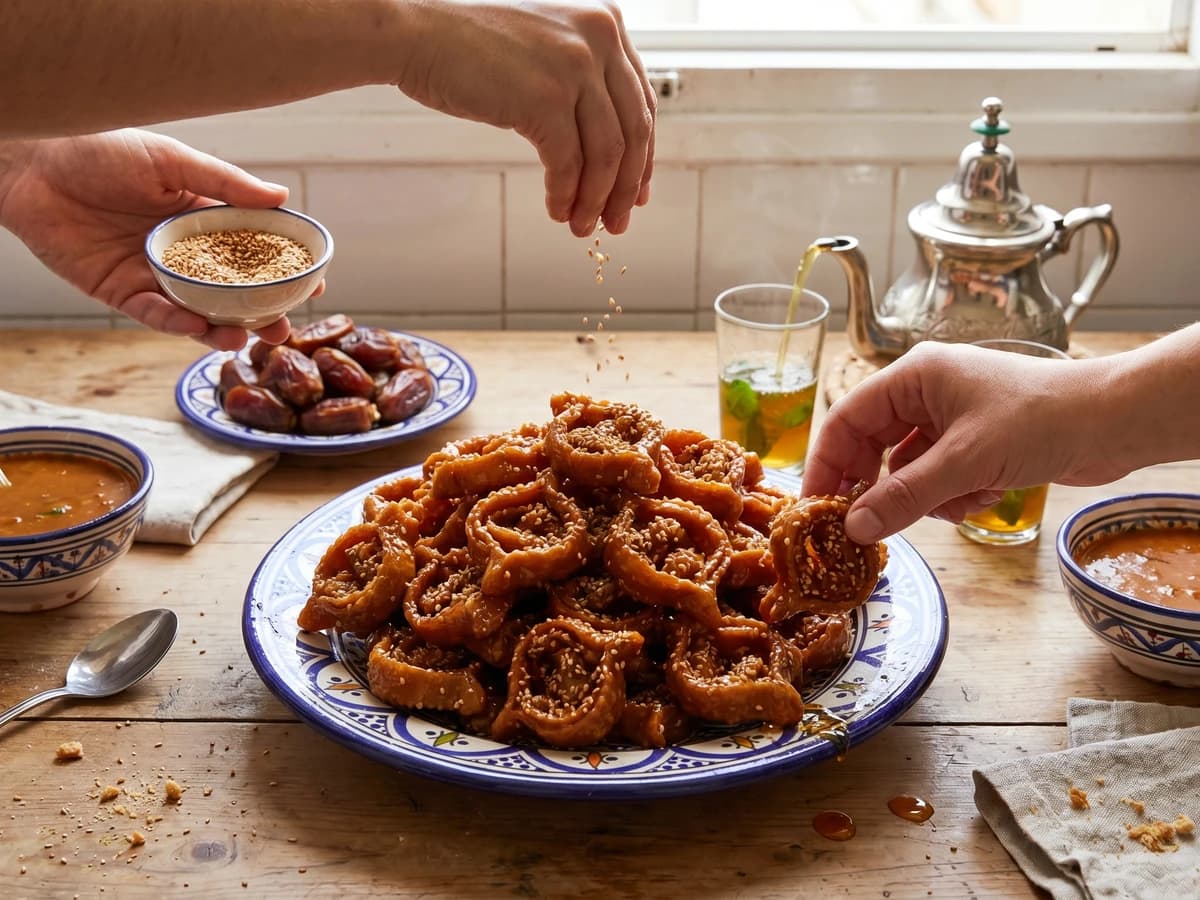
The flower of the Ramadan table: dough scented with toasted sesame, anise, saffron, and orange blossom water, fried crisp, then soaked in warm honey beside harira.

Chef Zohra
Slim warqa cigars filled with orange-blossom almond paste, fried until crisp under the teeth, then soaked in warm honey for the festive table.