
Chef Jeong-sun
Agwi-jjim (Braised Monkfish with Bean Sprouts)
Firm monkfish buried under crisp soybean sprouts, minari, and a red gochugaru sauce thickened at the end; Masan's market dish asks for heat, timing, and a steady hand.
A cooking platform built around craft, culture, and the stories behind what we eat.

Created by
Thin pork shoulder in a restrained gochujang marinade, grilled over hard heat until the edges darken and the sauce turns from wet paste into a red crust.
Jeyuk-gui lives or dies by the fire. Too low, and the gochujang marinade weeps into the pan and becomes jeyuk-bokkeum (stir-fried spicy pork). Good food, different dish. For gui (grilled food), the pork has to meet high heat, quickly, so the paste cooks onto the meat instead of pooling underneath it.
Choose pork shoulder, pork neck, or collar if your butcher has it, sliced thin but not shaved. Belly gives you richness, loin gives you dryness, but shoulder has the right balance for a weeknight table. The marinade must be red, yes, but not only hot and sweet. Gochujang is already salty and sweet, so I use enough to cling and stop there. Let the pork still taste like pork.
My teacher would make us wipe the bowl clean with one last piece of meat, then shake off the excess before it touched the grill. I thought that was severity. It was instruction. Wet marinade burns before the meat browns. Thin meat needs room. A lettuce wrap needs a piece that is cooked through, edged dark, and still juicy. 손맛 is real; I measure it anyway, so you can cook the same good plate twice.
Jeyuk means pork, and gui means grilled food; the red gochujang-marinated form belongs to Korea's modern home and restaurant table more than to old court records. Chili entered Korean cooking only after peppers arrived from the Americas a few centuries ago, and the sweet-hot pork marinades familiar today became especially common in the twentieth century as gochujang, pork, and tabletop grilling spread more widely. Jeyuk-gui is close kin to jeyuk-bokkeum, but the method is drier and hotter, with the marinade cooked into the meat rather than left as a pan sauce.
Quantity
700g
sliced 1/4 inch thick against the grain
Quantity
1/2 medium
grated
Quantity
3 tablespoons
Quantity
1 tablespoon
Quantity
2 tablespoons
Quantity
1 tablespoon
or 2 teaspoons honey
Quantity
1 tablespoon
Quantity
1 tablespoon
Quantity
5 cloves
minced
Quantity
1 teaspoon
finely grated
Quantity
1/2 teaspoon
Quantity
1/4 teaspoon
freshly ground
Quantity
1 tablespoon
for the grill or pan
Quantity
2
thinly sliced
Quantity
1 teaspoon
Quantity
to serve
| Ingredient | Quantity |
|---|---|
| pork shoulder, pork neck, or pork collarsliced 1/4 inch thick against the grain | 700g |
| oniongrated | 1/2 medium |
| gochujang (Korean fermented chili paste) | 3 tablespoons |
| gochugaru (Korean chili flakes) | 1 tablespoon |
| soy sauce | 2 tablespoons |
| maesil-cheong (Korean green plum syrup)or 2 teaspoons honey | 1 tablespoon |
| mirin or rice wine | 1 tablespoon |
| toasted sesame oil | 1 tablespoon |
| garlicminced | 5 cloves |
| fresh gingerfinely grated | 1 teaspoon |
| sugar | 1/2 teaspoon |
| black pepperfreshly ground | 1/4 teaspoon |
| neutral oilfor the grill or pan | 1 tablespoon |
| scallions (optional)thinly sliced | 2 |
| toasted sesame seeds (optional) | 1 teaspoon |
| lettuce leaves, perilla leaves, cooked rice, and ssamjang (optional) | to serve |
Slice the pork 1/4 inch thick against the grain, then cut any wide pieces into lengths that will fit neatly in a lettuce wrap. Do not shave it paper-thin for this dish. Jeyuk-gui needs enough thickness to stay juicy while the marinade cooks into a crust.
In a large bowl, stir together the grated onion, gochujang, gochugaru, soy sauce, maesil-cheong or honey, mirin, sesame oil, garlic, ginger, sugar, and black pepper. The marinade should be thick enough to coat a spoon, not loose like soup. That thickness matters because gui wants a coating that clings to the pork over high heat.
Add the pork and turn it by hand until every slice is coated. Let it stand 30 minutes at room temperature, or refrigerate up to 4 hours. Longer is not better here; the salt and fermented paste can make thin pork taste cured instead of fresh.
Heat a charcoal grill, gas grill, grill pan, or wide cast-iron skillet over high heat. Oil the grate or pan lightly. You need real heat before the pork goes down, because gochujang contains sugar and soybean paste; on a weak surface it sticks and scorches before the meat cooks.
Lift each piece from the bowl and let the excess marinade fall back before it touches the heat. Do not scrape the meat bare, just remove the heavy wet layer. A thin coating makes a red crust; a thick coating makes burnt paste.
Lay the pork in a single layer with space between pieces. Cook 2 to 3 minutes on the first side, until the edges darken and the underside releases, then turn and cook 2 minutes more. Move any pieces that color too fast to a cooler part of the grill or lower the heat slightly. The pork should be cooked through with no raw center.
Transfer the pork to a platter and let it rest 3 minutes while you cook the remaining batches. Scatter with scallions and toasted sesame seeds. Serve at once with lettuce, perilla leaves, rice, and ssamjang, so each person can wrap a piece with rice and a small dab of sauce.
1 serving (about 360g)
Culinary guides, cultural storytelling, and the editorial depth that makes cooking meaningful.
Discover Culinary ExplorerChef Jeong-sun
Firm monkfish buried under crisp soybean sprouts, minari, and a red gochugaru sauce thickened at the end; Masan's market dish asks for heat, timing, and a steady hand.

Chef Jeong-sun
A quick Korean rice bowl built on contrast: warm rice, cold popping flying-fish roe, chopped vegetables, gim, sesame oil, and the crisp rice bottom a hot stone bowl gives you.
Chef Jeong-sun
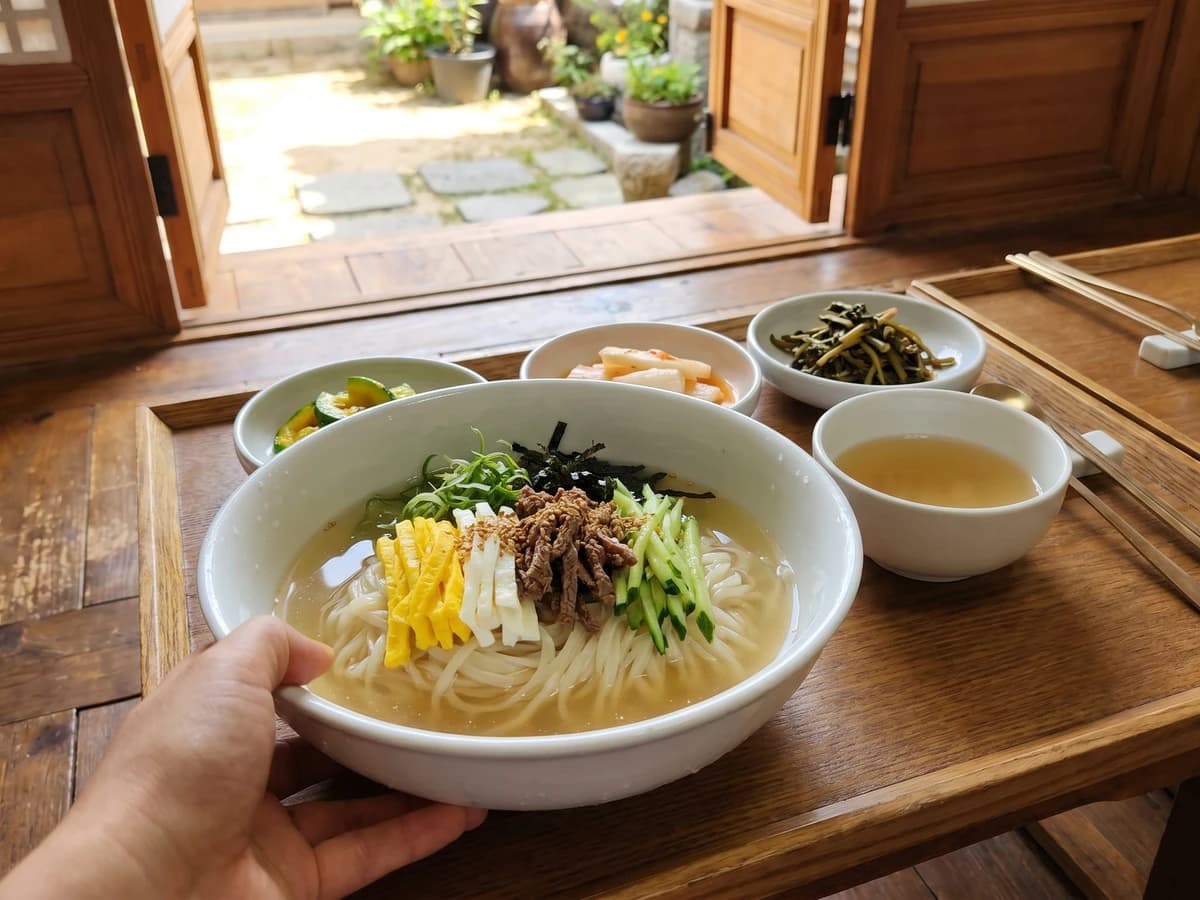
Andong's guest noodles, wheat and roasted soybean flour rolled thin, boiled and rinsed cold, then set in a clear chilled anchovy broth with careful strips of beef, egg, and cucumber.

Chef Jeong-sun
Andong's ritual-table rice served on an ordinary day: separate soy-sesame namul, warm rice, and clear radish soup, mixed without gochujang so every vegetable keeps its own voice.