
Chef Jeong-sun
Agwi-jjim (Braised Monkfish with Bean Sprouts)
Firm monkfish buried under crisp soybean sprouts, minari, and a red gochugaru sauce thickened at the end; Masan's market dish asks for heat, timing, and a steady hand.
A cooking platform built around craft, culture, and the stories behind what we eat.

Created by
A celebration dish from the coastal table: scored abalone first softened with gentle heat, then glossed in soy, garlic, and jujube so the cuts drink the sauce without losing their clean shellfish taste.
Jeonbok-jjim lives or dies under the knife before it ever meets the pot. Score too deep and the meat falls apart. Do not score at all and the sauce slides off the foot as if it never met it. My teacher made me cut shallow diamonds, 5mm apart and 3mm deep, then made me do it again when one line went too far. 눈동냥, 귀동냥 (borrowing with the eyes and ears), she said after I had already ruined two.
This is a celebration dish, not because it needs decoration, but because abalone costs money and asks for attention. The Korean table has many ways to honor it: raw by the sea, grilled over quick heat, folded into porridge for someone who needs strength, and braised like this for a table where elders are fed first. The sauce is soy, rice wine, ginger, and a little sweetness. It should shine on the abalone, not make it taste like beef marinade.
Tonight it asks for four things: scrub until the dark edge is clean, remove the hard mouth, score the flesh in shallow diamonds, and keep the heat quiet. Gentle heat keeps it tender; fast boiling tightens it into rubber. I give the minutes and the sauce measure because 손맛 is real, and I still measure it, so it can be handed on.
Jeonbok (abalone) has long been one of Korea's prized coastal foods; Joseon-era tribute records and local gazetteers list abalone from Jeju and the southern seas as products sent inland, often dried because fresh shellfish traveled poorly. Jeonbok-jjim belongs to the special-occasion side of the table, especially in coastal regions and banquet cooking, where expensive shellfish could be stretched by scoring, saucing, and serving it with rice and banchan. Modern abalone farming, especially around Wando in Jeollanam-do, has made fresh abalone far more available than it was in earlier home kitchens.
Quantity
8, 55 to 70g each in shell
scrubbed, trimmed, and scored
Quantity
2 tablespoons
for scrubbing
Quantity
4 slices, about 1/2 inch thick
Quantity
1/2 cup
Quantity
2 tablespoons
Quantity
3 tablespoons
Quantity
1 tablespoon
Quantity
2 teaspoons
Quantity
2 cloves
thinly sliced
Quantity
3 thin slices
Quantity
2
pitted and thinly sliced
Quantity
8
blanched and peeled
Quantity
1 teaspoon
Quantity
1 tablespoon
lightly crushed
| Ingredient | Quantity |
|---|---|
| fresh medium abalone (jeonbok)scrubbed, trimmed, and scored | 8, 55 to 70g each in shell |
| coarse sea saltfor scrubbing | 2 tablespoons |
| Korean radish (mu) | 4 slices, about 1/2 inch thick |
| anchovy-kelp broth or water | 1/2 cup |
| cheongju (Korean rice wine) or mirin | 2 tablespoons |
| soy sauce (jin-ganjang) | 3 tablespoons |
| sugar | 1 tablespoon |
| honey or maesil-cheong (green plum syrup) | 2 teaspoons |
| garlicthinly sliced | 2 cloves |
| fresh ginger | 3 thin slices |
| dried jujubespitted and thinly sliced | 2 |
| ginkgo nuts (optional)blanched and peeled | 8 |
| toasted sesame oil | 1 teaspoon |
| pine nutslightly crushed | 1 tablespoon |
Keep the abalone cold while you work. Sprinkle the coarse salt over the dark foot and shell, then scrub with a stiff brush until the black film loosens and the ridges of the shell are free of grit. Rinse quickly under cold running water. Do not soak them in fresh water; abalone is sea life, and a long soak weakens its clean taste.
Slide a sturdy spoon between the shell and the foot, keeping the spoon close to the shell so you do not tear the meat. Lift the abalone out. Pull away the green-brown viscera and save the clean livers for jeonbok-juk (abalone porridge) only if you will cook them the same day. Cut off the hard mouth at the narrow end and rinse the meat briefly. If you will serve in the shells, scrub the shells again and boil them for 2 minutes, then drain.
Lay each abalone flat, foot side up. With a small sharp knife, cut shallow diagonal lines 5mm apart and about 3mm deep, then turn the abalone and cut the same way again to make diamonds. Do not cut through. The scoring relaxes the foot and gives the sauce a place to sit; without it, the glaze slides off and the center stays tight.
Lay the radish slices in a wide shallow pan. Add the broth or water, cheongju, and ginger, then bring it to a quiet simmer over medium-low heat. Set the scored abalone on the radish, scored side up. Cover and cook 4 minutes for medium abalone. The radish lifts the meat away from direct heat and sweetens the liquid underneath.
Lift the abalone to a plate. Leave the radish and cooking liquid in the pan. Add the soy sauce, sugar, honey or maesil-cheong, garlic, and jujubes. Simmer uncovered 5 to 6 minutes, spooning the liquid over the radish, until the sauce reduces to about 1/3 cup and looks glossy. Taste it. It should be savory first, lightly sweet second.
Return the abalone to the pan, scored side up. Add the ginkgo nuts if using. Spoon the glaze over the score marks for 3 to 4 minutes, keeping the heat low enough that the sauce thickens without scorching. The abalone is ready when the edges curl slightly and a skewer meets firm but gentle resistance. If you use a thermometer, the center should reach 63 C or 145 F.
Turn off the heat and stir the sesame oil into the sauce. Let the abalone rest 3 minutes in the pan so the glaze settles into the cuts. Arrange the radish on a platter or tuck each abalone back into a cleaned shell. Spoon the sauce over the top and finish with pine nuts, jujube slivers, and ginkgo nuts. Serve with rice, a clear soup, and pale namul so the abalone can still taste like itself.
1 serving (about 190g)
Culinary guides, cultural storytelling, and the editorial depth that makes cooking meaningful.
Discover Culinary ExplorerChef Jeong-sun
Firm monkfish buried under crisp soybean sprouts, minari, and a red gochugaru sauce thickened at the end; Masan's market dish asks for heat, timing, and a steady hand.

Chef Jeong-sun
A quick Korean rice bowl built on contrast: warm rice, cold popping flying-fish roe, chopped vegetables, gim, sesame oil, and the crisp rice bottom a hot stone bowl gives you.
Chef Jeong-sun
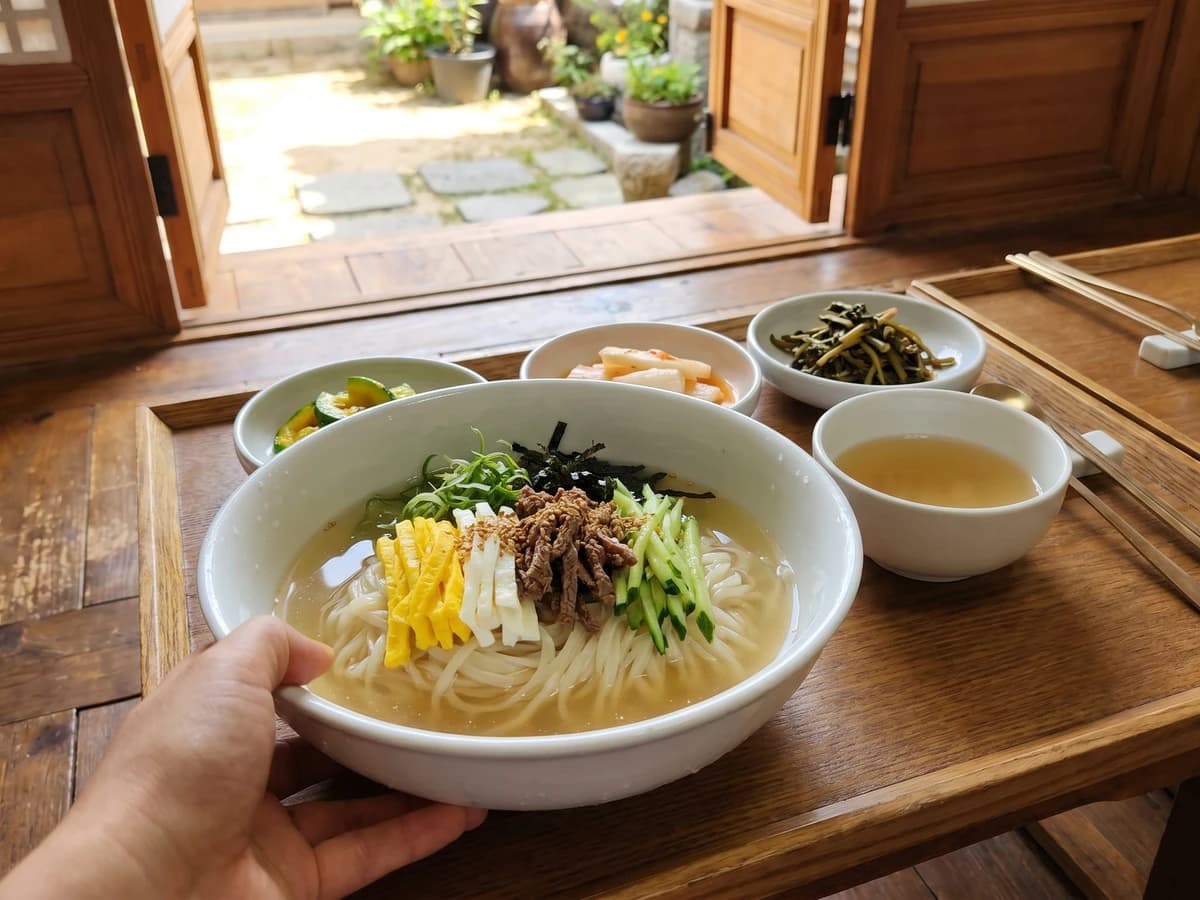
Andong's guest noodles, wheat and roasted soybean flour rolled thin, boiled and rinsed cold, then set in a clear chilled anchovy broth with careful strips of beef, egg, and cucumber.

Chef Jeong-sun
Andong's ritual-table rice served on an ordinary day: separate soy-sesame namul, warm rice, and clear radish soup, mixed without gochujang so every vegetable keeps its own voice.