
Chef Lupita
Acitrón de Cidra Conventual
Puebla's convent-style acitrón, made from cidra peel instead of endangered biznaga, built through repeated syrup soakings until the cubes turn firm, translucent, and ready for rosca or chiles en nogada.
A cooking platform built around craft, culture, and the stories behind what we eat.
Created by
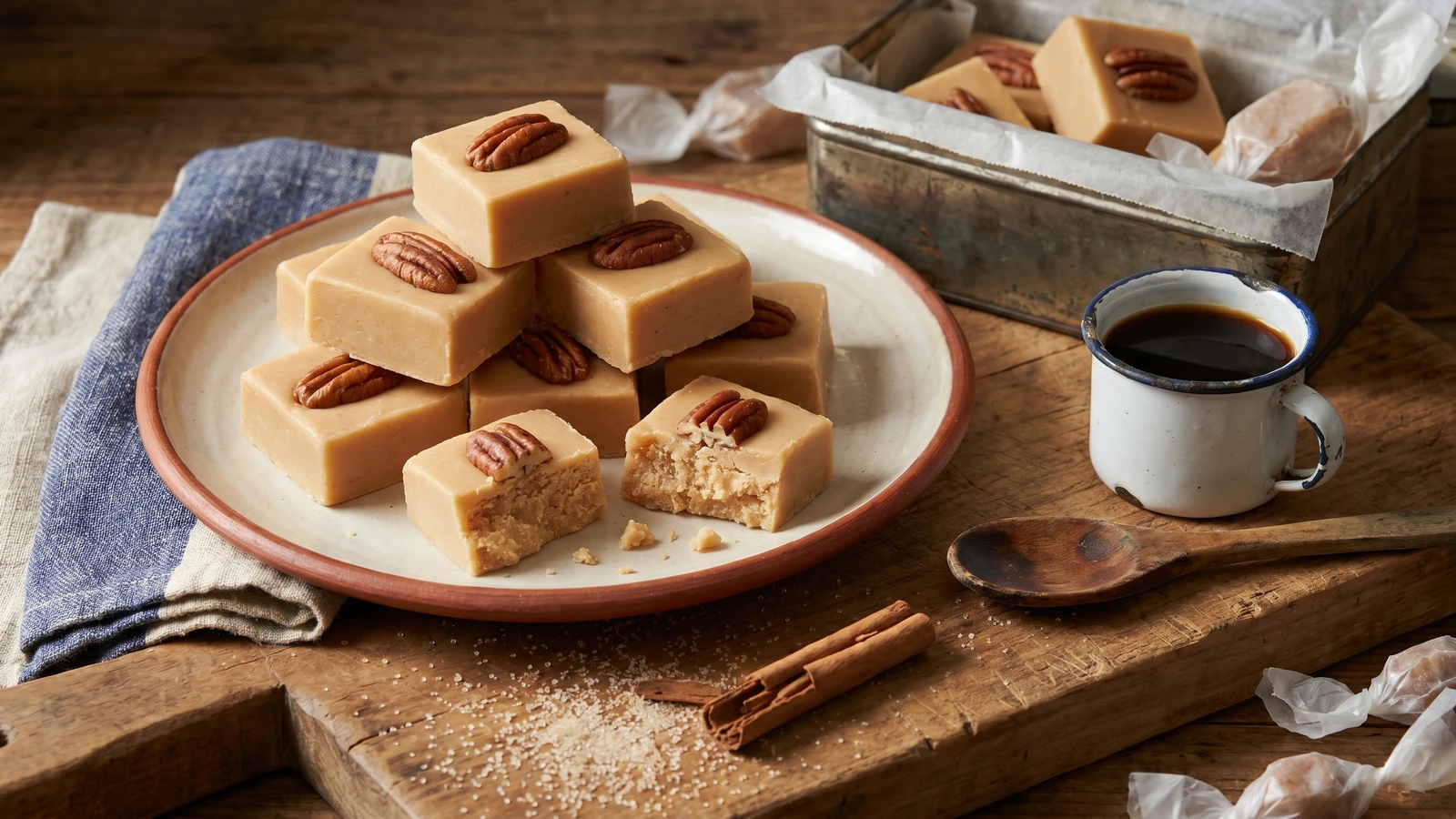
Sonora's patient burnt-milk fudge, cooked from whole milk, sugar, and a stick of canela until it firms into a pale-caramel slab you can slice with a knife and pack into a tin for the holidays.
Jamoncillo is from the north. Sonora, Chihuahua, Nuevo Leon, the whole norteno corridor where dairy is serious business and ranching shaped what people put on the table. This Sonora version is built on whole milk, not goat milk, not condensed milk, not store-bought cajeta. Just milk, sugar, canela, and time. Cada estado, su propia cocina, and in Sonora the kitchen smells like reducing milk for two hours before a feast day.
This is a peasant confection in the best sense. Three pantry ingredients and patience. The technique is the recipe. You cook whole milk with sugar over low heat until the lactose browns, the water cooks off, and what is left is a pale caramel slab firm enough to slice. The Sonoran cook beats it at the end so the texture turns short and slightly crumbly, not soft like cajeta and not chewy like dulce de leche. That texture is the regional fingerprint. A jamoncillo that bends is a jamoncillo that did not finish.
My mother kept a sheet of jamoncillo wrapped in wax paper in a tin on top of the refrigerator during December. She cut squares and sent them with us in lunchboxes for the last week of school before Christmas. The notebook has the recipe in pencil, with a margin note that reads: 'cuidado, se quema rapido al final.' Watch it, it burns fast at the end. She was right. Recetas probadas y garantizadas, but only if you stand at the stove. No me vengas con atajos.
Jamoncillo belongs to the family of milk-and-sugar confections that emerged in colonial New Spain after Spanish dairy animals were established in the northern frontier of what is now Mexico in the 17th century. The norteno states of Sonora, Chihuahua, Nuevo Leon, and Coahuila developed a distinct dulces de leche tradition tied to the cattle and goat ranches that defined the regional economy, with each state producing variations: Sonora's jamoncillo de leche from cow's milk, Coahuila's jamoncillo de pepita made with ground pumpkin seeds, and Chihuahua's chocolate-tinged versions. The name 'jamoncillo' likely derives from 'jamon,' a reference to the dense, sliceable, ham-like texture of the finished slab, distinguishing it from the pourable cajeta of Guanajuato and the softer dulces de leche of the Bajio.
Quantity
8 cups
not ultra-pasteurized
Quantity
2 1/2 cups
Quantity
1 stick (about 4 inches)
Quantity
1/2 teaspoon
Quantity
1 teaspoon
Quantity
pinch
Quantity
for greasing the pan
Quantity
for pressing on top
| Ingredient | Quantity |
|---|---|
| whole milknot ultra-pasteurized | 8 cups |
| granulated white sugar | 2 1/2 cups |
| Mexican canela | 1 stick (about 4 inches) |
| baking soda | 1/2 teaspoon |
| pure vanilla extract | 1 teaspoon |
| fine sea salt | pinch |
| unsalted butter | for greasing the pan |
| pecan halves (optional) | for pressing on top |
Grease an 8-by-8-inch glass or ceramic dish with unsalted butter. Line the bottom with parchment if you want clean edges later. Set it within reach of the stove. Once the jamoncillo reaches the right stage, it firms up quickly and you will not have time to hunt for the pan.
Pour the milk into a heavy-bottomed 6-quart pot. Wide and heavy matters. A thin pot scorches the bottom long before the milk reduces. Add the sugar, the canela stick, the baking soda, and the pinch of salt. Stir once to dissolve the sugar. The baking soda is not optional. It raises the pH and helps the milk proteins brown evenly instead of catching in burnt spots on the bottom of the pot.
Set the pot over medium heat. Stir gently with a wooden spoon as the milk warms. When it reaches a steady simmer, with small bubbles climbing the sides, lower the heat so the bubbles stay lazy and constant. A hard boil will scorch the bottom. You want patient evaporation, not aggression. This is a one-pot dish that takes its time. No me vengas con atajos.
Cook uncovered for 60 to 75 minutes, stirring every few minutes at first and more often as the volume drops. Drag the spoon across the bottom each time. If you feel any sandy resistance, the bottom is starting to catch. Lower the heat immediately. The milk will reduce from white to ivory to pale caramel as the lactose browns. The kitchen will start to smell sweet, almost toasted. That smell is the dish telling you it is working.
Around the 75-minute mark, the mixture will have reduced by roughly two thirds and turned a soft beige-caramel color. From here, stir constantly. The sugars are concentrating fast and the bottom will scorch the moment you turn away. Lower the heat to medium-low and pull the canela stick out with tongs. It has done its work.
Keep stirring until the jamoncillo thickens to the consistency of loose mashed potatoes and pulls away from the side of the pot in a single mass when you drag the spoon through. If you have a candy thermometer, you are looking for 235 to 240 degrees Fahrenheit, the soft-ball stage. Without a thermometer, drop a small spoonful into a glass of cold water. It should form a soft, pliable ball you can pick up with your fingers. If it dissolves, keep cooking. If it forms a hard ball, you went too far and the jamoncillo will be crumbly. Stop one shade before you think you should.
Pull the pot off the heat. Stir in the vanilla. Now beat the mixture with the wooden spoon for two to three minutes. It will go from glossy to matte and from soft to firm as it cools and the sugar starts to set. This beating is what gives Sonoran jamoncillo its short, slightly crumbly bite. Skip it and you have caramel, not jamoncillo. Asi se hace y punto.
Scrape the hot jamoncillo into the buttered pan. Work fast. Press it flat with the back of a buttered spoon or a spatula, all the way to the corners, until you have an even slab about three quarters of an inch thick. If using pecan halves, press them gently into the surface in evenly spaced rows. Let the slab cool at room temperature for at least two hours, until completely firm to the touch.
Turn the slab out onto a cutting board. Cut into one-and-a-quarter-inch squares with a sharp knife, wiping the blade between cuts. Each square should hold its shape, with a tender, slightly crumbly interior that gives way under the teeth. Store in a tin lined with wax paper. Saber cocinar es saber vivir.
1 serving (about 23g)
Culinary guides, cultural storytelling, and the editorial depth that makes cooking meaningful.
Discover Culinary ExplorerChef Lupita
Puebla's convent-style acitrón, made from cidra peel instead of endangered biznaga, built through repeated syrup soakings until the cubes turn firm, translucent, and ready for rosca or chiles en nogada.

Chef Lupita
Ciudad de México's Tulyehualco alegría is popped huautli folded into piloncillo honey, pressed with peanuts, pepitas, and raisins, then cut into the rectangular bars that built a pueblo's identity.

Chef Lupita
Oaxaca's pre-Columbian amaranth bar, popped on a hot comal and bound with piloncillo, honey, and the sacred Zapotec grain that the Spanish tried, and failed, to outlaw.

Chef Lupita
Querétaro's mercado candy of popped amaranto pressed with dark piloncillo syrup, pepitas, pecans, and cacahuate, a Bajío sweet that respects the seed before it decorates the table.