
Chef Dimitra
Agrafa Batzina (Μπατζίνα), Courgette and Feta Pie
Agrafa's batzina is the no-phyllo pie of Karditsa: grated courgette, feta, eggs, milk, and flour poured thin into a hot oiled tapsi.
A cooking platform built around craft, culture, and the stories behind what we eat.
Created by
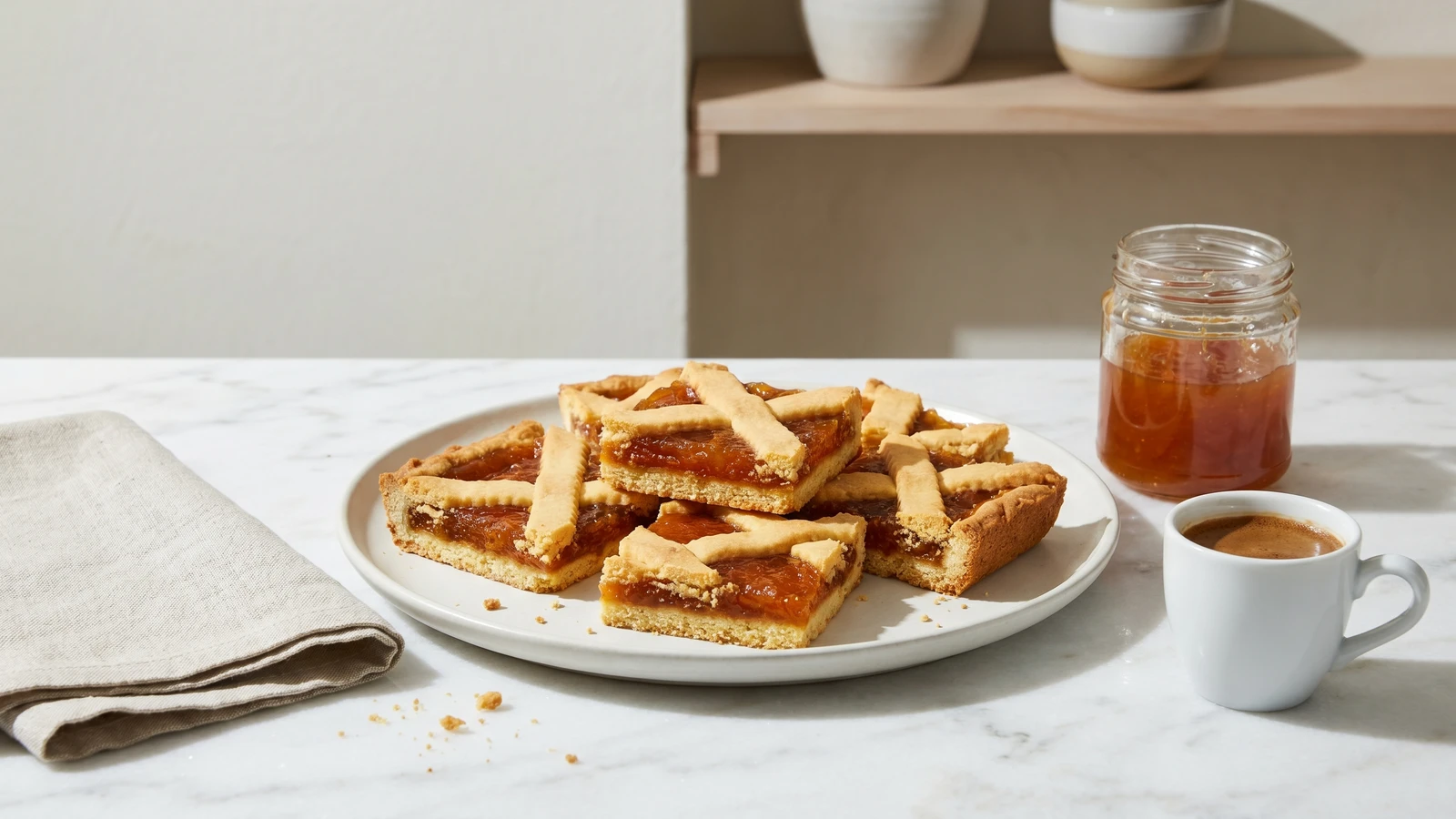
Pasta Flora is the Ionian-Venetian jam tart Greece made its own: tender shortcrust, thick fruit filling, and a lattice that bakes firm enough for school-day squares.
Ionian Pasta Flora is the Greek jam tart with an Italian surname and a Greek schoolbag life: buttery shortcrust below, thick quince or apricot filling in the middle, and a simple lattice on top. It belongs especially to the Ionian Islands, where Venetian words and pastry habits stayed in the kitchen long after the flags changed.
The one method that decides it is the filling. Use jam or spoon sweet boiled down until it is thick enough to mound, not run. If the fruit layer is loose, the lattice sinks and the squares smear under the knife. If it holds its shape on the spoon, the tart cuts cleanly and travels well, which is half the point of Pasta Flora.
The dough should be tender, not sandy and not cake-like. Work it only until it comes together, rest it cold, then press most of it into the pan and roll the rest into ropes for the lattice. This is not a pastry-shop trick. It is a home sweet, made ahead, wrapped in paper, and eaten with coffee or carried to school. Λίγα και καλά: good butter, good fruit, and a little patience.
Pasta Flora takes its name from Italian pasta frolla, shortcrust pastry, and entered Greek home baking through the long Venetian presence in the Ionian Islands, especially Corfu, Zakynthos, and Kefalonia. In twentieth-century Greece it moved from island and urban kitchens into zaharoplasteia and lunchboxes, usually filled with apricot, quince, cherry, or fig preserves. The Greek version is plainer than many Italian crostate, built to be cut into sturdy squares rather than served only as a formal tart.
Quantity
300g
plus extra for rolling
Quantity
8g
Quantity
1g
Quantity
150g
softened
Quantity
90g
Quantity
1
about 55g without shell
Quantity
1
Quantity
20ml
Quantity
1 tsp
finely grated
Quantity
1 tsp
Quantity
450g
fruit finely chopped, syrup reduced until thick
Quantity
1 tsp
only if the jam is very sweet
Quantity
1 tbsp
for brushing the lattice
| Ingredient | Quantity |
|---|---|
| all-purpose flourplus extra for rolling | 300g |
| baking powder | 8g |
| fine sea salt | 1g |
| unsalted buttersoftened | 150g |
| sugar | 90g |
| large eggabout 55g without shell | 1 |
| egg yolk | 1 |
| Metaxa or plain brandy | 20ml |
| orange zestfinely grated | 1 tsp |
| vanilla extract | 1 tsp |
| thick quince or apricot jam, or spoon sweet (glyko koutaliou)fruit finely chopped, syrup reduced until thick | 450g |
| lemon juice (optional)only if the jam is very sweet | 1 tsp |
| milkfor brushing the lattice | 1 tbsp |
If your jam is already thick enough to sit in a mound, leave it alone. If you're using spoon sweet, chop the fruit small and simmer it with its syrup in a small pan for 6 to 8 minutes, stirring often, until it drops heavily from the spoon. Stir in the lemon juice only if the fruit tastes too sweet. Let it cool completely before it touches the dough.
Whisk the flour, baking powder, and salt in a bowl. In a second bowl, beat the softened butter and sugar until creamy, then beat in the egg, yolk, brandy, orange zest, and vanilla. Add the flour mixture and mix just until a soft dough forms. Stop there. Overworking makes it tough.
Divide off one quarter of the dough for the lattice. Flatten both pieces into discs, wrap them, and chill for 25 minutes. The butter firms up, the dough stops sticking to everything, and you can shape the tart without adding too much flour.
Heat the oven to 175C. Lightly butter a 24cm square pan or a 26cm round tart pan. Press the larger piece of dough evenly over the base and a little up the sides, about 5mm thick. Spread the cooled fruit filling over it, leaving a narrow clean edge.
Roll the smaller piece of dough into thin ropes, or roll it out and cut 1.5cm strips. Lay them over the filling in a simple cross lattice. Don't fuss over perfect weaving. A home Pasta Flora should look handled by human hands. Brush the lattice lightly with milk.
Bake for 32 to 38 minutes, until the edges are golden and the lattice is lightly browned. Cool in the pan for at least 1 hour before cutting. The filling sets as it cools, and that is when the squares become clean.
1 serving (about 65g)
Culinary guides, cultural storytelling, and the editorial depth that makes cooking meaningful.
Discover Culinary ExplorerChef Dimitra
Agrafa's batzina is the no-phyllo pie of Karditsa: grated courgette, feta, eggs, milk, and flour poured thin into a hot oiled tapsi.

Chef Dimitra
Zagori's flour pie skips phyllo completely: a loose egg-and-flour batter, crumbled feta, and a hot buttered tapsi that makes the edges crisp.

Chef Dimitra
Hydra and Andros give amygdalota their island surname: ground almond, sugar, egg white, and rosewater, baked pale so the center stays soft as marzipan.

Chef Dimitra
Asia Minor ekmek kataifi is built in three clear layers: crisp syruped kataifi, thick semolina custard, and cold kaimaki cream under pistachios.