The celebrated salad of Piedmont, where precisely diced vegetables meet homemade mayonnaise and quality tuna. Every Italian family serves this at New Year's, and every family argues about whose mother made it best.
Salads
Italian, Piedmontese
New Years
Holiday
Make Ahead
1 hr 30 min
Active Time
30 min cook•6 hr total
Yield8 servings
Insalata russa is not Russian. It is Italian, through and through, despite what the name suggests. A French chef named Olivier created something with this name in Moscow in the 1860s, but what Italians make bears little resemblance to that original. We took the idea and made it ours, as we have done with so many things.
In Piedmont, this salad reaches its highest expression. The vegetables are cut into precise small dice, each piece the same size so they cook evenly and bind uniformly in the mayonnaise. The mayonnaise is made by hand, never from a jar. Quality tuna packed in olive oil provides richness. Some families add capers, others cornichons, still others a touch of anchovy. These variations are not errors. They are traditions passed through generations.
This is a dish that requires patience. You cannot rush the dicing. You cannot skip the homemade mayonnaise. You cannot serve it without proper chilling time. What you put in matters, but so does how carefully you execute each step. Simple does not mean easy.
Though named for Russia, insalata russa arrived in Italy via France in the late 19th century, transformed by Piedmontese cooks who added their regional sensibilities: quality tuna, proper mayonnaise, and meticulous technique. By the early 20th century, it had become inseparable from Italian celebrations, appearing on nearly every table from Christmas through Epiphany.
The technique, the tradition, and the story behind every dish.
Each vegetable must be cooked on its own, to its own proper doneness. Bring a large pot of salted water to a boil. Cook the potatoes whole in their skins until a knife slides through with slight resistance, 20 to 25 minutes depending on size. Remove and let cool. In the same water, cook the carrots whole until just tender, about 12 minutes. Remove and cool. Cook the green beans until crisp-tender, 4 to 5 minutes. Shock in ice water, drain, and set aside. Cook peas until just tender, 2 minutes for frozen, 4 for fresh. Shock in ice water and drain.
The vegetables must be tender but not soft. They will be diced small, and mushy vegetables will turn to paste when bound with mayonnaise. Err on the side of undercooking.
2
Cook the eggs
Place the four whole eggs in a single layer in a saucepan and cover with cold water by one inch. Bring to a boil over medium-high heat. The moment the water reaches a full boil, remove from heat, cover, and let stand exactly 10 minutes. Transfer eggs to ice water for 5 minutes. Peel when cool. The yolks should be fully set but not chalky.
3
Dice the vegetables precisely
Peel the cooled potatoes and carrots. Cut everything into a precise small dice, roughly one-quarter inch. This is not optional. Uniformity matters for texture and appearance. The potatoes, carrots, and green beans should all be the same size. The peas remain whole. Place all diced vegetables and the peas in a large mixing bowl.
A sharp knife and patience are all you need. The dicing takes time. Do not rush it, and do not think you can chop roughly and no one will notice. They will notice.
4
Make the mayonnaise
In a medium bowl, whisk the two egg yolks with the mustard, lemon juice, and a pinch of salt until combined. Begin adding the oil drop by drop, whisking constantly. After the first quarter cup, you may add the oil in a thin, steady stream, whisking without pause. The mayonnaise should become thick and glossy. If it breaks, start with a fresh yolk in a clean bowl and whisk the broken mixture into it gradually. Season with salt and white pepper.
Room temperature yolks emulsify more readily than cold ones. If your eggs came from the refrigerator, place the yolks in a warm bowl for 10 minutes before beginning.
5
Combine the salad
Flake the drained tuna into small pieces and add it to the vegetables. Add the chopped capers and diced cornichons. Drizzle the white wine vinegar over all and toss gently. Add approximately three-quarters of the mayonnaise and fold everything together with a rubber spatula. The vegetables should be bound but not swimming. You can always add more mayonnaise, but you cannot remove it. Season with salt and white pepper.
6
Prepare the eggs for garnish
Dice two of the hard-boiled eggs and fold them gently into the salad. Reserve the remaining two eggs for decoration. Slice them into rounds or cut into quarters, whichever you prefer.
7
Chill and serve
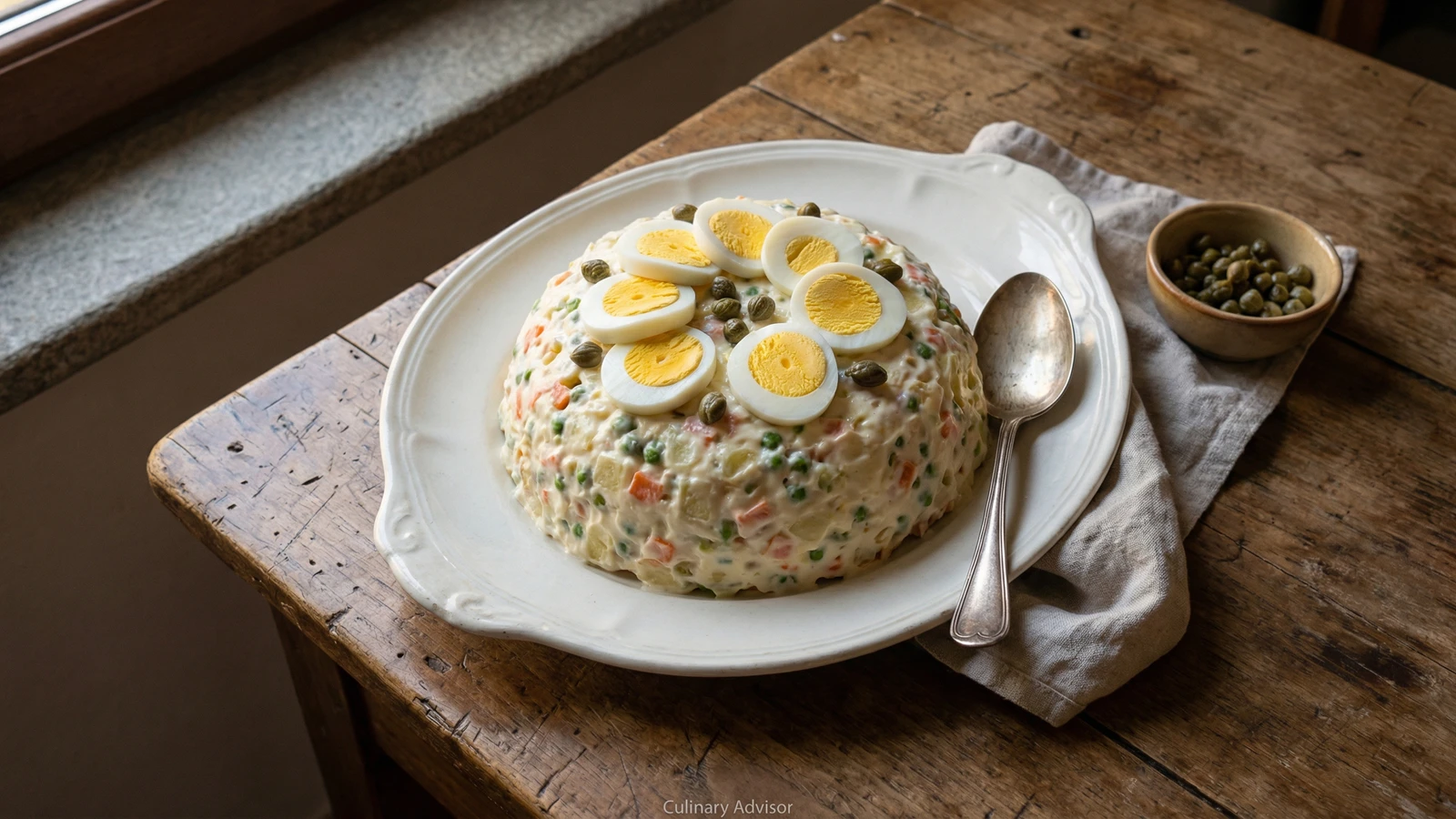
Transfer the salad to a serving bowl or mold it into a dome shape on a platter. Spread the reserved mayonnaise in a thin layer over the top and sides if you wish a more formal presentation. Arrange the reserved egg slices on top. Cover and refrigerate for at least 4 hours, preferably overnight. The flavors need time to marry. Serve cold.
Chef Tips
•The mayonnaise can break if the oil is added too quickly at the start or if the ingredients are too cold. Patience in the first minute saves frustration later.
•Italian tuna packed in olive oil has flavor that water-packed tuna cannot match. Seek out quality brands from Sicily or Sardinia. The difference is significant.
•White pepper is traditional because it does not leave black specks in the pale mayonnaise. This is aesthetics, not flavor. Use black pepper if that is what you have.
•Some Piedmontese cooks add a few mashed anchovy fillets to the mayonnaise. This is not an error. It adds depth without making the salad taste of fish. Consider it if you appreciate anchovy.
Advance Preparation
•The salad must be made at least 4 hours ahead and refrigerated. It is better the next day when the flavors have had time to blend.
•The mayonnaise can be made one day ahead and refrigerated. Let it come to room temperature and whisk briefly before using.
•The vegetables can be cooked and diced the day before, stored separately in the refrigerator. Assemble with mayonnaise at least 4 hours before serving.
Frequently Asked Questions
Nutrition Information
1 serving (about 215g)
Calories
405 calories
Total Fat
32 g
Saturated Fat
5 g
Trans Fat
0 g
Unsaturated Fat
25 g
Cholesterol
140 mg
Sodium
265 mg
Total Carbohydrates
18 g
Dietary Fiber
4 g
Sugars
3 g
Protein
12 g
Where cooking meets culture.
Culinary guides, cultural storytelling, and the editorial depth that makes cooking meaningful.