Culinary Explorer

A cooking platform built around craft, culture, and the stories behind what we eat.
Discover Culinary Explorer
Iced Oatmeal Cookies

Iced Oatmeal Cookies

Created by

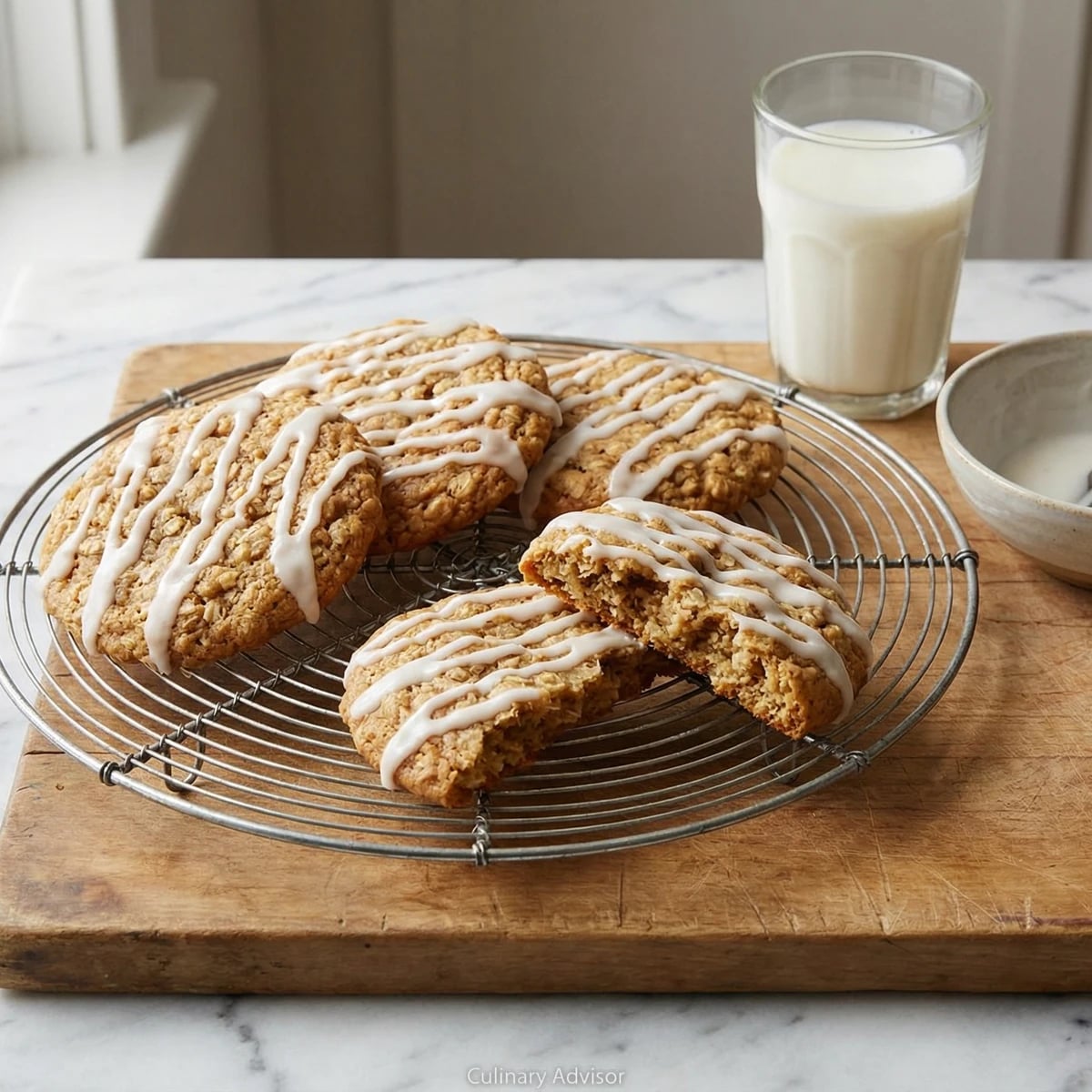
Tender spiced oatmeal cookies with crisp edges and soft centers, finished with a sweet vanilla glaze that hardens to a crackly shell. The cookie jar classic your grandmother made, perfected.

Pastries & Cookies
American
Make Ahead
Potluck
25 min
Active Time
12 min cook1 hr 30 min total
Yield36 cookies

The iced oatmeal cookie belongs to a proud lineage of American bakery classics. Before every corner had a coffee shop, before cookies became theatrical productions stuffed with candy bars, there was this: a humble round of spiced oats, soft in the middle, kissed with a simple sugar glaze. Every small-town bakery case held a version. They disappeared by the dozen at church potlucks and bake sales.

The oatmeal cookie arrived in American kitchens around the turn of the twentieth century, when Quaker Oats began printing recipes on their canisters. The icing came later, a bakery innovation that transformed a wholesome cookie into something worth stopping for. That thin shell of vanilla glaze shatters against your teeth, giving way to tender, spiced crumb beneath.

I've tested dozens of ratios over the years. This one delivers exactly what an iced oatmeal cookie should be: substantial without being dense, spiced without overwhelming, sweet but not cloying. The glaze sets firm enough to stack but stays thin enough to shatter. Make a double batch. They freeze beautifully, and you'll regret it if you don't.

The technique, the tradition, and the story behind every dish.

Discover Culinary Explorer

Ingredients

all-purpose flour

Quantity

2 1/4 cups (280g)

baking soda

Quantity

1 teaspoon

ground cinnamon

Quantity

1 teaspoon

nutmeg

Quantity

1/2 teaspoon

freshly grated

fine sea salt

Quantity

1/2 teaspoon

unsalted butter

Quantity

1 cup (2 sticks)

softened

light brown sugar

Quantity

1 cup (200g)

packed

granulated sugar

Quantity

1/2 cup (100g)

large eggs

Quantity

2

room temperature

pure vanilla extract

Quantity

2 teaspoons

old-fashioned rolled oats

Quantity

3 cups (270g)

raisins (optional)

Quantity

1 cup (120g)

powdered sugar

Quantity

2 cups (240g)

sifted

whole milk

Quantity

3 tablespoons

pure vanilla extract (for glaze)

Quantity

1/2 teaspoon

Equipment Needed

  • Stand mixer with paddle attachment (or hand mixer)
  • Two half-sheet baking pans
  • Parchment paper
  • Wire cooling rack
  • Cookie scoop or tablespoon measure
  • Fine-mesh sieve for sifting

Instructions

  1. 1

    Prepare dry ingredients

    Whisk together the flour, baking soda, cinnamon, nutmeg, and salt in a medium bowl. Set aside. The nutmeg should be freshly grated if you have whole nutmeg; pre-ground works but delivers perhaps half the fragrance. Your kitchen should smell faintly of warm spice just from the whisking.

    Sift the flour if it's been sitting in your pantry for months. Compacted flour throws off ratios and produces dense cookies.
  2. 2

    Cream butter and sugars

    Beat the softened butter in a stand mixer fitted with the paddle attachment on medium speed until smooth, about 30 seconds. Add both sugars and beat on medium-high for 3 full minutes, scraping the bowl once halfway through. The mixture should be noticeably lighter in color and fluffy in texture. This aeration creates tender cookies. Don't shortcut it.

    Properly softened butter holds a fingerprint when pressed but doesn't slump or look greasy. If your butter is too soft, refrigerate the finished dough for 30 minutes before baking.
  3. 3

    Add eggs and vanilla

    Add the eggs one at a time, beating well after each addition until fully incorporated. The mixture may look slightly curdled after the first egg. Keep beating. It will come together. Add the vanilla extract and beat for another 10 seconds to distribute it evenly.

  4. 4

    Incorporate dry ingredients

    Reduce mixer speed to low and add the flour mixture in three additions, mixing just until the last streak of flour disappears. Stop the mixer. Overworking develops gluten and produces tough cookies. The dough will be thick and somewhat sticky.

  5. 5

    Fold in oats and raisins

    Add the oats all at once and mix on low speed until just combined, about 15 seconds. If using raisins, fold them in now by hand with a sturdy spatula. The dough should be studded throughout with oats, not homogeneous. You want to see texture.

  6. 6

    Chill the dough

    Cover the bowl with plastic wrap and refrigerate for at least 30 minutes or up to 3 days. Chilled dough spreads less, giving you thicker, chewier cookies with better structure. The flavors meld during this rest. Patient cooks are rewarded.

    For advance preparation, scoop the dough into balls before chilling. Frozen dough balls bake directly from the freezer; add 2 minutes to baking time.
  7. 7

    Preheat and prepare pans

    Position racks in the upper and lower thirds of your oven and preheat to 350°F (175°C). Line two baking sheets with parchment paper. Do not grease the parchment. The cookies have enough butter.

  8. 8

    Portion the cookies

    Scoop rounded tablespoons of dough (about 1.5 ounces each) and roll into balls between your palms. Place on prepared baking sheets, spacing 2 inches apart to allow for spread. Flatten each ball slightly with your palm. They should be about 3/4 inch thick before baking.

  9. 9

    Bake until golden

    Bake for 10 to 12 minutes, rotating the sheets from top to bottom and front to back at the halfway point. The cookies are done when the edges are golden brown but the centers still look slightly underdone and puffy. They will firm as they cool. Pull them at 11 minutes for softer cookies, 12 for more structure.

    Every oven lies. Use the visual cues, not just the timer. Golden edges, pale centers, slight puff in the middle. That's your target.
  10. 10

    Cool completely

    Let cookies rest on the baking sheet for 5 minutes. They're fragile when hot. Transfer to a wire rack and cool completely before glazing, at least 30 minutes. The cookies should be room temperature or the glaze will melt and soak in rather than set on the surface.

  11. 11

    Make the vanilla glaze

    Whisk together the sifted powdered sugar, milk, and vanilla in a medium bowl until completely smooth with no lumps. The consistency should be like heavy cream: thick enough to coat a spoon but thin enough to drizzle from a fork. Add milk by the teaspoon if too thick, or more powdered sugar if too thin.

    Sifting the powdered sugar is not optional. Lumpy glaze looks amateur and never fully dissolves. Take the extra minute.
  12. 12

    Ice the cookies

    Dip a fork into the glaze and drizzle over each cookie in a zigzag pattern, or spread a thin layer over the entire top with the back of a spoon. For bakery-style presentation, do both: a base coat spread thin, allowed to set for 10 minutes, then decorative drizzle on top. Let the glaze harden completely, about 20 minutes, before stacking or storing.

Chef Tips

  • Old-fashioned rolled oats are essential here. Quick oats turn to mush and steel-cut oats stay too firm. Look for oats with visible structure, large flat flakes that will soften but hold their shape.
  • The raisin question divides families. I include them because a proper oatmeal cookie has raisins. If your household disagrees, substitute chocolate chips, dried cranberries, or butterscotch chips. The cookie forgives substitution.
  • For thinner, crispier cookies in the old bakery style, press the dough balls flatter before baking and add 1 to 2 minutes to the baking time. Watch carefully; they go from golden to burnt in seconds.
  • Room temperature eggs incorporate more smoothly into creamed butter. Set them out when you soften the butter, or submerge cold eggs in warm water for 5 minutes.
  • These cookies improve overnight. The spice flavors deepen and the texture becomes more tender as the oats continue to absorb moisture. Day-two cookies are the best cookies.

Advance Preparation

  • Dough can be refrigerated for up to 3 days before baking. Let it sit at room temperature for 10 minutes before scooping if very firm.
  • Portioned dough balls freeze beautifully for up to 3 months. Arrange on a baking sheet, freeze solid, then transfer to a freezer bag. Bake directly from frozen, adding 2 to 3 minutes to the baking time.
  • Un-iced cookies keep in an airtight container at room temperature for up to 5 days.
  • Iced cookies store in a single layer (or with parchment between layers) for up to 4 days. The glaze may soften slightly in humid conditions but will re-crisp if left uncovered for an hour.

Frequently Asked Questions

Nutrition Information

1 cookie (about 32g)

Calories
140 calories
Total Fat
3 g
Saturated Fat
2 g
Trans Fat
0 g
Unsaturated Fat
2 g
Cholesterol
5 mg
Sodium
38 mg
Total Carbohydrates
24 g
Dietary Fiber
0 g
Sugars
17 g
Protein
2 g

Note: Chef personas and recipes are created with AI assistance. Cook with care: follow safe food-handling practices, check doneness with a thermometer when needed, and adapt for allergies and your kitchen.

Where cooking meets culture.

Culinary guides, cultural storytelling, and the editorial depth that makes cooking meaningful.

Discover Culinary Explorer

More from The Great American Cookie Collection

Browse the full collection