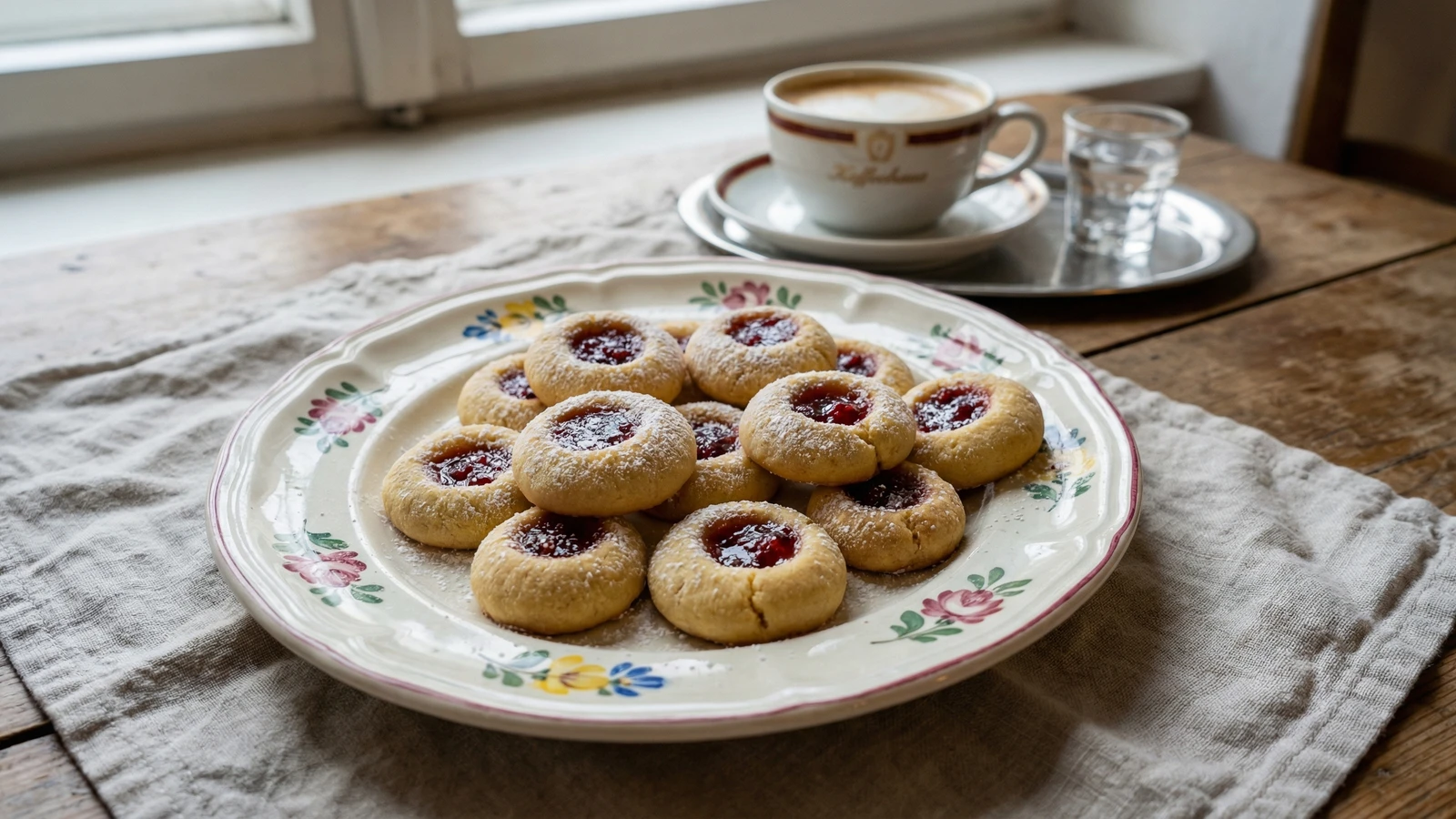
Buttery almond shortcrust rolled into small balls, pressed with your thumb, and filled with jewel-bright jam. The cookie that belongs on every Austrian Christmas plate.
Pastries & Cookies
Austrian
Christmas
Holiday
Make Ahead
40 min
Active Time
14 min cook•1 hr 30 min total
Yield40-45 cookies
In my grandmother Eva's kitchen in Kent, the Christmas baking started in November. Gretel would arrive with her notebook and a very specific list. Vanillekipferl first, then Linzer Augen, then these: Husarenkrapferl. She always made them last because they were her favorites and she wanted to give them her full attention.
Husarenkrapferl are almond shortcrust cookies, rich with butter and ground almonds, rolled into small balls and pressed with your thumb to make a hollow. You fill that hollow with jam, Ribiselmarmelade (red currant) if you're traditional, Marillenmarmelade (apricot) if you're from the right part of Austria, and then you bake them until the edges turn golden and the jam bubbles gently in its little well. They come out looking like tiny jeweled buttons.
The dough is forgiving and a pleasure to work with. Cold butter, ground almonds, flour, egg yolks, a little Vanillezucker. You bring it together quickly, chill it, then roll. Every ball gets your thumbprint. Gretel always said this was the most personal cookie in Austrian baking because every single one carries the mark of the hand that made it. No two look exactly alike. That's the point.
They keep beautifully in a tin for two weeks, which is why they're perfect for Weihnachtsbäckerei, the Austrian tradition of baking dozens of different cookie varieties in the weeks before Christmas. A proper Austrian Christmas plate has at least five kinds. Husarenkrapferl earn their place every year.
The name Husarenkrapferl means 'little Hussar doughnuts,' a reference to the Hungarian Hussars, the light cavalry of the Habsburg empire whose ornate uniforms featured rows of round, indented buttons. The thumbprint in each cookie is said to resemble those buttons. The recipe reflects the Hungarian influence woven through Austrian cuisine during centuries of shared empire, with the almond-rich shortcrust dough drawing on the Kipferl and Krapferl traditions that Viennese Konditoreien refined into an art form by the 19th century.
The technique, the tradition, and the story behind every dish.
Ribiselmarmelade (red currant jam) or Marillenmarmelade (apricot jam)
Quantity
approximately 100g
sieved
Ingredient
Quantity
unsalted buttercold and cubed
200g
powdered sugar (Staubzucker)
80g
vanilla sugar (Vanillezucker)
2 packets (16g)
fine salt
pinch
egg yolks
2 large
ground almonds (unpeeled)
100g
plain flour
280g
Ribiselmarmelade (red currant jam) or Marillenmarmelade (apricot jam)sieved
approximately 100g
Equipment Needed
•Baking trays (2 large)
•Parchment paper
•Fine-mesh sieve for the jam
•Wire cooling rack
•Cookie tin for storage
Instructions
1
Make the dough
Cut the cold butter into the flour using your fingertips or a pastry blender until the mixture looks like coarse sand. Add the powdered sugar, vanilla sugar, salt, ground almonds, and egg yolks. Work the dough together quickly with your hands until it just comes together in a smooth mass. Don't knead it. The moment it holds, stop. Overworked shortcrust gets tough because you develop the gluten, and that's the opposite of what you want here. This dough should bake tender and crumbly, almost dissolving on your tongue.
Use real Vanillezucker, not vanilla extract. Austrian baking depends on it. You can make your own by burying a split vanilla pod in a jar of powdered sugar for a week. The flavor is rounder and more fragrant than any extract.
2
Chill the dough
Flatten the dough into a disc, wrap it in cling film, and refrigerate for at least thirty minutes. The butter needs to firm up again after the warmth of your hands. Cold dough rolls cleanly into balls. Warm dough sticks to your palms and gives you ragged, uneven shapes. Patience here pays off in every cookie.
If your kitchen is warm, chill the dough for a full hour. You can also chill it overnight. It keeps beautifully in the fridge for up to two days.
3
Shape the cookies
Preheat your oven to 170°C (340°F), conventional heat, not fan. Line two baking trays with parchment paper. Pinch off pieces of dough about the size of a large cherry and roll them between your palms into smooth balls. Place them on the trays with about two centimeters of space between each. They spread a little but not much.
4
Press the thumbprints
Dip your thumb in a little flour and press firmly into the center of each ball. You want a proper well, deep enough to hold a good half-teaspoon of jam, but not so deep that you push through to the baking tray. If the edges crack, pinch them back together gently. A few cracks are fine. These are handmade cookies, not factory stamped. Gretel always said the cracks are how you know a real person made them.
If you find your thumb too wide, use the rounded end of a wooden spoon dipped in flour. It gives a neater well, though I prefer the honest look of a real thumbprint.
5
Fill with jam
Sieve your jam to remove any seeds or lumps. You want it smooth so it sits neatly in the wells. Using a small spoon or a piping bag with no tip, fill each thumbprint with jam. Don't overfill. The jam will bubble up slightly as it bakes, and if there's too much it spills over the sides and burns onto the tray. Fill to just below the rim of the well. A generous half-teaspoon per cookie is right.
Ribiselmarmelade (red currant jam) is the traditional choice and its tartness balances the sweet, buttery dough perfectly. Marillenmarmelade (apricot jam) is equally traditional in some regions. Both are correct. Use whichever you love.
6
Bake the cookies
Bake for 12 to 14 minutes, until the edges are pale golden and the jam has just begun to set. The cookies will still feel soft when you touch them. That's right. They firm up as they cool. If you bake them until they feel firm in the oven, they'll be overbaked by the time they reach room temperature. Pull them out when the tops are still slightly yielding and the color is the palest gold.
7
Cool and store
Let the cookies cool on the tray for five minutes, then transfer them carefully to a wire rack. They're fragile when warm. Once completely cool, dust lightly with powdered sugar if you like, though they're beautiful without it too. Store in a tin between layers of parchment paper. They keep for two weeks and actually improve after a day or two as the almond flavor deepens and the texture softens just slightly. Mahlzeit!
Chef Tips
•Ground almonds with the skin on (unpeeled) give these cookies a slightly deeper, nuttier flavor than blanched almonds. It's a small difference but it matters. Look for 'gemahlene Mandeln' if you have an Austrian or German shop near you.
•Sieve the jam. I can't say this strongly enough. Unsieved jam with seeds and chunks will not sit properly in the wells and the finished cookies will look messy. Thirty seconds with a sieve makes all the difference.
•If the dough warms up while you're rolling balls and the shapes start getting sticky and uneven, put the whole tray in the fridge for ten minutes. Cold dough behaves. Warm dough does whatever it wants.
•Store these in a cool place, not the fridge. A good tin in a cool room is ideal. The fridge dries out the shortcrust and dulls the flavor of the almonds.
Advance Preparation
•The dough can be made up to two days ahead and refrigerated. Let it sit at room temperature for fifteen minutes before rolling so it's pliable enough to shape without cracking.
•Baked Husarenkrapferl keep in an airtight tin for up to two weeks. They improve after the first day as the flavors settle.
•You can freeze the shaped, unbaked balls on a tray, then transfer to a bag. Bake from frozen, adding two minutes to the baking time. Press the thumbprints and fill with jam before baking, not before freezing.
Frequently Asked Questions
Nutrition Information
1 serving (about 18g)
Calories
90 calories
Total Fat
5 g
Saturated Fat
3 g
Trans Fat
0 g
Unsaturated Fat
2 g
Cholesterol
19 mg
Sodium
11 mg
Total Carbohydrates
9 g
Dietary Fiber
0 g
Sugars
4 g
Protein
1 g
Where cooking meets culture.
Culinary guides, cultural storytelling, and the editorial depth that makes cooking meaningful.