
Chef Lupita
Acitrón de Cidra Conventual
Puebla's convent-style acitrón, made from cidra peel instead of endangered biznaga, built through repeated syrup soakings until the cubes turn firm, translucent, and ready for rosca or chiles en nogada.
A cooking platform built around craft, culture, and the stories behind what we eat.
Created by
Ciudad de Mexico's conventual sweet from San Jeronimo, where yemas de huevo thicken in cinnamon almibar with almendra pelada and jerez until they become a glossy spoon dessert.
Ciudad de Mexico, Centro Historico, Convento de San Jeronimo. That is where this dish lives. Not in a cantina, not in a market fonda, but behind convent walls where women measured sugar, egg yolks, almonds, and time with a discipline most modern cooks have forgotten.
Huevos moles are not mole with eggs. No me vengas con that confusion. Here, mole means soft, tender, worked until the mixture loosens and tightens at the right moment. The yemas de huevo bind the almibar, the almendra pelada gives body, the canela holds the perfume, and the jerez cuts the sweetness. This is criollo-conventual cooking: ordered, quiet, exact.
I first copied this from a facsimile of Sor Juana's recipe manuscript, then cooked it three times before I trusted the texture. You don't rush yolks into hot syrup unless you want scrambled sugar. You temper. You stir. You watch the spoon. La cocina no es decoracion, es trabajo.
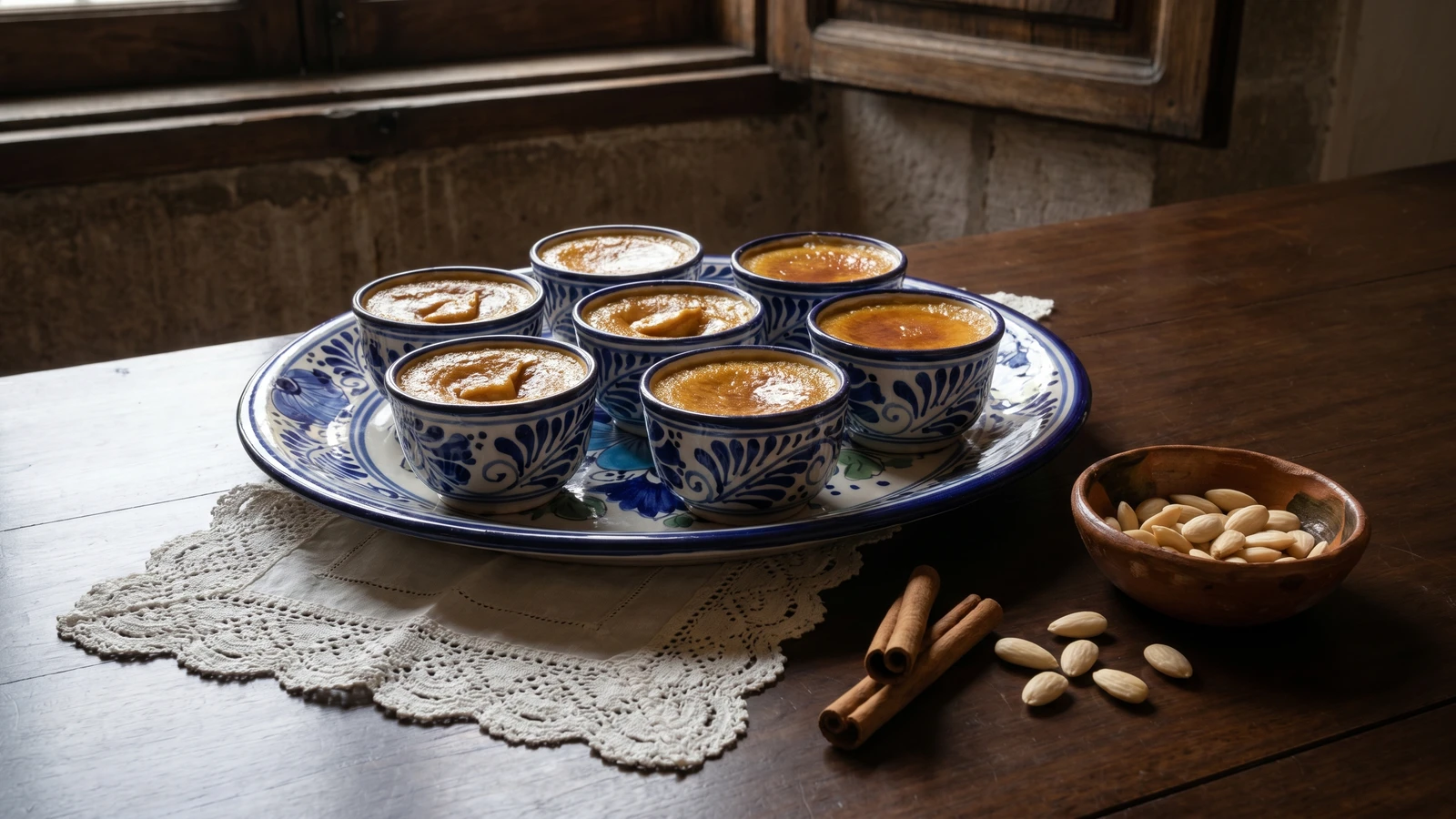
Serve it in small talavera cups or a shallow talavera platter, with nothing loud around it. The dessert is rich enough. Cada estado, su propia cocina, and Ciudad de Mexico's convent kitchens gave Mexico sweets that prove restraint can be as demanding as fire.
Huevos moles appears in the conventual recipe tradition associated with Sor Juana Ines de la Cruz, the 17th-century Jeronymite nun who lived at the Convento de San Jeronimo in Mexico City from 1669 until her death in 1695. The dish belongs to the wider Iberian and New Spanish family of egg-yolk sweets made possible by convent kitchens, where whites were often used for clarifying wines, starching habits, or other household work, leaving yolks for confectionery. In New Spain, sugar from colonial mills, cinnamon from Spanish trade routes, almonds from Mediterranean inheritance, and jerez entered convent technique and became Mexican dulceria.
Quantity
12
Quantity
1 cup
Quantity
1/2 cup
Quantity
1 stick, about 3 inches
Quantity
1/2 cup
finely ground
Quantity
2 tablespoons
Quantity
1 tablespoon
only if the mixture tightens too much
Quantity
1 small pinch
| Ingredient | Quantity |
|---|---|
| large yemas de huevo | 12 |
| granulated cane sugar | 1 cup |
| water | 1/2 cup |
| Mexican canela stick | 1 stick, about 3 inches |
| almendra peladafinely ground | 1/2 cup |
| dry jerez | 2 tablespoons |
| whole milk (optional)only if the mixture tightens too much | 1 tablespoon |
| fine sea salt | 1 small pinch |
Separate the eggs carefully and pass the yemas de huevo through a fine-mesh strainer into a bowl. Do not beat air into them. You want smooth yolks, not foam. If a little white clings to the yolk, remove it, because those strands cook faster and leave lumps.
Grind the almendra pelada until fine but not oily. A small food processor works if you pulse and stop before it becomes paste. The almond is not decoration here. It thickens the sweet and gives it the quiet body convent dulces need.
Combine the sugar, water, canela, and salt in a heavy saucepan. Bring to a steady simmer over medium heat and cook until the syrup reaches punto de hebra, about 223F to 225F, or until a drop between two fingers pulls into a thin thread once cooled slightly. Remove the canela. Do not use corn syrup. This is almibar, and the technique is the inheritance.
Whisk the strained yemas slowly while adding two or three tablespoons of hot almibar in a thin stream. Add another two tablespoons the same way. This raises the temperature of the yolks without shocking them. Pour yolks straight into the pot and you will make sweet scrambled eggs. The nuns at San Jeronimo knew better.
Lower the heat to the gentlest setting. Pour the tempered yolks back into the saucepan with the remaining almibar, stirring constantly with a wooden spoon. Cook for 8 to 12 minutes, scraping the bottom and corners, until the mixture turns glossy, thick, and falls from the spoon in heavy ribbons. It should not boil. If you see bubbles breaking hard at the surface, pull the pan off the heat and keep stirring.
Stir in the ground almendra pelada and cook 3 to 5 minutes more, until the mixture thickens enough that the spoon leaves a clean path across the bottom of the pan for one second. Add the jerez at the end and stir until absorbed. If the sweet tightens too much, add one tablespoon of milk. Only one. This is a correction, not a rescue mission.
Spoon the huevos moles into small talavera cups or one shallow talavera platter. Let cool to room temperature, then chill at least 2 hours. Serve in small portions. It should be dense, glossy, and spoonable, with canela first on the nose and egg yolk richness underneath. Asi se hace y punto.
1 serving (about 70g)
Culinary guides, cultural storytelling, and the editorial depth that makes cooking meaningful.
Discover Culinary ExplorerChef Lupita
Puebla's convent-style acitrón, made from cidra peel instead of endangered biznaga, built through repeated syrup soakings until the cubes turn firm, translucent, and ready for rosca or chiles en nogada.

Chef Lupita
Ciudad de México's Tulyehualco alegría is popped huautli folded into piloncillo honey, pressed with peanuts, pepitas, and raisins, then cut into the rectangular bars that built a pueblo's identity.

Chef Lupita
Oaxaca's pre-Columbian amaranth bar, popped on a hot comal and bound with piloncillo, honey, and the sacred Zapotec grain that the Spanish tried, and failed, to outlaw.

Chef Lupita
Querétaro's mercado candy of popped amaranto pressed with dark piloncillo syrup, pepitas, pecans, and cacahuate, a Bajío sweet that respects the seed before it decorates the table.