Culinary Explorer

A cooking platform built around craft, culture, and the stories behind what we eat.
Discover Culinary Explorer
Huevos en Salsa de Pulque

Huevos en Salsa de Pulque

Created by

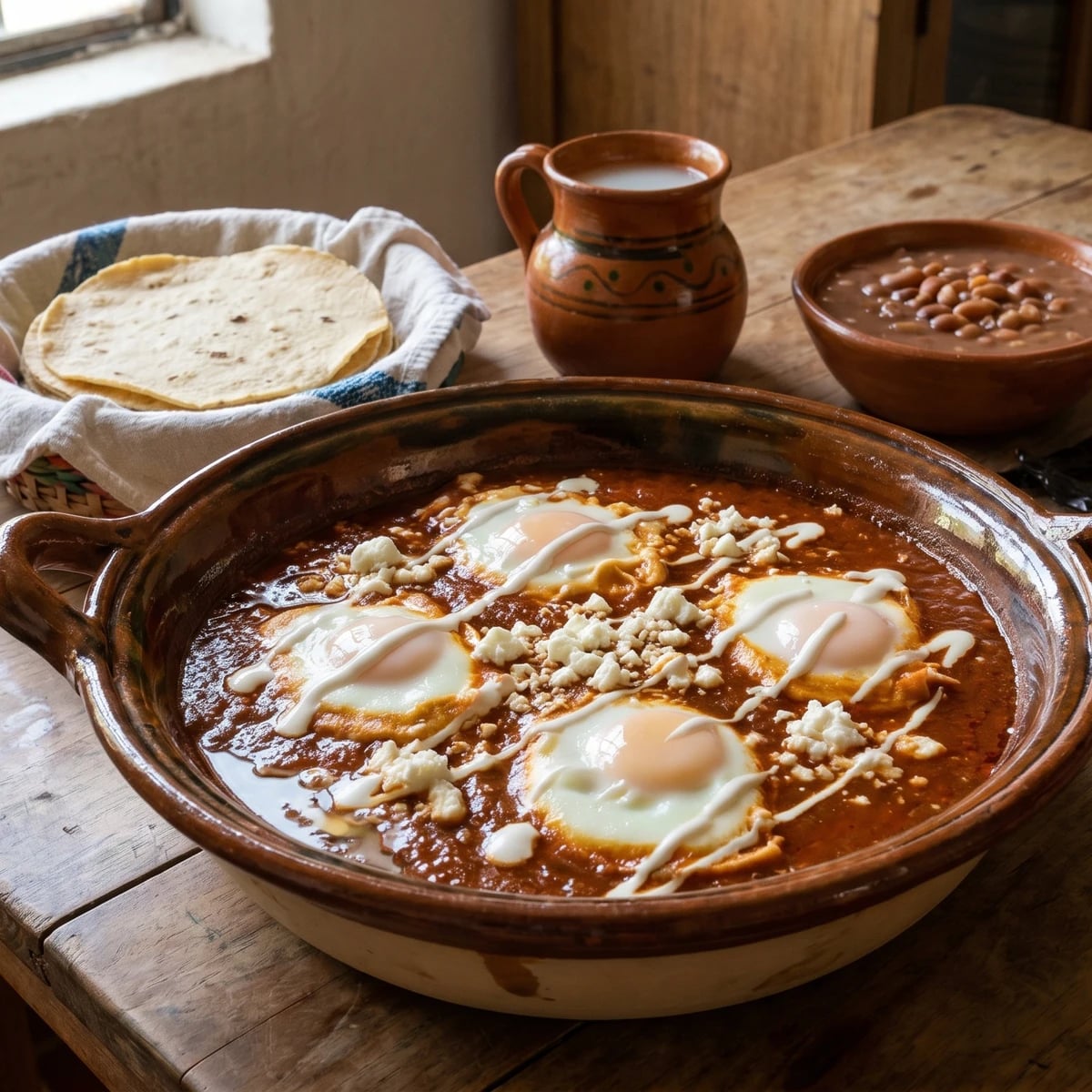
Tlaxcala's pulque-belt breakfast: eggs poached in a salsa of fermented agave, toasted chile pasilla, charred jitomate, and epazote. The maguey kitchen on a plate, eaten with warm corn tortillas at a wooden table.

Breakfast & Brunch
Mexican
Comfort Food
Special Occasion
Weeknight
20 min
Active Time
30 min cook50 min total
Yield4 servings

This is from Tlaxcala. The pulque belt, that stretch of the central highlands that runs from eastern Estado de Mexico through Tlaxcala into the Llanos de Apan in Hidalgo, where the maguey pulquero grows in rows across the dry fields and the tlachiqueros still scrape the aguamiel out of the heart of the plant at dawn. Pulque is not a flavoring here. It is the kitchen.

The salsa is built on chile pasilla, toasted on the comal until it smells like raisins and tobacco, then soaked, blended with charred jitomate and onion and garlic, and fried in manteca until the fat beads at the edge. The pulque comes in at the end, loosens the salsa, cooks down to leave behind that faint sourness and the body that only fermented agua de maguey can give. The eggs poach right in the cazuela. The yolks stay soft. The whites set into the salsa. The epazote ties it all to the maguey country it came from.

My mother did not cook with pulque. She was from Jalisco, where tequila is the daughter of the agave and pulque was something her own mother dismissed as the drink of campesinos. The first time I ate huevos en salsa de pulque was in a fonda outside Huamantla, where a senora named Rosario poured the pulque straight from a clay jarra into the cazuela and told me her mother had cooked the same dish every Sunday for forty years. I wrote it down in the back of my notebook before I left the table. Saber cocinar es saber vivir.

Pulque is the oldest fermented beverage in Mesoamerica, produced from the aguamiel sap of several maguey species (primarily Agave salmiana and Agave atrovirens) and consumed ceremonially by the Mexica, who restricted its use to elders, priests, and pregnant women under penalty of death for unauthorized drunkenness. After the conquest, pulque became the everyday drink of the working classes in the central highlands, and the great pulque haciendas of Tlaxcala, Hidalgo, and Estado de Mexico industrialized production in the 19th century, supplying Mexico City through dedicated pulque trains. The use of pulque in cooking, mixiotes, adobos, breads, and salsas like this one, predates its industrial era and reflects a peasant kitchen tradition that treated the beverage as a fermenting agent and a source of complex flavor, not just a drink.

The technique, the tradition, and the story behind every dish.

Discover Culinary Explorer

Ingredients

dried chile pasilla

Quantity

6

stemmed and seeded

ripe jitomate

Quantity

4 medium (about 1 pound)

white onion

Quantity

1/2 medium, plus 1/4 onion finely chopped for the salsa base

garlic cloves

Quantity

3

unpeeled

manteca de cerdo (pork lard)

Quantity

2 tablespoons

pulque blanco

Quantity

1 1/2 cups

fresh, unflavored

fresh epazote

Quantity

1 sprig

kosher salt

Quantity

1 teaspoon, plus more to taste

large eggs

Quantity

8

at room temperature

crumbled queso fresco (optional)

Quantity

1/2 cup

Mexican crema (optional)

Quantity

1/4 cup

hand-pressed corn tortillas (optional)

Quantity

for serving

warmed

frijoles de la olla (optional)

Quantity

for serving

Equipment Needed

  • Cast iron comal or heavy skillet for toasting and charring
  • Wide 12-inch clay cazuela or heavy skillet with a lid
  • High-powered blender
  • Small cups or ramekins for cracking eggs

Instructions

  1. 1

    Toast the pasilla

    Heat a dry comal over medium. Toast the pasilla chiles for about 20 seconds per side, pressing them flat with a spatula. The pasilla is thin and turns bitter fast. Watch them. They are ready when they release that dark, raisin-and-tobacco smell that makes pasilla pasilla. Transfer to a bowl, cover with hot tap water, and let them soften for 15 minutes. Hot water, not boiling. Boiling cooks the skin and makes the salsa bitter.

    Pasilla is the dried chilaca. Do not let a vendor sell you ancho and call it pasilla. The two are confused constantly outside Mexico. Pasilla is long and wrinkled and almost black. Ancho is wide and reddish-brown. They are not interchangeable here.
  2. 2

    Char the jitomate and garlic

    On the same comal, char the whole jitomate, the half onion, and the unpeeled garlic cloves. Turn them as the skins blister and blacken in patches. The jitomate takes about 8 minutes, the garlic about 5, the onion about 6. You want char marks, not full destruction. Peel the garlic once cool enough to handle. Leave the jitomate skins on. That char is the smoke of the salsa.

  3. 3

    Blend the salsa base

    Drain the pasilla and transfer to the blender with the charred jitomate, charred onion half, peeled garlic, and half a cup of the pulque. Blend until smooth but not aerated. You want body, not foam. Pulque foams if you bully it in the blender. Pulse, then blend in short bursts.

  4. 4

    Fry the salsa

    In a wide cazuela or heavy skillet, melt the manteca over medium heat. When it shimmers, add the finely chopped quarter onion and cook for two minutes until translucent. Pour in the blended salsa. It will sputter and complain. Cook for 8 to 10 minutes, stirring often, until the salsa darkens, thickens, and the fat starts to bead at the edges. La manteca es el sabor. This is the step that separates a serious salsa from a raw, watery one.

  5. 5

    Add the pulque and epazote

    Pour in the remaining cup of pulque and add the sprig of epazote. Stir. The salsa will loosen and turn a shade lighter as the pulque comes in. Lower the heat to a steady simmer and cook for 5 minutes, until the alcoholic edge of the pulque cooks off and the salsa tightens again into a loose, spoon-coating consistency. Taste for salt. The pulque carries its own slight sweetness and tang. The salt has to lift both.

    Pulque outside the central highlands is hard to find fresh. If you cannot get pulque blanco from a tlachiquero or a Tlaxcala market, look for canned pulque from brands like Loncho or Sierra Morena. Beer is not a substitute. A substitution is a compromise, not an upgrade.
  6. 6

    Poach the eggs in the salsa

    With the salsa at a gentle simmer, crack each egg into a small cup and slip it into the salsa, spacing them around the cazuela. Do not stir. The whites will set in the salsa and the yolks will hold round. Cover the cazuela and cook for 4 to 5 minutes, until the whites are firm and the yolks are still soft when you press them gently with the back of a spoon. If you like the yolks more set, give them another minute. So se hace y punto.

  7. 7

    Bring the cazuela to the table

    Pull the epazote sprig out. Carry the cazuela to the table on a wooden board. Crumble queso fresco over the top and drizzle with a little crema. Serve with warm hand-pressed corn tortillas and a side of frijoles de la olla. Each person scoops an egg and a generous ladle of salsa onto their plate and eats with the tortillas as the spoon. This is breakfast in Tlaxcala. Recetas probadas y garantizadas.

Chef Tips

  • Pulque blanco, the unflavored kind straight from the tlachiquero, is what you want. Pulque curado, the flavored versions sold in pulquerias and made with fruit or oats, is for drinking, not cooking. The sugar and fruit will throw the salsa off.
  • Pulque is alive. It ferments continuously, which is why it does not travel well. If you have access to fresh pulque, use it within two days. If you are working with canned, open it just before you cook with it.
  • The eggs must be fresh. Old eggs spread in the salsa instead of holding round. Crack one into a small cup first. If the white is loose and watery, those eggs are not for poaching.
  • If pulque is genuinely impossible to find, this dish becomes huevos en salsa de pasilla, which is a fine dish, but it is not huevos en salsa de pulque. Do not call it what it is not.

Advance Preparation

  • The salsa base (through step 4, before adding the pulque) can be made one day ahead and refrigerated. Reheat in the cazuela, add the pulque and epazote, then poach the eggs at serving time.
  • Do not add the pulque or poach the eggs in advance. The pulque loses its character if it sits and the eggs only work when they are served straight from the salsa.

Frequently Asked Questions

Nutrition Information

1 serving (about 320g)

Calories
390 calories
Total Fat
25 g
Saturated Fat
10 g
Trans Fat
0 g
Unsaturated Fat
13 g
Cholesterol
405 mg
Sodium
680 mg
Total Carbohydrates
16 g
Dietary Fiber
4 g
Sugars
6 g
Protein
18 g

Note: Chef personas and recipes are created with AI assistance. Cook with care: follow safe food-handling practices, check doneness with a thermometer when needed, and adapt for allergies and your kitchen.

Where cooking meets culture.

Culinary guides, cultural storytelling, and the editorial depth that makes cooking meaningful.

Discover Culinary Explorer

More from Central Mexican Breakfast & Almuerzo

Browse the full collection