
Chef Lupita
Aporreadillo Michoacano con Huevo
Michoacán's Tierra Caliente almuerzo, where salted beef is softened, pounded, fried in lard, folded with egg and chile perón salsa, then served beside morisqueta like a proper working table.
A cooking platform built around craft, culture, and the stories behind what we eat.
Created by
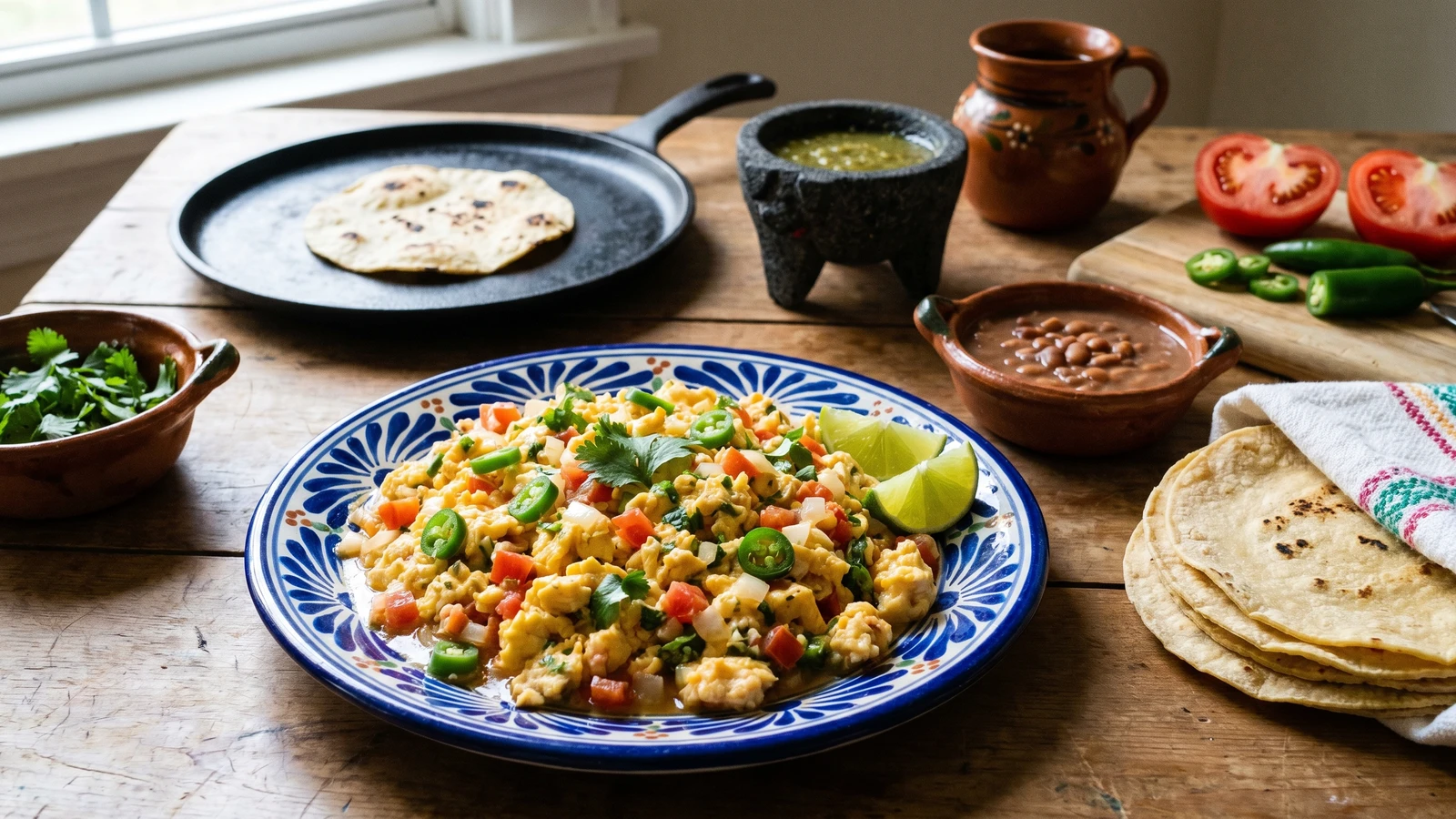
Ciudad de Mexico's breakfast eggs, scrambled with jitomate, white onion, chile serrano, and cilantro in pork lard. The colors of the flag in one pan, eaten with frijoles and warm corn tortillas.
This is a Ciudad de Mexico breakfast. You will find it in fondas across the country, but the central highlands is where it lives, where the jitomate is folded into the eggs not as garnish but as the dish itself. The name tells you what it is. Red jitomate, white onion, green chile serrano and cilantro. The flag, on a plate, before nine in the morning.
The trinity has to be diced fine. This is not pico de gallo dumped on top of cooked eggs. The vegetables cook into a quick salsa in the pan, the eggs go in after, and the curds come out holding the color and the flavor of all three. If you cut the vegetables too big, the eggs slide off them. If you cut them too small, they disappear. Practice on the cutting board. The knife work is the whole recipe.
My mother made these on weekday mornings when there was no time for anything else. She kept the jitomate diced in a jar in the refrigerator from the night before, so all she had to do in the morning was hit the pan with manteca and crack the eggs. Eight minutes from cold stove to plate. She used to say huevos a la mexicana is the proof that good Mexican cooking does not need hours. It needs the right ingredients, the right fat, and the right hand. Saber cocinar es saber vivir.
Huevos a la Mexicana emerged in the post-independence 19th century as a deliberate culinary expression of national identity, with the red, white, and green of the dish mirroring the colors of the Mexican flag adopted in 1821. The plate became a fixture of fonda and home breakfasts in central Mexico as eggs transitioned from a luxury to a daily protein with the expansion of poultry farming around Mexico City in the late 1800s. The chile serrano, native to the mountainous regions of Puebla, Hidalgo, and Veracruz, replaced the milder chiles used in earlier scrambled-egg preparations and gave the dish the sharp, green heat that distinguishes it from huevos rancheros and huevos ahogados.
Quantity
8
at room temperature
Quantity
2 medium
finely diced
Quantity
1/2 medium
finely diced
Quantity
2
finely chopped with seeds (use 1 if you want less heat)
Quantity
1/3 cup, chopped, plus more for serving
Quantity
2 tablespoons
Quantity
1 teaspoon, plus more to taste
Quantity
for serving
Quantity
for serving
warmed on a comal
Quantity
for serving
| Ingredient | Quantity |
|---|---|
| large eggsat room temperature | 8 |
| ripe jitomate (Roma tomatoes)finely diced | 2 medium |
| white onionfinely diced | 1/2 medium |
| fresh chile serranofinely chopped with seeds (use 1 if you want less heat) | 2 |
| fresh cilantro leaves and tender stems | 1/3 cup, chopped, plus more for serving |
| manteca de cerdo (pork lard) | 2 tablespoons |
| kosher salt | 1 teaspoon, plus more to taste |
| frijoles refritos or frijoles de la olla (optional) | for serving |
| hand-pressed corn tortillas (optional)warmed on a comal | for serving |
| salsa verde or salsa roja (optional) | for serving |
Dice the jitomate, white onion, and chile serrano as fine as you can. The pieces should be small enough to fold into the eggs without weighing them down. This is not pico de gallo. The vegetables disappear into the eggs and you want them to season every bite, not sit on top in big chunks. Use a sharp knife and take your time at the cutting board.
Crack the eggs into a bowl. Add half a teaspoon of salt. Beat with a fork until the yolks and whites are completely combined and a little foam appears on top. Do not add milk. Do not add water. Milk dulls the flavor and turns the eggs gray. Huevos a la mexicana is eggs and the trinity. Nothing else.
Melt the manteca in a heavy skillet over medium heat. When it shimmers, add the white onion and chile serrano. Cook for two minutes, stirring, until the onion turns translucent and the kitchen smells sharp and green. La manteca es el sabor. Vegetable oil will work in a pinch but the flavor is flatter and you will taste the difference.
Add the diced jitomate and the remaining half teaspoon of salt. Cook for three to four minutes, stirring occasionally, until the tomato releases its juice and that juice cooks down to a thick, glossy base. The mixture should look like a loose, rough salsa sitting in the pan. If the jitomate is still watery when you add the eggs, you will end up with soup, not huevos. Wait for it to tighten.
Lower the heat to medium-low. Pour the beaten eggs over the tomato mixture. Wait ten seconds without touching them. Then, with a wooden spoon or a silicone spatula, pull the eggs from the edges of the pan toward the center in slow, deliberate folds. You are not stirring. You are folding. The curds should be soft and large, holding the red of the jitomate, the white of the onion, and the green of the chile in every piece. The colors of the flag. That is where the name comes from.
Off the heat, scatter the chopped cilantro across the eggs and fold once or twice. The cilantro stays bright green and raw, not cooked. Slide the eggs onto a warm plate. Serve immediately with a spoonful of frijoles on the side and a stack of warm corn tortillas. The tortillas are not optional. You scoop the eggs into them like a soft taco. Así se hace y punto.
1 serving (about 155g)
Culinary guides, cultural storytelling, and the editorial depth that makes cooking meaningful.
Discover Culinary ExplorerChef Lupita
Michoacán's Tierra Caliente almuerzo, where salted beef is softened, pounded, fried in lard, folded with egg and chile perón salsa, then served beside morisqueta like a proper working table.

Chef Lupita
Guerrero's Costa Grande aporreado is salted cecina pounded soft, scrambled with egg, and finished in a red guajillo and chile de árbol salsa loud with garlic and cilantro.

Chef Lupita
Los Altos de Chiapas turns two-night fermented white corn into a tart-sweet atole, cooked with canela and piloncillo, then poured hot into jícaras for desayuno.

Chef Lupita
Oaxaca's Mixteca region ferments nixtamalized masa for days until it turns tart and alive, then simmers it with piloncillo and canela into a thick, warm atole served at first light in clay.