
Chef Fai
Dry Egg Noodles (Ba Mee Haeng)
The four pillars live at the bottom of the bowl before the noodles ever touch it: nam pla for salt, sugar for sweet, vinegar for sour, chili for heat. Every noodle cart in Bangkok runs on this principle.
A cooking platform built around craft, culture, and the stories behind what we eat.
Created by
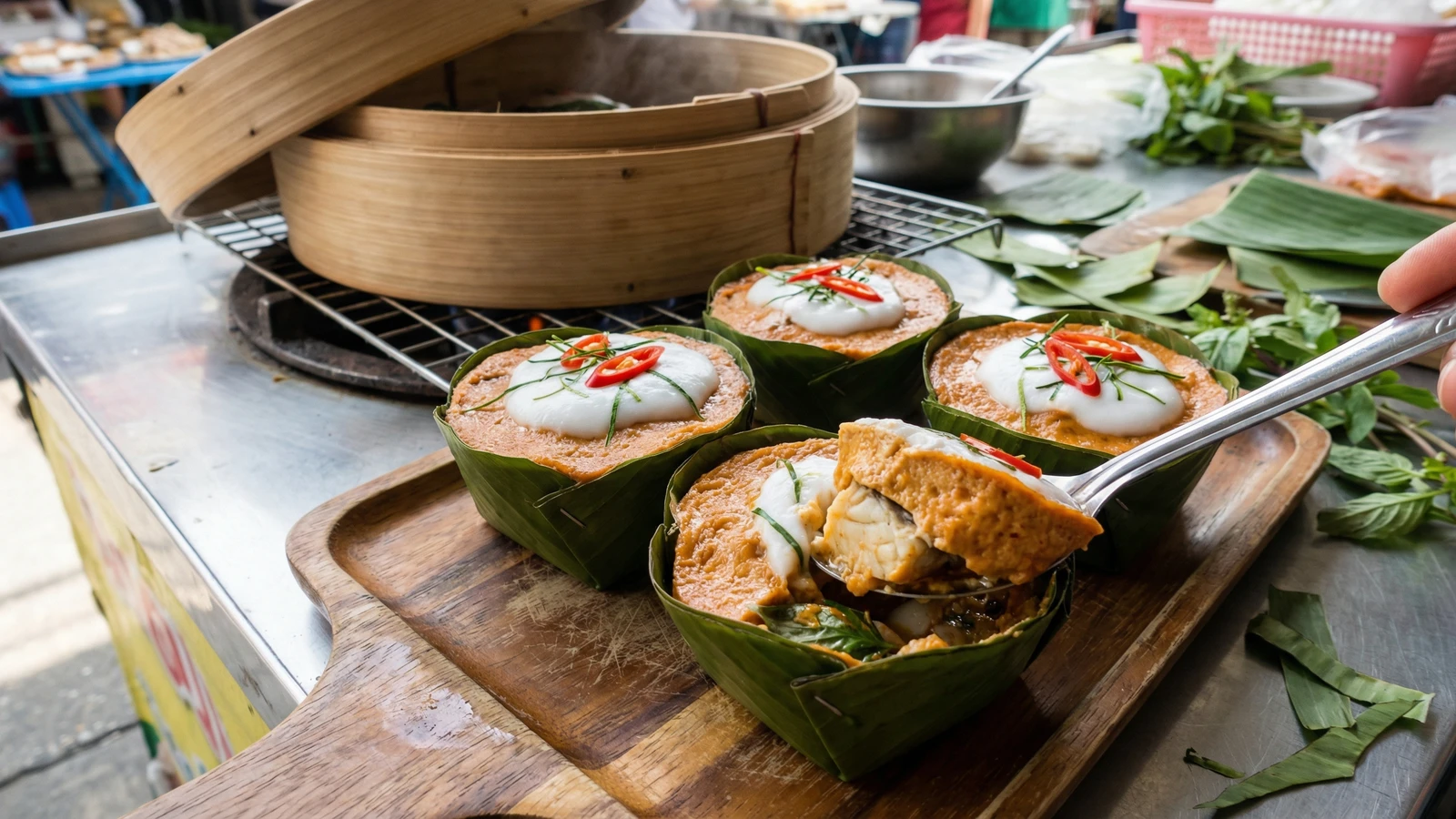
Same red kreung tam as gaeng phet, but steamed into a silky custard with fish and coconut cream. One paste, two dishes. That's the system at work. Principles, not recipes.
This is the dish that proves the kreung tam is everything.
Hor mok uses the exact same red curry paste as gaeng phet. Same dried chilies, same shallots, same garlic, galangal, lemongrass, kaffir lime zest, cilantro root, peppercorns, kapi. Pound for pound, ingredient for ingredient, the same paste. But instead of frying it in cracked coconut cream and building a liquid curry, you fold it into egg and thick coconut cream, wrap it in banana leaf, and steam it. The result is a silky, set custard that holds its shape when you spoon into it. Same foundation. Completely different dish. If that doesn't convince you Thai food is a system, nothing will.
Ajarn always said: "If you understand the kreung tam, you can cook anything." He wasn't being dramatic. He was being literal. A paste is not a recipe. It's a platform. Gaeng phet, gaeng khua, hor mok: three dishes, one paste, three techniques. The kreung tam stays constant. Everything around it changes. That's what separates a cook who understands principles from one who follows instructions.
The science matters here. The egg is the binder. It's what transforms liquid curry into a custard that sets under steam. The thick coconut cream provides fat, which carries the volatile aromatic compounds from the paste into every bite. The fish gets gently cooked inside the custard, staying tender because the temperature never exceeds 100°C. You're not boiling. You're not frying. You're steaming. Gentle, even heat. The banana leaf is not decoration. It's insulation and perfume. The leaf imparts a subtle green, grassy flavor that you can't replicate with a ramekin.
I teach hor mok at every Fai Thai workshop because it breaks people's assumptions. They think Thai food is all about the wok, all about high heat and speed. Hor mok is quiet. Patient. You pound the paste, fold the custard, line the cups, and wait. The steam does the work. When you peel back the banana leaf and that fragrance hits you, curry and coconut and kaffir lime, that's when people understand. The kreung tam is everything.
Hor mok is one of Central Thailand's oldest curry preparations, predating the wok-fried curries that dominate modern Thai cooking. The technique of steaming curry paste with protein in banana leaf wrappings appears in Thai culinary manuscripts from the early Rattanakosin period (late 18th century), when steaming was a primary cooking method in palace and commoner kitchens alike. The dish shares a structural lineage with Khmer amok, reflecting centuries of culinary exchange between the Siamese and Khmer courts, though the Thai version is distinguished by its heavier reliance on fresh herbs in the kreung tam and the use of kaffir lime leaf as both a mixing ingredient and a garnish.
Quantity
7
soaked 15 minutes, deseeded
Quantity
5
Quantity
1 tablespoon
Quantity
4
sliced
Quantity
6 cloves
Quantity
1 tablespoon
sliced thin
Quantity
2 stalks
lower 3 inches only, sliced thin
Quantity
1 teaspoon
Quantity
3
scraped and chopped
Quantity
1 teaspoon
Quantity
400g
sliced into thin pieces
Quantity
200ml, plus 4 tablespoons reserved for topping
Quantity
1 large
Quantity
2 tablespoons
Quantity
1 teaspoon
Quantity
5
3 finely shredded for custard, 2 cut into hair-thin strips for topping
Quantity
1 cup
Quantity
8
about 3-inch diameter
Quantity
1
sliced into thin rings for garnish
| Ingredient | Quantity |
|---|---|
| dried red spur chilies (prik chi fa haeng)soaked 15 minutes, deseeded | 7 |
| dried bird's eye chilies (prik khi nu haeng) | 5 |
| shrimp paste (kapi) | 1 tablespoon |
| shallots (hom daeng)sliced | 4 |
| garlic | 6 cloves |
| galangal (kha)sliced thin | 1 tablespoon |
| lemongrass (takhrai)lower 3 inches only, sliced thin | 2 stalks |
| kaffir lime zest (phiw makrut) | 1 teaspoon |
| cilantro roots (rak phak chi)scraped and chopped | 3 |
| white peppercorns (prik thai) | 1 teaspoon |
| firm white fish fillet (snapper, sea bass, or barramundi)sliced into thin pieces | 400g |
| thick coconut cream (hua kathi) | 200ml, plus 4 tablespoons reserved for topping |
| egg | 1 large |
| fish sauce (nam pla) | 2 tablespoons |
| palm sugar (nam tan pip) | 1 teaspoon |
| kaffir lime leaves (bai makrut)3 finely shredded for custard, 2 cut into hair-thin strips for topping | 5 |
| Thai sweet basil leaves (horapha) | 1 cup |
| banana leaf cups (krathong bai tong)about 3-inch diameter | 8 |
| red spur chili (prik chi fa)sliced into thin rings for garnish | 1 |
Start with the dried chilies in the granite mortar. Pound them to a rough powder. Then the peppercorns. Then the salt from the kapi goes in to act as an abrasive. Add the lemongrass, galangal, and kaffir lime zest, pounding each addition until it breaks down before adding the next. Then cilantro root, garlic, shallots. Pound and scrape, pound and scrape. The paste should be smooth, fragrant, and deep red. When the aroma fills the room and there are no visible fibers left, you're done. This is the exact same paste you'd use for gaeng phet. Same ingredients, same technique. The difference is what you do with it next.
In a large bowl, combine the finished kreung tam with the thick coconut cream (reserve 4 tablespoons for topping). Beat the egg and add it in. Stir in the fish sauce, palm sugar, and shredded kaffir lime leaves. Mix until everything is completely incorporated. The mixture should be a uniform deep orange-red, smooth, and thick enough to coat the back of a spoon. Taste it. It should be salty from the nam pla, barely sweet from the palm sugar, rich from the coconut cream, and deeply aromatic from the paste. Adjust now, because you can't adjust once it's steaming.
Place a few horapha (Thai sweet basil) leaves at the bottom of each banana leaf cup. The basil isn't just a garnish. It's a bed that perfumes the custard from below as it steams. If you can't find banana leaf cups, you can make them by cutting banana leaves into 6-inch circles, softening them over a flame for a few seconds so they become pliable, and pinning them into cup shapes with toothpicks. Or use small ramekins. The banana leaf is ideal, but the custard is the priority.
Lay a few thin slices of fish into each banana leaf cup on top of the basil. Pour or ladle the curry custard mixture over the fish, filling each cup about three-quarters full. Don't overfill. The custard will expand slightly as it sets, and you need room for the coconut cream topping. Tap each cup gently on the counter to settle the mixture and release any air bubbles.
Spoon about half a tablespoon of the reserved thick coconut cream onto the surface of each cup. It should float on top, forming a white layer over the red custard. This cap does two things: it insulates the custard surface during steaming, and it gives you that beautiful contrast of white cream over red curry when you serve. Top each with a few hair-thin strips of kaffir lime leaf and a ring or two of red chili.
Set up your steamer with water at a rolling boil. Place the cups in the steamer, cover with the lid wrapped in a clean towel to catch condensation (dripping water ruins the surface), and steam over medium-high heat for 15 to 20 minutes. The custard is done when it's set but still has a slight wobble in the center. Like a panna cotta. If you jiggle the cup and the surface doesn't move at all, you've overcooked it. It should tremble. Insert a toothpick: it should come out clean but moist. Pull them out and let them rest for 2 minutes. The residual heat will finish the set.
1 serving (about 225g)
Culinary guides, cultural storytelling, and the editorial depth that makes cooking meaningful.
Discover Culinary ExplorerChef Fai
The four pillars live at the bottom of the bowl before the noodles ever touch it: nam pla for salt, sugar for sweet, vinegar for sour, chili for heat. Every noodle cart in Bangkok runs on this principle.

Chef Fai
The kreung tam fried in cracked coconut cream until the oil bleeds red. That's the technique. Concentrated, semi-dry, spooned thick over crispy fish. This is what happens when the four pillars meet restraint.

Chef Fai
Isan foraging in a bowl: wild taro stems stripped of their sting, simmered in padaek broth with a pounded chili paste and yanang leaf extract. The land feeds you if you know the rules.

Chef Fai
Lanna's kreung tam breaks from Central Thai rules: ginger over galangal, cumin and coriander from Burmese spice routes, tamarind for sour instead of lime. The North has its own system, and this curry is its crown.