
Chef Jeong-sun
Agwi-jjim (Braised Monkfish with Bean Sprouts)
Firm monkfish buried under crisp soybean sprouts, minari, and a red gochugaru sauce thickened at the end; Masan's market dish asks for heat, timing, and a steady hand.
A cooking platform built around craft, culture, and the stories behind what we eat.

Created by
The 2014 honey-butter craze brought to Korean fried chicken: double-fried wings tossed in a thin butter, honey, and garlic glaze that shines without drowning the crust.
Honey butter chikin lives or dies in the last bowl, after the frying is already finished. People think the sweetness is the point. It isn't. The point is a crisp crust carrying a thin gold coat of butter, honey, and garlic, just enough to make the chicken shine and not enough to soak it.
This is modern Korean chicken-shop food, the kind carried home in a box for a birthday, a baseball game, or a night when nobody wants to cook rice. I don't dress it up as old. It belongs to delivery culture and snack shelves, and that is still part of the Korean table. A street-root dish deserves the same notebook as a holiday one.
The work tonight is simple but strict: dry the chicken, coat it so the starch clings, fry it twice, and keep the sauce loose. Notebook 91 says 50g butter and 3 tablespoons honey for 1.2kg chicken. More than that tastes generous for five minutes and soggy by the time the second person reaches in. 손맛 is real; I measure it anyway.
Honey-butter flavor became a national craze in Korea after Haitai-Calbee released Honey Butter Chip in 2014, a snack so scarce that stores rationed bags and resellers listed them online at inflated prices. Korean fried chicken itself is a modern food shaped by postwar cooking oil, American-style fried chicken, local delivery culture, and the chimaek habit of pairing chicken with beer. Honey butter chikin belongs to that recent lineage: a chicken-shop adaptation of a snack flavor, not an old court dish and not pretending to be one.
Quantity
1.2kg
separated
Quantity
1 teaspoon
Quantity
1/2 teaspoon
freshly ground
Quantity
1 tablespoon
grated
Quantity
2 cloves
grated
Quantity
1 tablespoon
Quantity
1 large
Quantity
1/2 cup
Quantity
1/4 cup
Quantity
2 tablespoons
Quantity
1/2 teaspoon
Quantity
1.5 liters
Quantity
50g
Quantity
3 tablespoons
Quantity
1 tablespoon
Quantity
1 teaspoon
Quantity
1 clove
finely minced
Quantity
1/4 teaspoon
Quantity
1 tablespoon
Quantity
2 tablespoons
finely chopped
Quantity
2
thinly sliced
| Ingredient | Quantity |
|---|---|
| chicken wings, drumettes, and flatsseparated | 1.2kg |
| fine sea salt | 1 teaspoon |
| black pepperfreshly ground | 1/2 teaspoon |
| oniongrated | 1 tablespoon |
| garlicgrated | 2 cloves |
| rice wine or soju | 1 tablespoon |
| egg white | 1 large |
| potato starch | 1/2 cup |
| cornstarch | 1/4 cup |
| rice flour | 2 tablespoons |
| baking powder | 1/2 teaspoon |
| neutral frying oil | 1.5 liters |
| unsalted butter | 50g |
| honey | 3 tablespoons |
| corn syrup or rice syrup | 1 tablespoon |
| soy sauce | 1 teaspoon |
| garlicfinely minced | 1 clove |
| fine sea salt | 1/4 teaspoon |
| toasted sesame seeds | 1 tablespoon |
| roasted peanuts or almonds (optional)finely chopped | 2 tablespoons |
| scallions (optional)thinly sliced | 2 |
Pat the chicken very dry, especially around the joints. Toss it with the salt, pepper, grated onion, grated garlic, and rice wine. Let it stand 20 minutes. This short seasoning reaches the meat without making the skin wet and loose, which is the first way fried chicken loses its bite.
Add the egg white and toss until the chicken feels sticky. In a separate bowl, whisk the potato starch, cornstarch, rice flour, and baking powder. Coat each piece well, pressing the starch into the skin and shaking off loose powder. Rest the coated chicken on a rack for 10 minutes, until the surface looks patchy and damp in places. That damp starch fries into ridges; dry dust falls into the oil.
Heat the oil in a heavy pot to 160C. Fry the chicken in batches for 6 to 7 minutes, turning once or twice, until pale gold and cooked through at the bone. Do not crowd the pot. The oil should recover quickly after the chicken goes in, or the crust drinks oil instead of setting. Transfer to a rack and rest 10 minutes.
Raise the oil to 190C. Fry the chicken again in batches for 2 to 3 minutes, until deep golden and audibly crisp when lifted with tongs. This second fry drives off surface moisture. It is not showing off; it is why Korean chicken survives sauce and still cracks under the teeth.
While the last batch drains, melt the butter in a wide skillet over low heat. Add the honey, corn syrup, soy sauce, minced garlic, and salt. Stir for 60 to 90 seconds, just until the garlic softens and the sauce turns thin, smooth, and gold. Do not boil it hard. Thick honey-butter sauce is candy, and candy softens crust.
Put the fried chicken in a large bowl. Pour over the warm glaze and toss quickly, 8 to 10 turns, until each piece shines but no sauce pools at the bottom. Scatter sesame seeds, nuts if using, and scallions if using. Serve at once with pickled radish (chikin-mu) and cold drinks. Write down the toss, too. Too much sauce is how a good crust disappears.
1 serving (about 265g)
Culinary guides, cultural storytelling, and the editorial depth that makes cooking meaningful.
Discover Culinary ExplorerChef Jeong-sun
Firm monkfish buried under crisp soybean sprouts, minari, and a red gochugaru sauce thickened at the end; Masan's market dish asks for heat, timing, and a steady hand.

Chef Jeong-sun
A quick Korean rice bowl built on contrast: warm rice, cold popping flying-fish roe, chopped vegetables, gim, sesame oil, and the crisp rice bottom a hot stone bowl gives you.
Chef Jeong-sun
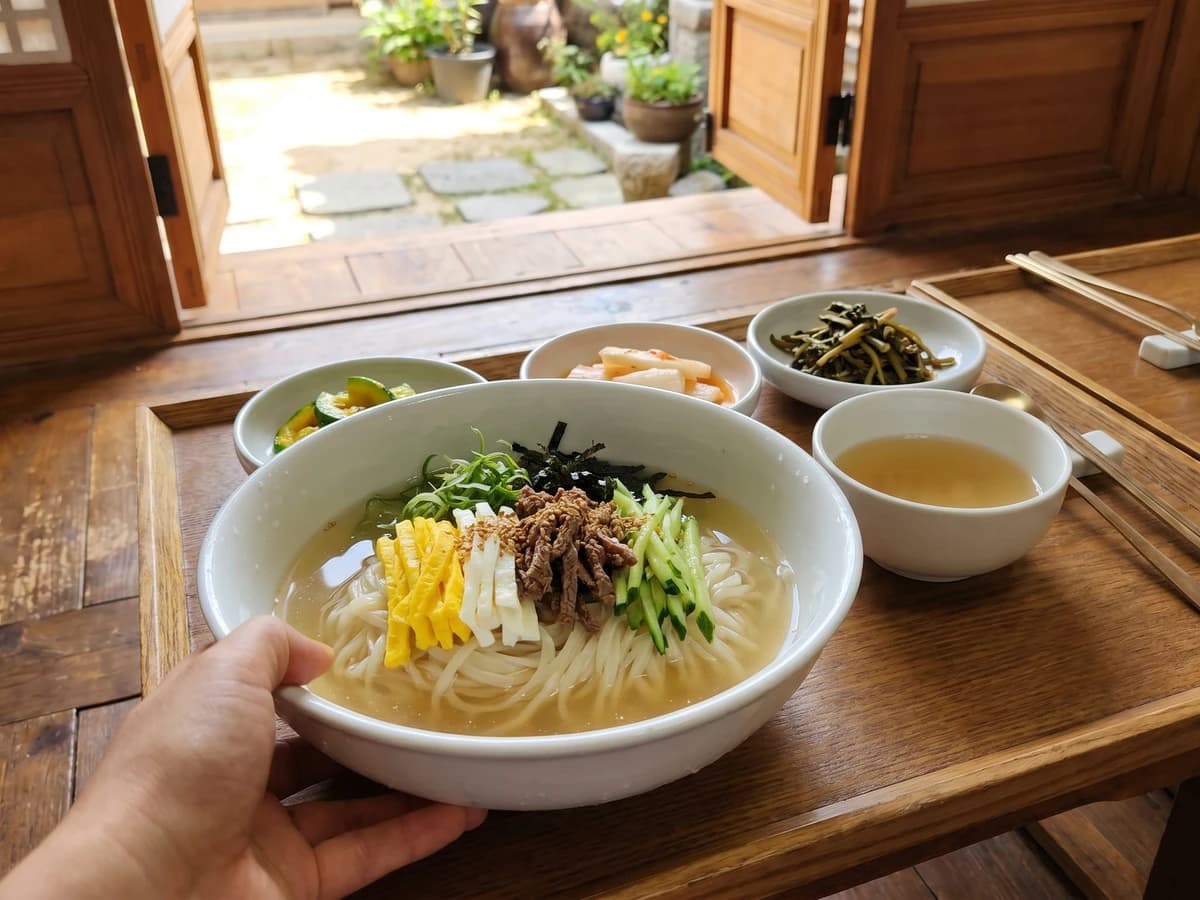
Andong's guest noodles, wheat and roasted soybean flour rolled thin, boiled and rinsed cold, then set in a clear chilled anchovy broth with careful strips of beef, egg, and cucumber.

Chef Jeong-sun
Andong's ritual-table rice served on an ordinary day: separate soy-sesame namul, warm rice, and clear radish soup, mixed without gochujang so every vegetable keeps its own voice.