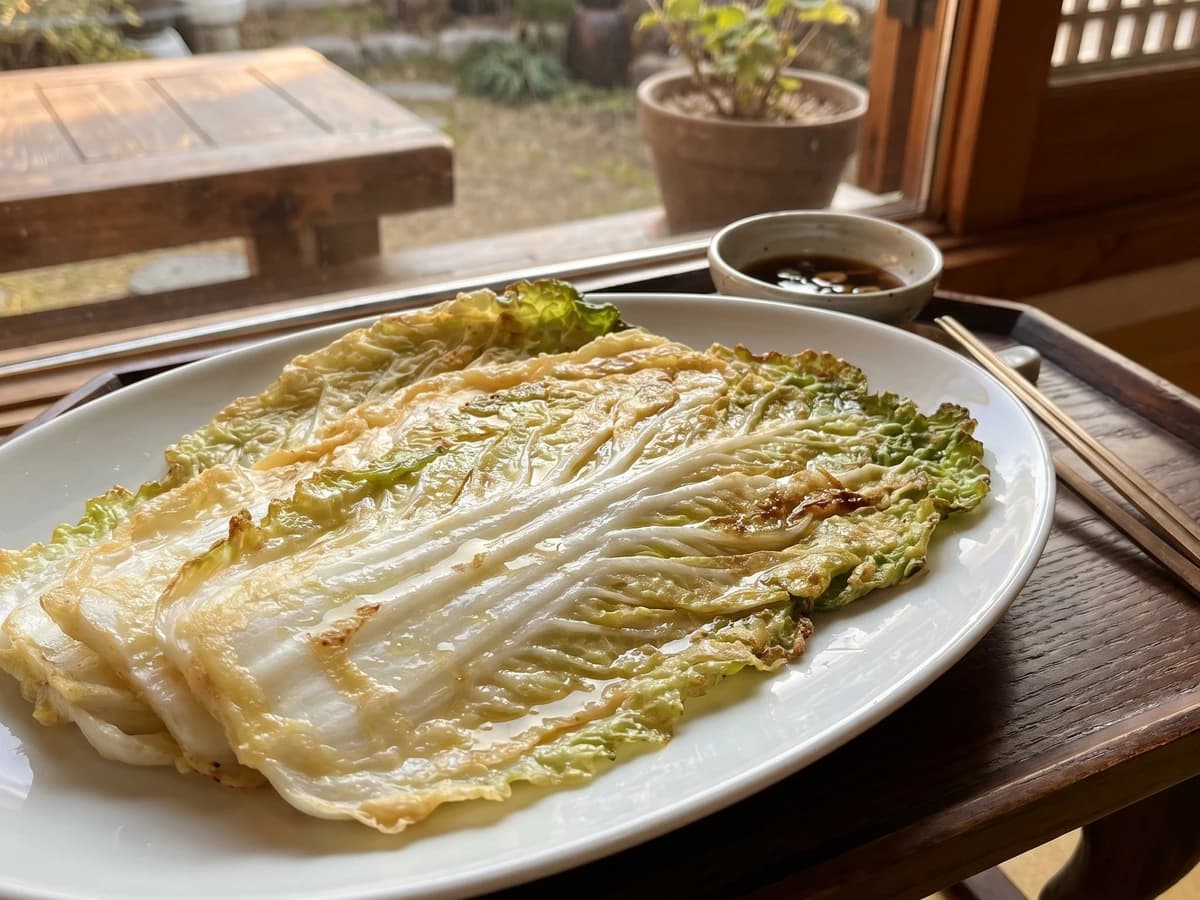
Chef Jeong-sun
Baechu-jeon (배추전, Napa Cabbage Pancake)
A Gyeongsang home pancake made from one whole napa cabbage leaf at a time, flattened at the rib, brushed in thin salted batter, and fried until sweet, tender, and quietly crisp at the edges.
A cooking platform built around craft, culture, and the stories behind what we eat.
Created by
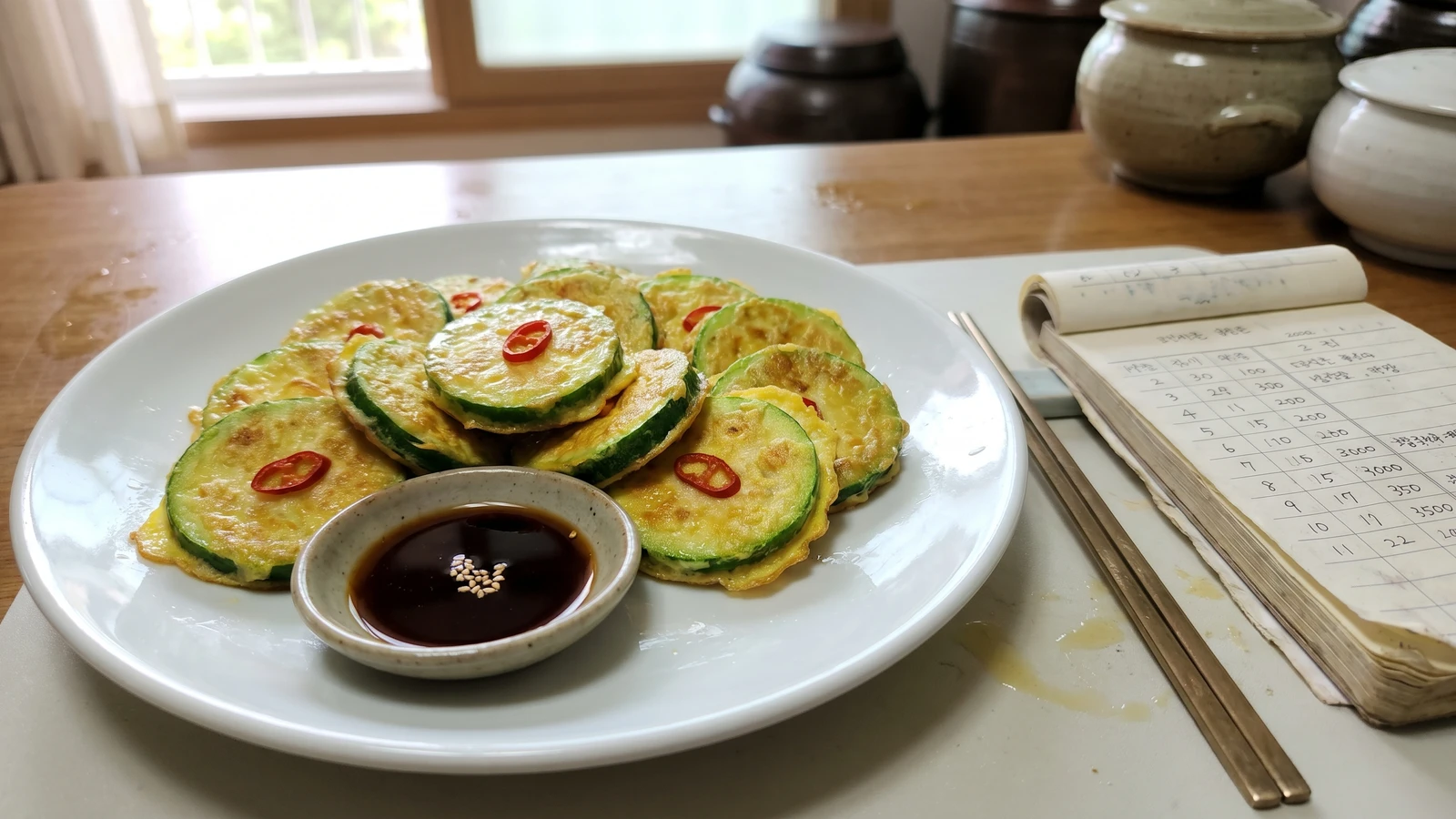
Thin young zucchini rounds, salted so they hold, touched with flour and egg, then pan-fried until gold at the edges and tender in the middle.
Hobak-jeon lives or dies before it reaches the pan. Slice the zucchini evenly, salt it lightly, and blot it well. If you skip that, the flour slides off, the egg turns patchy, and the zucchini steams itself soft. My teacher would tap one round with her chopstick and know whether the cook had been patient. 눈동냥, 귀동냥. Borrowing with the eyes, borrowing with the ears.
This is the gentlest jeon on a holiday platter, the one that sits beside fish jeon, meat patties, and green onion pancakes without raising its voice. It also belongs to an ordinary dinner with rice and a small bowl of soy-vinegar dipping sauce. Use young Korean squash, aehobak (애호박), if your market has it. Its flesh is tender and a little sweet. A firm small zucchini will do, but choose one no wider than 5 cm so the rounds cook through before the egg browns too far.
The coating is not batter. It is a thin dusting of flour and a clean coat of egg, just enough to hold the vegetable and give it a golden face. Keep the heat at medium-low, wipe the pan between batches if browned egg gathers, and salt with restraint. Let it taste like itself. A plate of hobak-jeon should remind you that quiet food still asks for careful hands.
Jeon, also called jeonyueo or jeonyuhwa in older records, appears throughout Joseon-era cooking as a method of coating fish, meat, or vegetables with flour and egg before pan-frying, especially for feast tables and ancestral rites. Squash came to Korea after the Columbian exchange, and aehobak (young Korean squash) became a common summer vegetable for soups, namul, and jeon because it cooks quickly and takes seasoning gently. Hobak-jeon remains both holiday food and home banchan, which is exactly how many Korean dishes live two lives.
Quantity
2 small, about 450g total
cut into 6 mm rounds
Quantity
3/4 teaspoon
for salting the zucchini
Quantity
1/3 cup
Quantity
2
Quantity
1 tablespoon
for loosening the egg
Quantity
1/8 teaspoon
for the egg
Quantity
3 tablespoons, divided
for pan-frying
Quantity
1
thinly sliced
Quantity
2 tablespoons
for dipping sauce
Quantity
1 tablespoon
for dipping sauce
Quantity
1 teaspoon
for dipping sauce
Quantity
1/2 teaspoon
for dipping sauce
Quantity
1/2 teaspoon
finely chopped, for dipping sauce
| Ingredient | Quantity |
|---|---|
| Korean young squash (aehobak) or firm small zucchinicut into 6 mm rounds | 2 small, about 450g total |
| fine sea saltfor salting the zucchini | 3/4 teaspoon |
| all-purpose flour | 1/3 cup |
| large eggs | 2 |
| waterfor loosening the egg | 1 tablespoon |
| fine sea saltfor the egg | 1/8 teaspoon |
| neutral oilfor pan-frying | 3 tablespoons, divided |
| red chili (optional)thinly sliced | 1 |
| soy saucefor dipping sauce | 2 tablespoons |
| rice vinegarfor dipping sauce | 1 tablespoon |
| waterfor dipping sauce | 1 teaspoon |
| toasted sesame seedsfor dipping sauce | 1/2 teaspoon |
| scallionfinely chopped, for dipping sauce | 1/2 teaspoon |
Cut the zucchini into even 6 mm rounds. Lay them in one layer on a tray and sprinkle both sides with 3/4 teaspoon fine sea salt. Rest 10 minutes. The salt seasons the center and pulls out surface moisture, so the flour clings instead of turning gummy.
Pat each round dry with a clean towel or paper towel, top and bottom. Be thorough. Water left on the surface makes bare patches in the coating, and bare patches leak juice into the oil.
Put the flour in a shallow dish. Beat the eggs with 1 tablespoon water and 1/8 teaspoon salt in a second shallow dish until no thick streaks of white remain. The water loosens the egg just enough for a thin coat; heavy egg hides the zucchini.
Dredge the zucchini rounds lightly in flour, then tap off every bit of excess. You should still see the green edge clearly. Too much flour makes a pasty layer between the vegetable and the egg.
Dip each floured round into the beaten egg and let the excess drip back into the dish. If using red chili, press one thin slice onto the top of some rounds now. It is a small holiday face, not a requirement.
Heat 1 tablespoon oil in a wide skillet over medium-low heat. Add the rounds in one layer with space between them. Cook 1 1/2 to 2 minutes on the first side, until pale gold, then turn and cook 1 to 2 minutes more. The zucchini should be just tender, not collapsed, and the egg should stay yellow-gold rather than brown.
Move the cooked jeon to a rack or a paper towel-lined tray. Wipe out browned egg bits before the next batch and add more oil as needed, about 1 tablespoon at a time. Clean oil keeps the next round tasting fresh.
Stir together the soy sauce, rice vinegar, water, sesame seeds, and scallion for a light cho-ganjang (soy-vinegar dipping sauce). Serve the hobak-jeon warm or at room temperature. Do not drown it in sauce; touch one edge and eat.
1 serving (about 150g)
Culinary guides, cultural storytelling, and the editorial depth that makes cooking meaningful.
Discover Culinary ExplorerChef Jeong-sun
A Gyeongsang home pancake made from one whole napa cabbage leaf at a time, flattened at the rib, brushed in thin salted batter, and fried until sweet, tender, and quietly crisp at the edges.

Chef Jeong-sun
A holiday jeon of fresh shiitake or oyster mushrooms, salted lightly, dusted thinly, and carried through egg in a quiet pan until the mushroom stays earthy and the coating stays tender.

Chef Jeong-sun
Soaked mung beans ground coarse, folded with pork, bracken, sprouts, and kimchi, then fried thick until the edges crisp and the center stays tender enough for a shared table.

Chef Jeong-sun
A summer garlic chive pancake fried thin, crisp at the edges and chewy in the center, with just enough batter to hold the green pile together and a sharp soy-vinegar dip.