
Chef Lupita
Aguascalientes Beef Tongue Pozole (Pozole de Lengua)
Aguascalientes' Bajio pozole de lengua, built with cacahuazintle hominy, tender beef tongue, chile ancho and guajillo, with xoconostle brightness and table garnishes.
A cooking platform built around craft, culture, and the stories behind what we eat.
Created by
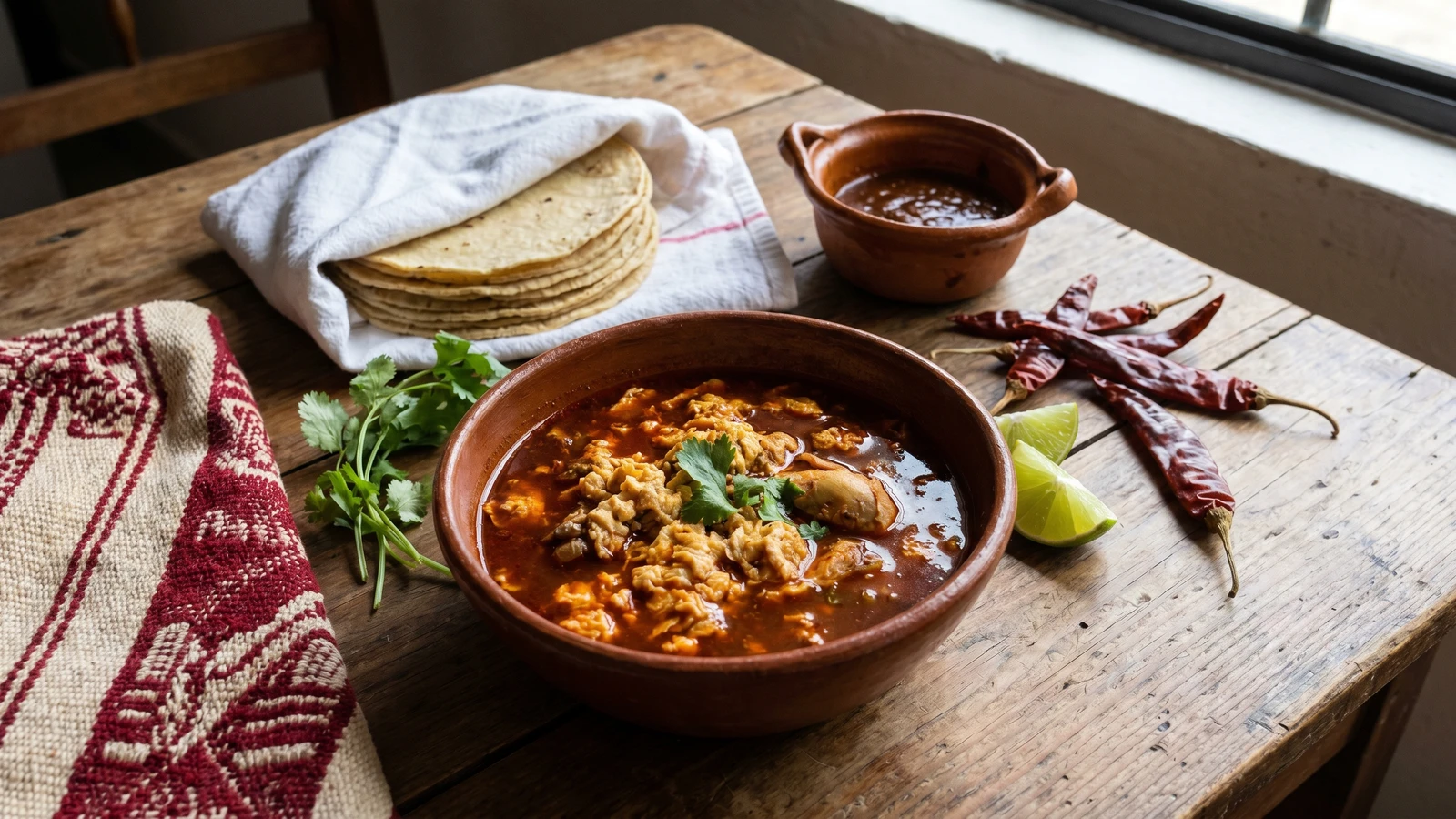
From the Valles Centrales of Oaxaca, the wedding broth that opens the feast: chicken, livers, and eggs scrambled into a guajillo-red caldo, ladled out to every guest before the mole negro makes its entrance.
This is an Oaxacan dish. Specifically, it belongs to the Villa de Etla and the surrounding towns of the Etla district in the Valles Centrales, where weddings still follow a structure older than anyone at the table. The higaditos come first. They are the opening act. The mole negro comes later, and the mole gets the glory, but the higaditos are what the kitchen sends out while the guests are arriving, while the mezcal is being poured, while the band is setting up. This is the dish that says the celebration has begun.
Highaditos means little livers. That is exactly what they are: chicken livers and pieces of the bird simmered in a guajillo-red broth, and then the beaten eggs go in. Not on the side. Not fried separately. Into the pot. You pour them in a thin stream while the broth simmers and they set into soft, ragged curds that catch the chile and float through the caldo like clouds stained red. The technique is simple but the timing matters. Pour the eggs into a rolling boil and they turn to rubber. Pour them into a broth that has gone still and they sink to the bottom in a lump. The broth needs to be moving, barely, a lazy simmer. Then you pour. Then you wait. Asi se hace y punto.
I collected this recipe from a senora in San PabloEtla who had been making higaditos for every wedding in her family since she was eighteen years old. She stood at a clay pot the size of a laundry basin and stirred with a wooden spoon that had lost its handle years ago. She told me the eggs have to be from the yard, not from the store, because yard eggs set firmer and hold their shape in the broth. She was right. My mother never made this dish because she was from Jalisco, but she had a note in her notebook, one line in pencil: "Oaxaca wedding soup, eggs in the broth, ask Dona Carmen for the rest." I never found Dona Carmen. I found the senora in Etla instead. Saber cocinar es saber vivir.
Higaditos de boda belong to the Oaxacan wedding meal structure known as the 'comida de boda,' a multi-course feast whose sequence, from caldo to mole to tamales to mezcal, has been documented in the Valles Centrales since at least the 19th century. The use of organ meats in the opening course reflects a practical economy: when a family slaughters chickens or turkeys for the mole, the livers, gizzards, and necks go into the first-course broth rather than being discarded. The technique of streaming beaten eggs into simmering broth appears across several Mexican states, but the Etla version, specifically built on chile guajillo and tied to wedding ritual, is a regional marker that distinguishes Valles Centrales celebrations from those in the Sierra Norte or the Istmo de Tehuantepec, where the opening courses follow different traditions entirely.
Quantity
1 (about 3 1/2 pounds)
cut into 8 pieces
Quantity
8 ounces
cleaned of any green bile spots and halved
Quantity
8
stemmed and seeded
Quantity
4 medium
Quantity
1 medium
quartered (half for the broth, half for the sauce)
Quantity
5 (3 for the broth, 2 for the sauce)
Quantity
6
Quantity
2 tablespoons
Quantity
1/2 teaspoon
Quantity
4
Quantity
6
Quantity
1 teaspoon
Quantity
2
Quantity
1 tablespoon, plus more to taste
Quantity
10 cups
Quantity
for serving
Quantity
for serving
Quantity
for serving
warmed
| Ingredient | Quantity |
|---|---|
| whole chickencut into 8 pieces | 1 (about 3 1/2 pounds) |
| chicken liverscleaned of any green bile spots and halved | 8 ounces |
| dried chile guajillostemmed and seeded | 8 |
| Roma tomatoes | 4 medium |
| white onionquartered (half for the broth, half for the sauce) | 1 medium |
| garlic cloves | 5 (3 for the broth, 2 for the sauce) |
| large eggs | 6 |
| manteca de cerdo (pork lard) | 2 tablespoons |
| cumin seeds | 1/2 teaspoon |
| whole cloves | 4 |
| black peppercorns | 6 |
| dried Mexican oregano | 1 teaspoon |
| bay leaves | 2 |
| kosher salt | 1 tablespoon, plus more to taste |
| water | 10 cups |
| fresh cilantro sprigs (optional) | for serving |
| lime wedges (optional) | for serving |
| hand-pressed corn tortillas (optional)warmed | for serving |
Place the chicken pieces in a large clay olla or heavy stockpot. Add the water, two quarters of the onion, three garlic cloves, bay leaves, and salt. Bring to a gentle simmer over medium heat. Skim the gray foam that rises in the first ten minutes. Every spoonful of foam you remove is clarity you are adding to the broth. Reduce the heat until the surface barely moves: one or two lazy bubbles every few seconds. Cover partially and simmer for 45 minutes to one hour, until the chicken is cooked through and tender but not falling off the bone. You will return the chicken to the pot later, so it does not need to be shredded-soft yet.
While the chicken simmers, heat a dry comal or cast iron skillet over medium heat. Press each guajillo flat against the hot surface with a spatula for about 20 seconds per side. The chile will puff, change color slightly, and release a warm, earthy smell that fills the kitchen. Do not blacken them. Burned guajillo turns bitter and there is no coming back from that. Transfer the toasted chiles to a heatproof bowl and cover with hot tap water. Not boiling water. Hot water softens the flesh gently. Boiling water cooks the skin and gives the sauce a harsh, rubbery taste. Soak for 20 minutes.
On the same comal, roast the four Roma tomatoes and the remaining two onion quarters, turning them occasionally until they are charred in patches and soft throughout, about 10 to 12 minutes. Add the two remaining garlic cloves for the last three minutes, letting the skins darken. The tomatoes should be blistered and collapsing. Set everything aside. This char is not decoration. It is the smoky backbone of the sauce.
Drain the soaked chiles, discarding the water. Transfer them to a blender with the roasted tomatoes, roasted onion, roasted garlic, cumin seeds, cloves, peppercorns, and oregano. Add one cup of the chicken broth from the pot. Blend on high until completely smooth, scraping down the sides if needed. Strain through a medium-mesh sieve into a bowl, pressing on the solids with the back of a spoon to extract everything. Discard the skins. The sauce should be a deep, opaque red.
In a wide skillet or cazuela, melt the manteca de cerdo over medium-high heat. When the lard shimmers, pour in the strained guajillo sauce all at once. It will sputter and hiss. Stand back but do not walk away. Stir constantly for five to seven minutes, until the sauce darkens by a shade, thickens slightly, and the fat begins to separate at the edges. La manteca es el sabor. This step concentrates the chile flavor and removes the raw taste. You will smell the difference: it goes from sharp and vegetal to deep and rounded.
Remove the chicken pieces from the broth and set aside on a plate. Fish out and discard the spent onion, garlic, and bay leaves. Pour the fried guajillo paste into the pot of broth and stir to combine. The broth will turn a rich guajillo red. Bring it back to a gentle simmer and taste for salt. The broth should be assertive, slightly more seasoned than you think is right, because the eggs will absorb salt when they go in. Return the chicken pieces to the pot.
Add the cleaned chicken livers to the simmering broth. They cook quickly, six to eight minutes. You want them just cooked through: firm on the outside but still slightly pink at the very center. Overcooked liver turns chalky and metallic. The livers will give up a little of their mineral richness into the broth, and that is part of what makes higaditos taste like higaditos. No me vengas con atajos: the livers are the dish. The name tells you so.
Crack all six eggs into a bowl and beat them well with a fork until the whites and yolks are fully combined, no streaks of white remaining. Bring the broth to a bare simmer: small bubbles rising slowly, the surface just moving. This is the critical moment. Hold the bowl six inches above the pot and pour the beaten eggs in a thin, steady stream while stirring the broth gently in one direction with a wooden spoon. The eggs will set into soft, ragged curds and ribbons that float through the red broth. Do not stir violently or the curds will break into tiny specks. Do not pour the eggs in all at once or they will clump into a single mass at the bottom. One thin stream. One slow stir. Let the broth do the work.
Once the eggs are set, about two minutes after you finish pouring, remove the pot from the heat. Let it rest for five minutes. The curds will firm gently as the broth settles. Ladle into deep bowls, making sure each serving gets a piece of chicken, a few livers, and a generous share of the egg curds floating in the guajillo broth. Set cilantro, lime, and warm tortillas at the table. This is the first course. The mole comes later. Recetas probadas y garantizadas.
1 serving (about 300g)
Culinary guides, cultural storytelling, and the editorial depth that makes cooking meaningful.
Discover Culinary ExplorerChef Lupita
Aguascalientes' Bajio pozole de lengua, built with cacahuazintle hominy, tender beef tongue, chile ancho and guajillo, with xoconostle brightness and table garnishes.

Chef Lupita
Veracruz's Gulf coast rice from Alvarado, built with seafood stock, tomato, chile chipotle, epazote, shrimp, fish, jaiba, and pulpo, served loose and brothy in a clay cazuela.

Chef Lupita
Costa Chica's wet salt-beef stew, built from chile costeño, guajillo, tomato, manteca, yuca, plantain, and masa dumplings, the ranching pot of Cuajinicuilapa and Pinotepa.

Chef Lupita
Michoacán's P'urhépecha atápakua is a masa-thickened sauce and stew at once, built with pork, chile guajillo, and hierbabuena added only at the end.