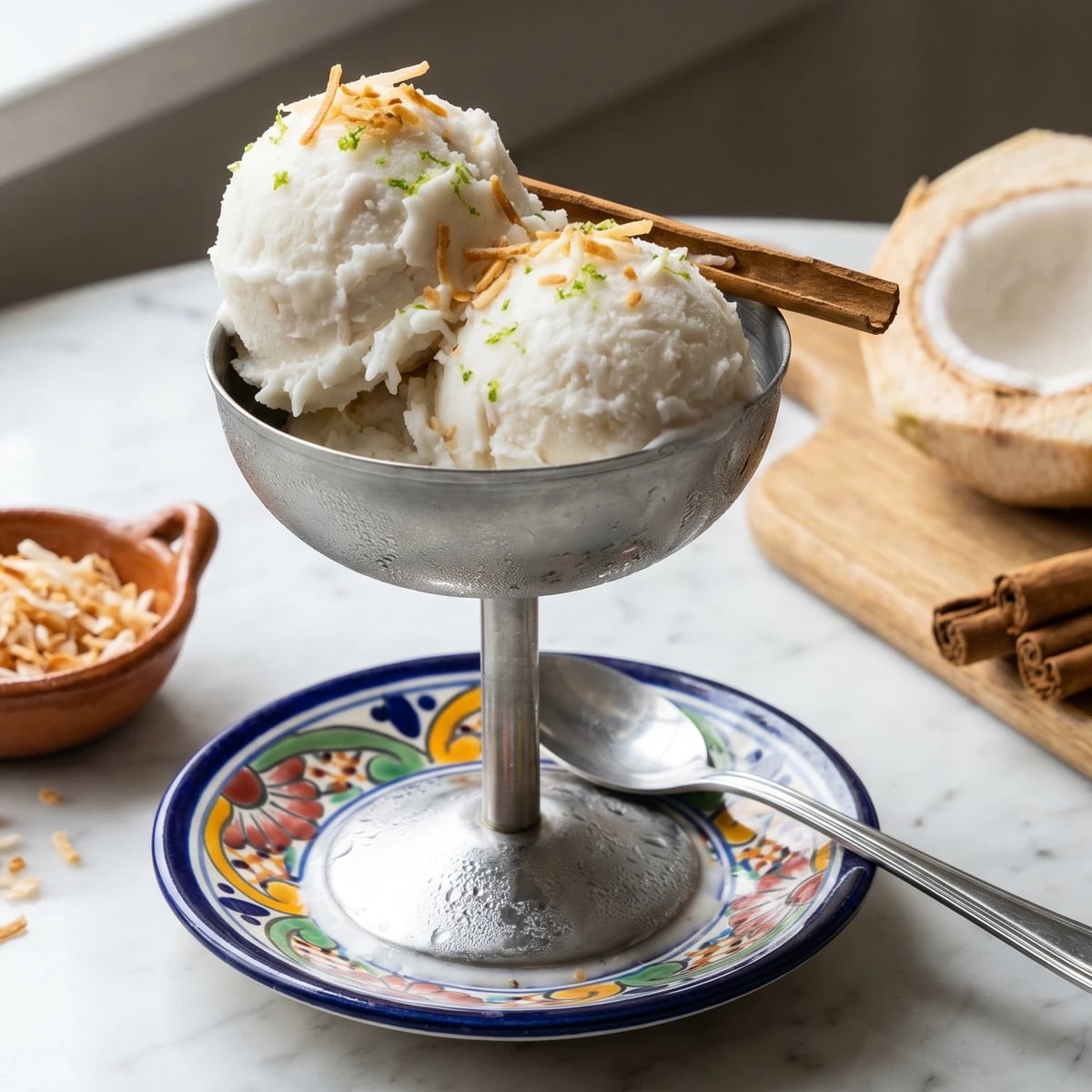
Yucatan's coconut helado, built on coco tierno and the canela of Merida's market, churned to a soft cream and served the way they do it at Sorbeteria Colon on a Sunday afternoon.
Desserts
Mexican
Comfort Food
Make Ahead
Picnic
30 min
Active Time
20 min cook•8 hr total
YieldAbout 1.5 quarts, 8 servings
This is from Yucatan. From Merida specifically, and from the small puertos along the Gulf coast, Progreso, Telchac, Chuburna, where coconut palms grow within sight of the water and the helado vendors push their carts down the malecon every Sunday afternoon. Helado de coco belongs to that geography. It is not the coconut ice cream of a national supermarket freezer. It is the helado you eat from a metal coupe at Sorbeteria Colon while the heat of the peninsula presses against the courtyard walls.
The dish has two coconuts in it because Yucatan has two coconuts available. The coco tierno gives you the water and the soft jellied pulp that melts into the base. The coco maduro gives you the firm white flesh that shreds and shaves. One without the other is incomplete. The canela is Mexican canela, the soft papery Ceylon bark that the women at the Lucas de Galvez market sell by the bundle. Cassia cinnamon from a supermarket jar is not the same spice and the helado will tell you so.
My mother did not make this. She was from Jalisco and Jalisco does not have this dish. But I have a page in my notebook from a senora named Dona Felicitas who sold helados from a cart in Progreso for forty years. She showed me how to crack the coco tierno with the back of a cleaver and where to scrape the pulp without losing it to the shell. Esto no es comida de un solo Mexico. Cada estado, su propia cocina.
The coconut palm is not native to the Yucatan peninsula; it was introduced via the Manila galleon trade in the 16th century, when Spanish ships brought coconuts from the Philippines and the Pacific to ports including Acapulco and, eventually, the Gulf coast of Yucatan. By the 19th century, coconut cultivation along the Yucatecan littoral had given rise to a distinct repertoire of regional sweets, cocadas, dulce de coco, and the helado de coco served at marble-topped sorbeterias in Merida. The Sorbeteria Colon, founded in 1907 on the Paseo de Montejo, is widely credited with formalizing the Yucatecan helado tradition and remains the reference point against which home cooks measure their own versions.
The technique, the tradition, and the story behind every dish.
•Heavy cleaver or large chef's knife for opening coconuts
•Box grater for the mature coconut
•Heavy 3-quart saucepan
•Fine-mesh strainer
•Ice cream maker, 1.5-quart capacity or larger
•Cast iron comal for toasting the shavings
Instructions
1
Open the young coconuts
Set the young coconuts on a sturdy cutting board. Trim the husk down with a heavy knife until you find the soft spot at the top. Crack through it carefully and pour the agua de coco into a measuring cup. You want about a cup and a half. Drink any extra cold, that is the cook's pay. Split the coconuts open with the back of a cleaver and scoop out the tender pulp with a spoon. It should be soft enough to scrape, almost jellied. Chop it roughly and set aside.
If you cannot find young coconuts, increase the canned coconut milk to two cans and skip the agua de coco. The texture will be denser but the flavor still belongs to the dish. A compromise, not an upgrade.
2
Open the mature coconut
Pierce the soft eye of the brown coconut with a screwdriver or thick skewer and drain whatever water is inside. Bake the whole coconut at 375F for 12 minutes. The shell will crack and the flesh will pull away from the wall. Wrap it in a towel, hit it once firmly with a hammer along the equator, and it will split. Pry the flesh from the shell with a sturdy butter knife. Peel off the thin brown skin with a vegetable peeler. You should have about two cups of firm white pulp. Reserve half a cup for shaving and shred the rest on the medium holes of a box grater.
3
Steep the canela in the milk
In a heavy 3-quart saucepan, combine the whole milk, canned coconut milk, sugar, salt, and the canela stick. Add the grated mature coconut. Set over medium-low heat. Bring it just to the edge of a simmer, never to a boil. Boiling scalds the milk and the canela turns medicinal. Hold it at that lazy heat for 15 minutes so the canela perfumes the dairy and the coconut releases its oils.
Use real Mexican canela, the thin papery bark that crumbles in your fingers. Cassia cinnamon, the stiff dark sticks from the supermarket, is a different spice. It is harsher and overpowers the coconut.
4
Thicken the base
Whisk the cornstarch into the agua de coco until smooth. Pour it slowly into the warm milk while whisking constantly. Cook for two to three minutes, stirring with a wooden spoon, until the base thickens enough to coat the back of the spoon. Drag a finger across the spoon, the line should hold. Pull the pot off the heat. Fish out the canela stick. Stir in the sweetened condensed milk, the heavy cream, and the vanilla.
5
Chill thoroughly
Pour the base through a fine-mesh strainer set over a clean bowl. Press hard on the grated coconut to extract every drop. The pulp has done its work, discard it or save it for cocadas. Stir the chopped tender coconut pulp into the strained base. Cover and refrigerate for at least six hours, ideally overnight. The base must be cold all the way through before it goes into the machine. A warm base churns into a grainy ice cream every time. No me vengas con atajos.
6
Churn the helado
Pour the cold base into the bowl of an ice cream maker and churn according to the manufacturer's instructions, usually 20 to 25 minutes. It is ready when it looks like soft serve and holds a soft peak when you lift the paddle. While it churns, toast the reserved coconut shavings on a dry comal over medium-low heat, tossing constantly, until golden at the edges. Watch them. They burn in seconds.
7
Freeze and serve
Scrape the churned helado into a chilled container, fold in half of the toasted coconut shavings, and press a piece of parchment directly against the surface before sealing. Freeze for at least three hours to firm up. Scoop into chilled coupes or small clay cazuelitas. Crown each scoop with the remaining toasted shavings and a fine grating of lime zest if you like. Eat it the way they do at Sorbeteria Colon in Merida, sitting in the shade with the heat of the Yucatecan afternoon pressing in from outside. Saber cocinar es saber vivir.
Chef Tips
•If you can find a young coconut still in its full husk, not the trimmed white drums sold in supermarkets, take it. The water inside the husk is sweeter and the pulp is softer. Pregunta a las senoras del mercado where they get theirs.
•Do not use sweetened shredded coconut from the baking aisle. It is full of preservatives and corn syrup and it will turn the helado cloying. Shred your own from the mature coconut. It takes 20 minutes and the difference is the whole dish.
•An ice cream maker is the right tool for this. You can make it without one by freezing the base in a shallow pan and stirring every 30 minutes with a fork for three hours, but the texture will be more granizado than helado. Both are good. They are not the same thing.
Advance Preparation
•The base can be made up to two days ahead and refrigerated. The flavor of the canela deepens overnight and the second day version is often better than the first.
•Once churned and frozen, helado de coco keeps for two weeks in the freezer with a piece of parchment pressed against the surface. After that, ice crystals form and the texture suffers.
•The coconuts can be cracked and the pulp extracted one day ahead. Refrigerate the agua de coco and the pulp separately in covered containers.
Frequently Asked Questions
Nutrition Information
1 serving (about 275g)
Calories
590 calories
Total Fat
39 g
Saturated Fat
30 g
Trans Fat
0 g
Unsaturated Fat
7 g
Cholesterol
55 mg
Sodium
175 mg
Total Carbohydrates
52 g
Dietary Fiber
3 g
Sugars
45 g
Protein
9 g
Where cooking meets culture.
Culinary guides, cultural storytelling, and the editorial depth that makes cooking meaningful.