
Chef Klaus
Berlin Currywurst
The Berlin Imbiss counter on a plate: fried sausage cut thick, a tomato curry sauce cooked until glossy, and enough fries or bread to chase every bit.
A cooking platform built around craft, culture, and the stories behind what we eat.
Created by
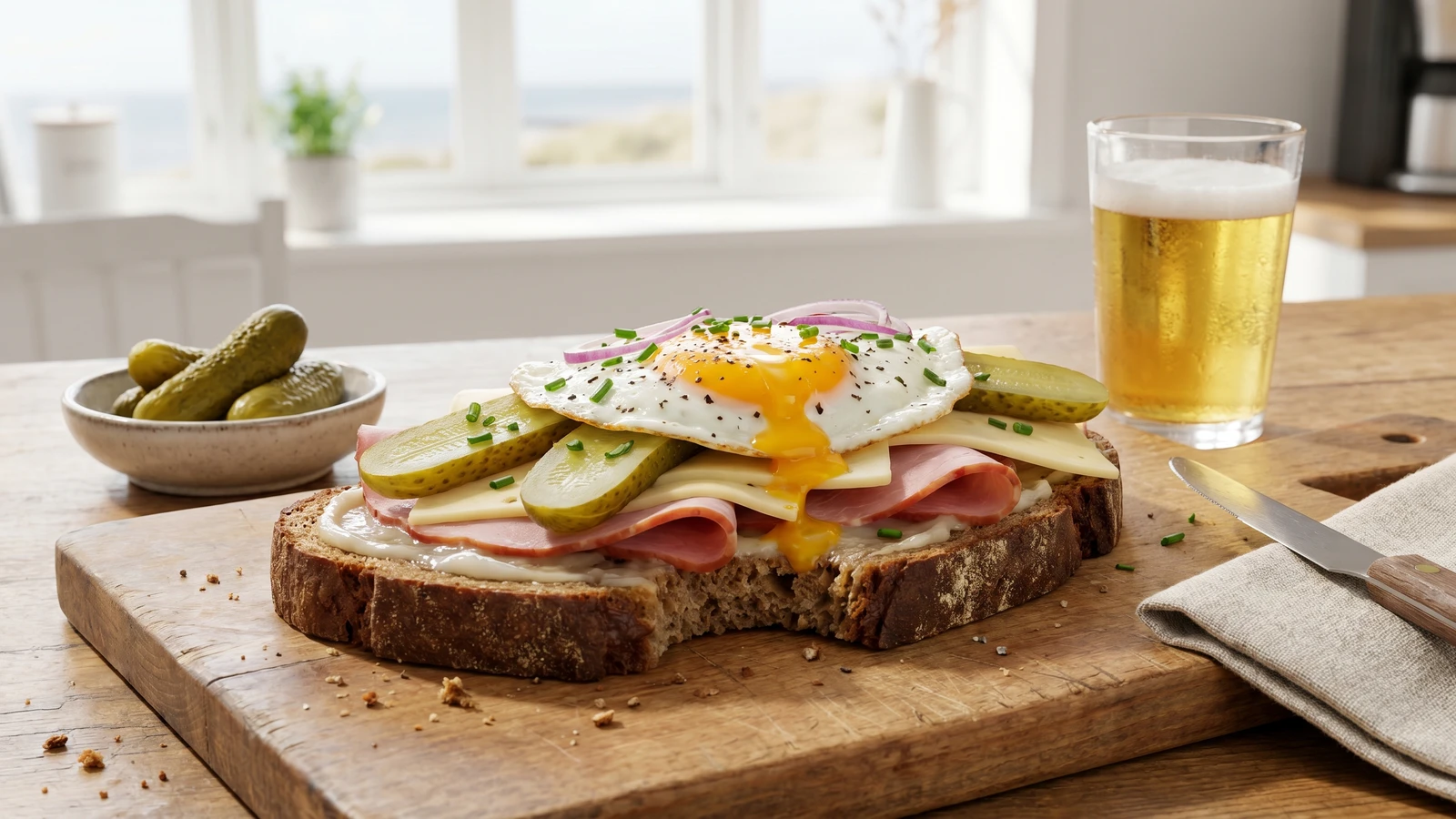
A North Frisian open-faced bread built from the winter larder: dark rye, Schmalz, smoked ham, cheese, pickle, and one fried egg with the yolk still soft.
Halligbrot belongs to North Frisia, to the low Halligen in the Wadden Sea, where bread had to be dense, food had to keep, and a Stulle, an open-faced bread, was expected to do real work. This is not delicate café cooking. It is dark rye, pork Schmalz, smoked ham, cheese, a sharp pickle, and a fried egg set on top like it paid rent.
Im Norden anders, im Süden anders. Up north the rye is dark and sour, the ham is cured or smoked, and the fat is Schmalz because the larder made sense of every bit of the pig. Further south you would see softer Bauernbrot, butter, radishes, maybe Obazda in Bavaria. Fine for them. This one stays on the marsh.
The deciding technique is the bread. Toast the rye only enough to firm the surface, then spread the Schmalz while the bread is still just warm, because the fat melts into the top crust and seals it against the pickle and egg. Skip that and the bread goes wet underneath. Fry the egg gently so the white sets before the yolk hardens. Runter mit der Temperatur. A hard fried egg on Halligbrot is only a lid.
Weggeworfen wird nichts. The Schmalz is thrift, the ham is preservation, the pickle is winter brightness, and the cheese makes a cold island bread into supper. Build it tall, eat it with a knife and fork if you must. Schön ist, was schmeckt.
The Halligen are small, low North Frisian marsh islands off the coast of Schleswig-Holstein, settled around raised mounds called Warften because storm tides could cover the land around them. Their cooking grew from the North Sea larder: dark rye breads, cured pork, preserved vegetables, eggs, and dairy that could hold through hard weather and isolation. Halligbrot is a modern named Stulle from that island logic rather than a court dish, and its argument is regional: northern rye and Schmalz against the softer breads and buttered Brotzeit plates of the south.
Quantity
4 thick slices
Quantity
4 tablespoons
soft enough to spread
Quantity
8 thin slices
Quantity
4 slices
Quantity
4
Quantity
1 tablespoon
for frying
Quantity
2 large
sliced lengthwise
Quantity
1 small
sliced very thin
Quantity
1 tablespoon
chopped
Quantity
to taste
Quantity
to taste
| Ingredient | Quantity |
|---|---|
| dark rye bread, Schwarzbrot or dense Roggenmischbrot | 4 thick slices |
| pork Schmalzsoft enough to spread | 4 tablespoons |
| Katenschinken or smoked cured ham | 8 thin slices |
| Tilsiter, young Gouda, or North German Schnittkäse | 4 slices |
| large eggs | 4 |
| butter or lardfor frying | 1 tablespoon |
| dill picklessliced lengthwise | 2 large |
| red onionsliced very thin | 1 small |
| chiveschopped | 1 tablespoon |
| freshly ground black pepper | to taste |
| fine salt | to taste |
Toast the rye lightly, just until the surface firms and the cut side smells sour and nutty. Do not dry it into a cracker; dense rye needs a little chew, or the finished bread eats like punishment.
Spread the Schmalz over the rye while the bread is still just warm. The fat melts into the top crust and seals it, so the pickle, ham, and egg do not soak the bread from above. Nicht aus dem Glas unless it is real butcher's Schmalz, not a sweet sandwich spread pretending to be lunch.
Lay the smoked ham over the Schmalz, then set the cheese on top and tuck the pickle slices along one side. Ham goes under the cheese because the fat in the cheese holds the cured meat down, and the pickle stays visible so every bite can find some sharpness.
Melt the butter or lard in a frying pan over medium-low heat, crack in the eggs, and salt only the whites. Keep the heat gentle so the whites set cleanly before the yolks harden; a fierce pan gives you rubber edges and a chalky middle. Runter mit der Temperatur.
Slide one fried egg onto each bread, grind black pepper over the yolk, scatter with chives, and add the onion slices last. Würzen, Fett, Salz zum Schluss: the sharp onion and pepper go on after the fat, so they cut through the Schmalz instead of disappearing into it. Serve at once, with a knife and fork if the stack has ambitions.
1 serving (about 250g)
Culinary guides, cultural storytelling, and the editorial depth that makes cooking meaningful.
Discover Culinary ExplorerChef Klaus
The Berlin Imbiss counter on a plate: fried sausage cut thick, a tomato curry sauce cooked until glossy, and enough fries or bread to chase every bit.

Chef Klaus
A northern fish-stall roll built on sharp Bismarck herring, raw onion, and pickle, with one rule deciding the whole thing: the vinegar cure goes on cold and gets its time.

Chef Klaus
Franconia's sour-poached bratwurst skips the grill: raw sausages, onion, vinegar, wine, and one quiet rule, keep the sud below the boil.

Chef Klaus
A Berlin Brühwurst belongs in hot water, not boiling water: warm it gently, keep the skin tight, then eat it in a roll with sharp mustard.