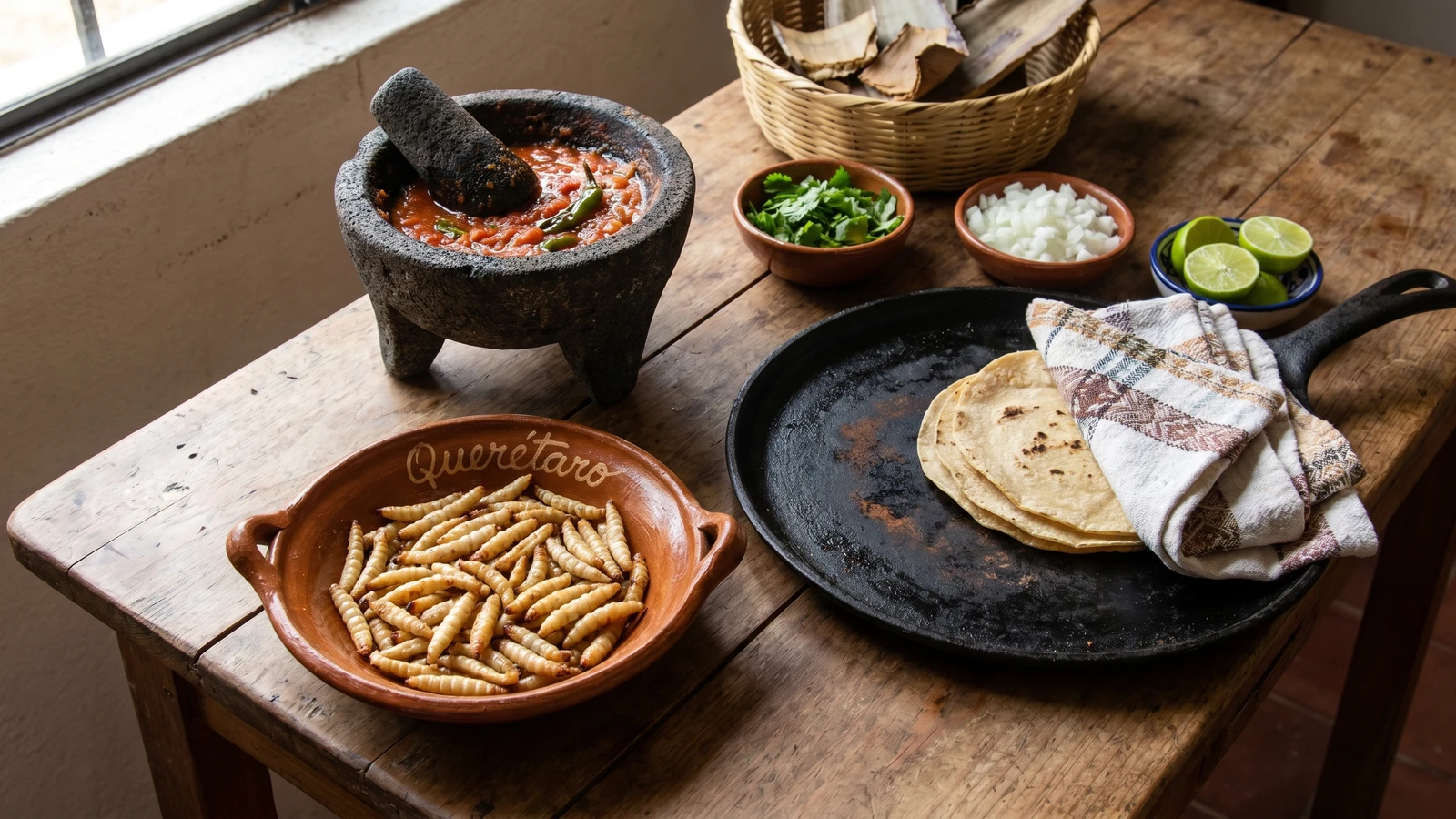
Querétaro's Sierra Gorda gives you this rare comal snack: white maguey worms toasted in manteca until crisp, folded into hot corn tortillas with molcajete salsa.
Appetizers & Snacks
Mexican
Special Occasion
Dinner Party
25 min
Active Time
20 min cook•45 min total
Yield4 appetizer servings
Querétaro, Sierra Gorda and the semidesert around Tolimán, Cadereyta, and Peñamiller. That is where this dish lives. The gusano blanco is not a novelty. It is a seasonal harvest from the heart of the maguey, known by the Chichimeca-Otomí families who understand which plant can be opened and which one must be left alone.
These worms are pale, fat, and delicate, taken from maguey pencas in the rainy season and treated like what they are: expensive, scarce, and tied to land that does not forgive waste. You do not drown them in sauce. You clean them, salt them, toast them on a comal with a little manteca de cerdo, and let their nutty flavor speak. La cocina no es decoración, es trabajo.
The salsa belongs in the molcajete: jitomate, chile serrano, garlic, and salt. No blender here. The crushed texture grabs the warm tortilla and the crisp worms without turning the taco wet. I learned this version from a señora outside Cadereyta who slapped my hand away when I reached for more salsa. She was right. The salsa supports the gusano. It does not bury it.
Cada estado, su propia cocina. If you cannot get real gusano blanco de maguey, do not pretend with mealworms from a pet store. Make quesadillas de flor de calabaza and wait for the season. Some ingredients cannot be faked.
White maguey worms, commonly identified as larvae of the maguey moth Aegiale hesperiaris, have been eaten in central Mexico since pre-Columbian times, especially in maguey-growing regions of Hidalgo, Tlaxcala, Estado de México, Puebla, and Querétaro. In Querétaro's Otomí-Chichimeca semidesert, maguey has long provided pulque, fiber, boundary markers, food, and ritual material, making the insect harvest part of a larger agave economy rather than a separate curiosity. The worms remain seasonal and expensive because harvesting them requires cutting into the plant, so responsible cooks buy from trusted collectors who know how to protect the maguey stand.
The technique, the tradition, and the story behind every dish.
fresh white maguey worms (gusanos blancos de maguey)
Quantity
8 ounces
carefully rinsed and patted dry
kosher salt
Quantity
1 teaspoon
divided
manteca de cerdo
Quantity
2 tablespoons
ripe jitomates roma
Quantity
4 medium
fresh chile serrano
Quantity
3
garlic clove
Quantity
1 small
unpeeled
coarse sea salt
Quantity
1/4 teaspoon, plus more to taste
small hand-pressed corn tortillas
Quantity
12
warmed
white onion (optional)
Quantity
1/2 small
finely diced
fresh cilantro leaves (optional)
Quantity
1/3 cup
torn
limes (optional)
Quantity
2
halved
Ingredient
Quantity
fresh white maguey worms (gusanos blancos de maguey)carefully rinsed and patted dry
8 ounces
kosher saltdivided
1 teaspoon
manteca de cerdo
2 tablespoons
ripe jitomates roma
4 medium
fresh chile serrano
3
garlic cloveunpeeled
1 small
coarse sea salt
1/4 teaspoon, plus more to taste
small hand-pressed corn tortillaswarmed
12
white onion (optional)finely diced
1/2 small
fresh cilantro leaves (optional)torn
1/3 cup
limes (optional)halved
2
Equipment Needed
•Seasoned cast iron comal or heavy clay comal
•Volcanic stone molcajete and tejolote
•Cotton servilleta for keeping tortillas warm
•Small barro cazuelita for serving the toasted worms
Instructions
1
Clean the worms
Place the gusanos blancos in a shallow bowl of cool water and move them gently with your fingers. Lift them out, do not pour them through the dirty water. Pat them completely dry on a clean kitchen towel. They are delicate. Treat them like the expensive seasonal harvest they are, not like something to punish in a pan.
2
Salt and rest
Sprinkle the worms with 1/2 teaspoon kosher salt and let them sit for 10 minutes while you heat the comal. The salt firms the surface and helps them crisp instead of steaming in their own moisture. If they go onto the comal wet, you already lost the texture.
3
Char the salsa vegetables
Heat a dry comal over medium-high heat. Place the jitomates, chile serrano, and unpeeled garlic on the surface. Turn them with tongs until the tomatoes blister and soften, the serranos show black spots, and the garlic skin is dark in places, about 10 to 12 minutes. This is not burning for drama. The char gives the salsa its backbone.
4
Grind the salsa
Peel the garlic and put it in a molcajete with the coarse sea salt. Grind to a paste. Add the serranos and crush them, then add the jitomates one at a time, grinding until the salsa is rough and juicy. Taste for salt. A blender makes this salsa too smooth and too loose. No me vengas con atajos.
Use two serranos if your guests are cautious. Use three if they know what they came to eat. This dish is about the maguey worms, not about proving pain tolerance.
5
Toast the worms
Lower the comal heat to medium. Add the manteca de cerdo and let it melt into a thin glossy layer. Add the drained gusanos blancos in one layer. They should touch the hot surface, not pile on top of each other. Cook for 6 to 8 minutes, turning gently, until they tighten, turn lightly golden, and the edges crisp. La manteca es el sabor. Oil will cook them, but it will not give the same roundness.
6
Warm the tortillas
Move the worms to the cooler edge of the comal or a small clay cazuelita. Warm the corn tortillas on the comal until they puff in spots and show light brown freckles, about 30 seconds per side. Keep them wrapped in a cotton servilleta so they stay soft. Flour tortillas belong to the north. Here, use corn.
7
Serve immediately
Set the toasted worms, warm tortillas, molcajete salsa, diced white onion, cilantro, and lime halves on the table. Build small tacos: tortilla, a spoonful of gusanos, a little salsa, onion, cilantro, and a squeeze of lime. Eat them while the edges are still crisp. Recetas probadas y garantizadas.
Chef Tips
•Buy gusanos blancos only from a trusted mercado vendor or responsible collector. Ask where they came from and when they were harvested. Pregúntale a las señoras del mercado. If the vendor shrugs, keep walking.
•The season matters. Fresh gusano blanco appears during the rainy months in maguey regions, and scarcity is part of the dish. Frozen worms can work if they were frozen clean and raw, but they will be softer. That is a compromise, not an upgrade.
•Do not confuse gusanos blancos with chinicuiles. Chinicuiles are red maguey worms, usually from the root area, with a stronger flavor and different use. This recipe is for the pale white worm from the maguey penca.
•Use a molcajete for the salsa. The rough stone crushes the chile skin and tomato flesh into a texture that clings to the taco. A smooth blender salsa slides off and makes the tortilla soggy.
Advance Preparation
•The salsa can be made up to 2 hours ahead and kept at room temperature. Do not refrigerate it before serving unless your kitchen is very hot, because cold salsa dulls the flavor of the toasted worms.
•Clean and dry the gusanos blancos up to 4 hours ahead. Keep them covered in the refrigerator on a towel-lined plate, then salt them only 10 minutes before cooking.
•Tortilla masa can be prepared earlier the same day and kept covered. Press and cook the tortillas close to serving so they stay flexible.
Frequently Asked Questions
Nutrition Information
1 serving (about 210g)
Calories
360 calories
Total Fat
16 g
Saturated Fat
5 g
Trans Fat
0 g
Unsaturated Fat
11 g
Cholesterol
60 mg
Sodium
800 mg
Total Carbohydrates
42 g
Dietary Fiber
7 g
Sugars
3 g
Protein
17 g
Where cooking meets culture.
Culinary guides, cultural storytelling, and the editorial depth that makes cooking meaningful.