
Chef Lupita
Almendrados Conventuales Poblanos
Puebla's convent almond cookies, made from blanched almonds, sugar syrup, egg yolks, canela, and patient hands, the kind of sweet that belongs beside coffee in talavera, not in a plastic bakery box.
A cooking platform built around craft, culture, and the stories behind what we eat.
Created by
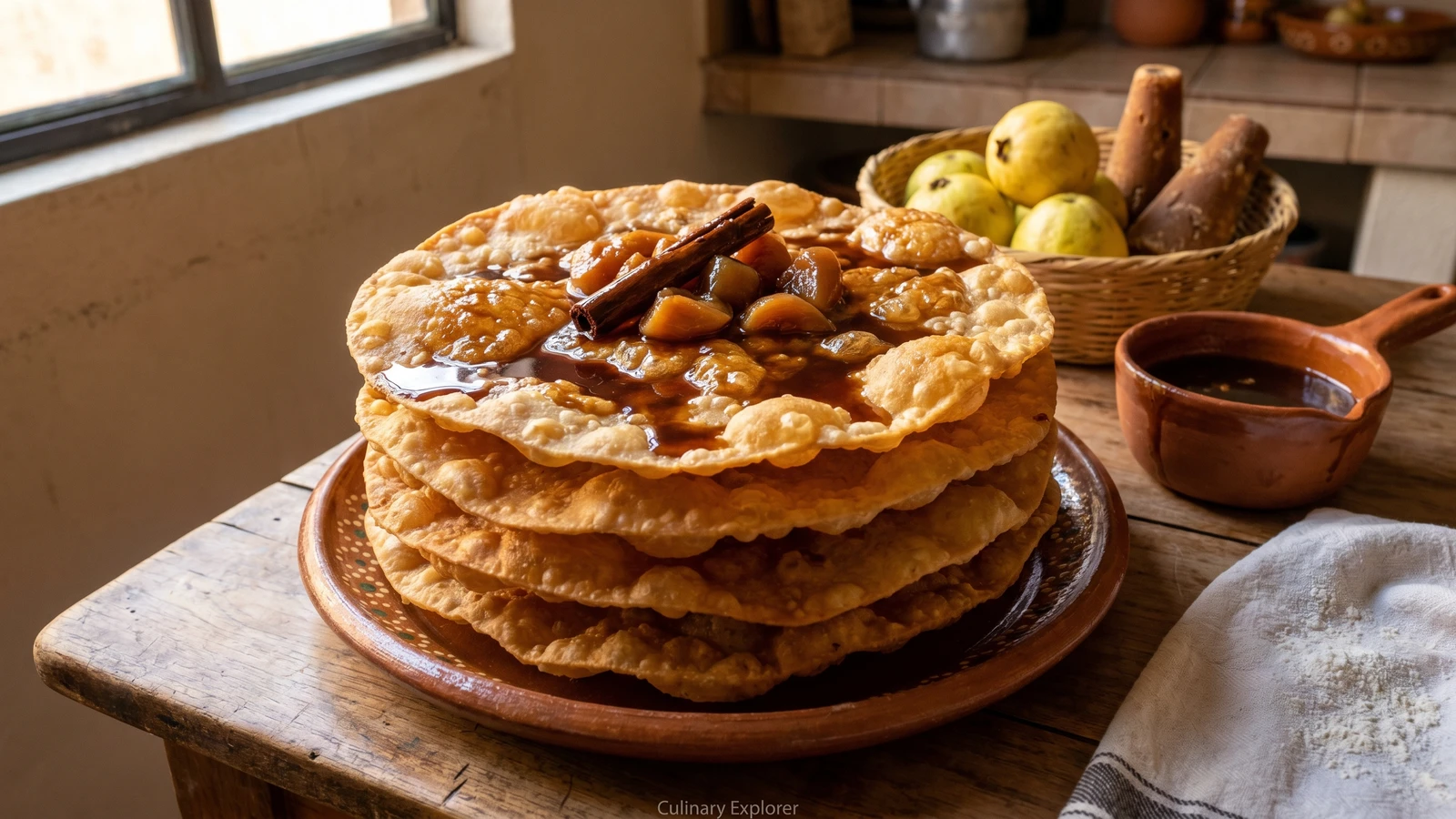
Jalisco's Christmas buñuelos are stretched over the knee until almost transparent, fried crisp in hot oil, then drowned in piloncillo syrup perfumed with guava, cinnamon, and clove.
Jalisco gives you these buñuelos from Guadalajara, from the Christmas stalls near San Juan de Dios, from family kitchens where the table gets dusted with flour and nobody pretends this is a tidy job. This is not a doughnut. It is a thin wheat dough stretched until the light passes through it, fried into a crisp sheet, then served with miel de piloncillo, guava, cinnamon, and clove.
The defining technique is the knee. Buñuelos de rodilla are stretched over a clean cloth-covered knee because the curve gives you a wide, even pull without tearing the dough. I learned it from a señora in Tlaquepaque who worked faster than I could write. She told me, 'If it tears, you were impatient.' She was right. The dough needs rest, and the cook needs discipline.
The syrup matters as much as the frying. Piloncillo gives you dark sugarcane depth, guayaba gives Jalisco its holiday perfume, and canela gives the pot its spine. Don't pour maple syrup on this. No me vengas con atajos. Cada estado, su propia cocina, and this one belongs on a Guadalajara Christmas table, stacked high on a barro canelo platter from Tonalá.
Buñuelos arrived in New Spain through Spanish frying traditions, but Mexican cooks changed them with local sugarcane piloncillo, regional fruit, and holiday ritual. In Jalisco, the large buñuelo de rodilla became tied to Christmas and New Year's street stalls, especially in Guadalajara, Tlaquepaque, and Tonalá, where they are often sold stacked like thin clay plates and served with syrup poured at the table. The use of guava in the syrup reflects western Mexico's winter fruit season, when guayabas appear in markets for ponche, cajeta, and holiday sweets.
Quantity
3 cups, plus more for dusting
Quantity
1 tablespoon
Quantity
1/2 teaspoon
Quantity
1/2 teaspoon
Quantity
2
room temperature
Quantity
3 tablespoons
melted and cooled slightly
Quantity
3/4 cup, plus 1 to 2 tablespoons more if needed
Quantity
1 teaspoon
Quantity
for frying
Quantity
2 cones, about 8 ounces total
chopped
Quantity
3 cups
Quantity
4
quartered
Quantity
1
Quantity
3
Quantity
1 strip
white pith removed
Quantity
1 pinch
| Ingredient | Quantity |
|---|---|
| all-purpose flour | 3 cups, plus more for dusting |
| granulated sugar | 1 tablespoon |
| fine sea salt | 1/2 teaspoon |
| baking powder | 1/2 teaspoon |
| large eggsroom temperature | 2 |
| manteca de cerdomelted and cooled slightly | 3 tablespoons |
| warm water | 3/4 cup, plus 1 to 2 tablespoons more if needed |
| Mexican vanilla extract | 1 teaspoon |
| vegetable oil or fresh pork lard | for frying |
| piloncillo coneschopped | 2 cones, about 8 ounces total |
| water for syrup | 3 cups |
| ripe guavasquartered | 4 |
| Mexican cinnamon stick | 1 |
| whole cloves | 3 |
| orange peelwhite pith removed | 1 strip |
| fine sea salt for syrup | 1 pinch |
Whisk the flour, sugar, salt, and baking powder in a wide bowl. Make a well in the center and add the eggs, melted manteca, warm water, and vanilla. Mix with your hand until a shaggy dough forms. It should feel firm but not dry. If flour remains at the bottom of the bowl, add warm water one tablespoon at a time.
Turn the dough onto a lightly floured table and knead for 8 to 10 minutes. Push it away with the heel of your hand, fold it back, turn it, and repeat. The dough is ready when it feels elastic and smooth, not sticky. This kneading is what lets you stretch it paper-thin later. Skip it and the dough fights you.
Divide the dough into 12 equal balls. Rub each one lightly with oil, cover with a clean kitchen towel, and rest for 30 minutes. The rest relaxes the dough so it stretches instead of snapping back. This is not wasted time. This is the dough learning to behave.
While the dough rests, combine the piloncillo, water, guavas, cinnamon, cloves, orange peel, and pinch of salt in a saucepan. Simmer over medium heat for 25 to 30 minutes, until the piloncillo dissolves and the syrup turns dark amber with soft pieces of guava. Strain if you want a clean syrup, or leave the fruit in if your family likes spooning it over the buñuelos. In Guadalajara, both ways have defenders.
Roll each dough ball on a lightly floured surface into a thin circle, about 8 inches wide. Keep the remaining balls covered while you work. The first round will look too thick. Good. The rolling starts the shape. The knee finishes it.
Cover one knee with a clean cotton towel. Lay one rolled round over the curve of your knee and gently pull the edges outward, rotating as you go, until the dough is 10 to 12 inches wide and thin enough to see light through it. Do not yank. Stretch with patience. If a small hole appears, leave it. A few holes prove a human hand made it.
Lay the stretched rounds on clean towels for 10 to 15 minutes, turning once. They should feel slightly leathery on the surface but still flexible. This short drying helps them blister and crisp in the oil instead of puffing into soft bread. La cocina no es decoración, es trabajo.
Heat 2 inches of oil or fresh lard in a wide heavy pot to 350F. Use a thermometer if you have one. If you don't, drop in a tiny scrap of dough. It should bubble immediately and rise, but not darken in seconds. Fat that is too cool makes greasy buñuelos. Fat that is too hot burns them before they crisp.
Lower one dough sheet into the hot fat. Press the center gently with tongs so it stays mostly flat, then turn once when the underside is golden. Fry 45 to 60 seconds per side, until the buñuelo is crisp, blistered, and the color of toasted wheat. Drain on a rack or paper towels. Repeat with the rest, letting the fat return to 350F between rounds.
Stack the buñuelos on a large platter and pour warm piloncillo syrup over each one at the table, or dip them quickly in the syrup if you want the feria style. Eat them while they are crisp at the edges and soaked in the center. That contrast is the point. Recetas probadas y garantizadas.
1 serving (about 95g)
Culinary guides, cultural storytelling, and the editorial depth that makes cooking meaningful.
Discover Culinary ExplorerChef Lupita
Puebla's convent almond cookies, made from blanched almonds, sugar syrup, egg yolks, canela, and patient hands, the kind of sweet that belongs beside coffee in talavera, not in a plastic bakery box.

Chef Lupita
Ciudad de Mexico's panaderia banderillas are long sticks of hojaldre pressed with sugar, baked until amber, and finished with a hard glaze for coffee at the kitchen table.

Chef Lupita
Mérida's pale egg-yolk-and-vanilla kisses, tiny cookies built on eight yolks and a perfume of orange blossom, sandwiched with guava paste and dusted heavy with powdered sugar.

Chef Lupita
Hidalgo's bisquet de nata carries Pachuca's mining history into the breakfast table: a Cornish-style bread softened by Mexican nata, split warm and eaten with café de olla.