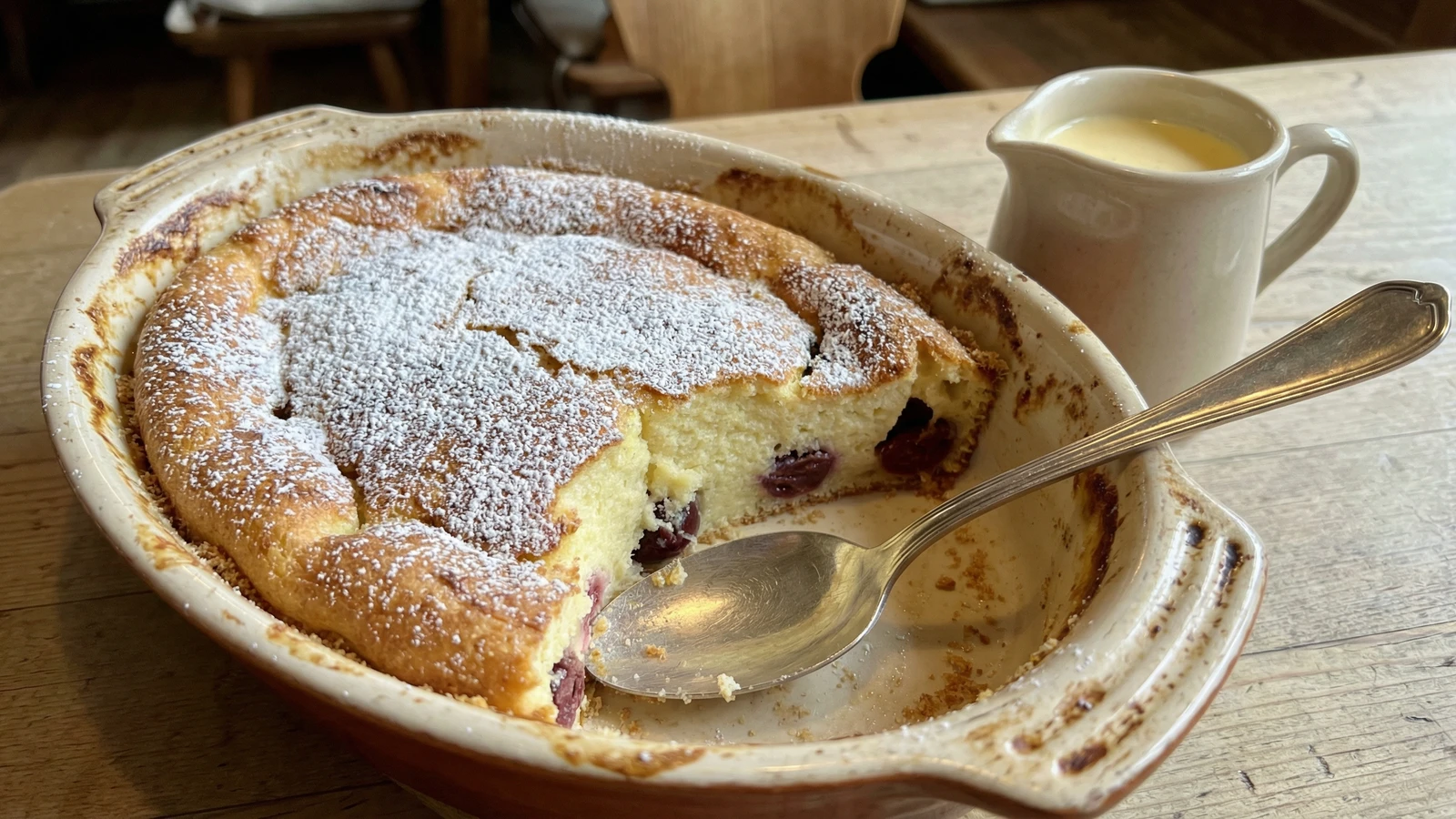
Pillowy semolina soufflé baked golden in a buttered dish, studded with sour cherries and dusted with powdered sugar. The weeknight Mehlspeise that makes the whole kitchen smell like your grandmother's house.
Desserts
Austrian
Weeknight
Comfort Food
25 min
Active Time
35 min cook•1 hr total
Yield4 servings
In my grandmother Eva's kitchen in Kent, Gretel would sometimes look at the clock, look at the cupboard, and decide we were having a Grießauflauf. It wasn't a production. It was what happened when there was milk, eggs, butter, and a bag of semolina. Forty minutes later the kitchen smelled like vanilla and toasted butter, and something golden and trembling came out of the oven.
Grießauflauf belongs to the family of Austrian Aufläufe, baked dishes that puff up in the oven like a soufflé but are far less temperamental. You cook the Grieß (semolina) in milk until it thickens into a soft porridge, stir in egg yolks, butter, lemon zest, and Vanillezucker, then fold in whipped egg whites. That's where the magic is. The whites turn something dense and humble into something that rises and breathes. Pour it into a buttered dish, scatter sour cherries on top if you have them, and let the oven do the rest.
Austrians don't treat Mehlspeisen as afterthoughts. They treat them as meals. Grießauflauf with a warm vanilla sauce and a simple salad is a proper Austrian supper, not a compromise. This is the kind of cooking that reminds you how little you actually need to make something beautiful. Good eggs. Real butter. A hot oven. Patience enough to whip the egg whites properly. That's it.
Aufläufe are part of the vast Austrian Mehlspeisen tradition, flour-based dishes that evolved as both peasant sustenance and bourgeois comfort food across the Habsburg lands. Grießauflauf appears in Austrian cookbooks from the mid-19th century onward, often listed alongside Topfenauflauf and Semmelauflauf as standard Bürgerliche Küche, the respectable home cooking of the middle class. In Austrian households, a Mehlspeise served as a main course on meatless days, particularly Fridays, a tradition that persisted well into the 20th century and gave these sweet baked dishes their central place in the cuisine.
The technique, the tradition, and the story behind every dish.
sour cherries (Weichseln) (optional)pitted, fresh or jarred
150g
fine breadcrumbs
for coating the dish
powdered sugar
for dusting
Equipment Needed
•Heavy-bottomed saucepan (2-liter)
•Baking dish, approximately 24 x 18cm
•Hand mixer or stand mixer for egg whites
•Large spatula for folding
•Fine sieve for powdered sugar
Instructions
1
Cook the semolina
Pour the milk into a heavy saucepan with the butter, salt, and Vanillezucker. Bring it to a gentle simmer over medium heat. When small bubbles appear at the edges and the butter has melted, pour in the semolina in a thin, steady stream while stirring constantly with a wooden spoon. Keep stirring. The moment you stop, the semolina clumps. Reduce the heat to low and cook for about three minutes, stirring all the while, until the mixture thickens into a smooth, dense porridge that pulls away from the sides of the pan. It should look like a very thick Béchamel. Take it off the heat.
Use fine semolina (Weichweizengrieß), not the coarse kind you'd use for pasta. Coarse semolina won't dissolve properly and the texture will be gritty instead of smooth.
2
Enrich with yolks and lemon
Let the semolina mixture cool for five minutes. It needs to come down enough that the egg yolks don't scramble when they hit the pot. Stir in the sugar and lemon zest first, then beat in the egg yolks one at a time, stirring vigorously after each one. The mixture will turn a beautiful pale gold. It should be thick and glossy. Set it aside while you deal with the whites.
3
Whip the egg whites
In a large, spotlessly clean bowl, beat the egg whites with a pinch of salt until they hold stiff, glossy peaks. This is the step that makes or breaks the whole dish. The whites are the only leavening. They're what transforms a bowl of semolina porridge into something that puffs and trembles in the oven. If you turn the bowl upside down and the whites don't move, you're there. If they slump, keep going.
Any trace of fat, any drop of egg yolk in the whites, and they won't whip. Separate the eggs carefully, one at a time, over a small bowl so a single broken yolk doesn't ruin the whole batch.
4
Fold and combine
Stir one third of the whipped whites into the semolina mixture. Don't be gentle with this first addition. You're loosening the base so it's light enough to accept the rest without deflating. Now fold in the remaining whites in two additions. Use a large spatula or metal spoon. Cut down through the center, sweep along the bottom, fold over the top. Rotate the bowl. Repeat until you see no more white streaks, then stop. Every extra fold knocks air out, and air is what you're counting on.
5
Prepare the dish
Preheat your oven to 180°C (350°F). Butter a medium baking dish, about 24 by 18 centimeters, generously. Coat the buttered surface with fine breadcrumbs, tilting the dish so the crumbs cling to the bottom and sides. Tap out the excess. The breadcrumb coating gives the Auflauf a thin, golden crust and keeps it from sticking. If using sour cherries, drain the jarred ones well on kitchen paper. Wet fruit will make the base soggy.
6
Assemble and bake
Pour half the batter into the prepared dish. Scatter the sour cherries evenly over the surface. They'll sink slightly, which is exactly right. You want them nestled in the middle, where every spoonful catches one or two. Pour the remaining batter gently over the top and smooth it with a spatula. Bake for 30 to 35 minutes until the top is risen, golden brown, and just firm when you press the center lightly. The Auflauf will puff up proudly in the oven. It will settle a little when it comes out. That's normal. It's not a soufflé competing for a Michelin star. It's home cooking.
Don't open the oven door for the first 25 minutes. The structure is fragile while it's setting. A rush of cold air will collapse it before the eggs have had time to firm up.
7
Dust and serve
Dust the top generously with powdered sugar through a fine sieve. Serve straight from the dish with a large spoon, while it's still warm and slightly trembling in the center. A jug of warm vanilla sauce alongside is the traditional companion, or a simple spoonful of cold Schlagobers if you prefer. Mahlzeit!
Chef Tips
•Use real Vanillezucker, not vanilla extract. You can make your own by burying a split vanilla pod in a jar of caster sugar for a week. The Vanillezucker gives Mehlspeisen that particular rounded warmth you can't get from extract alone. Gretel always said she could taste the difference across the room.
•If you can't find Weichseln (sour cherries), use jarred Morello cherries, drained very well. Sweet cherries won't work. The sharpness of sour cherries is what cuts through the sweetness of the Auflauf. Without that contrast, the whole dish falls flat. In summer, fresh Weichseln from a farmers' market are the best thing that can happen to this recipe.
•Grießauflauf waits for nobody. Serve it within five minutes of leaving the oven. It's at its most beautiful the moment it comes out: puffed, golden, slightly quivering. Fifteen minutes later it's still delicious, but that glorious rise is gone. Accept the urgency and call everyone to the table before you open the oven door.
•If you're making this without fruit, add an extra teaspoon of lemon zest to the batter. The citrus does some of the same brightening work the cherries would do, keeping the sweetness in balance.
Advance Preparation
•The semolina base can be made up to two hours ahead and left covered at room temperature. Whip the egg whites and fold them in just before baking. Don't try to hold the assembled batter. Once the whites are folded in, it goes straight into the oven.
•Vanilla sauce can be made a day ahead and gently reheated. It thickens in the fridge, so thin it with a splash of milk when you warm it.
•If using jarred sour cherries, drain them onto kitchen paper at least 30 minutes before you need them. The drier they are, the better the Auflauf holds together.
Frequently Asked Questions
Nutrition Information
1 serving (about 255g)
Calories
480 calories
Total Fat
24 g
Saturated Fat
13 g
Trans Fat
0 g
Unsaturated Fat
9 g
Cholesterol
235 mg
Sodium
180 mg
Total Carbohydrates
53 g
Dietary Fiber
2 g
Sugars
31 g
Protein
15 g
Where cooking meets culture.
Culinary guides, cultural storytelling, and the editorial depth that makes cooking meaningful.