
Chef Dimitra
Agrafa Batzina (Μπατζίνα), Courgette and Feta Pie
Agrafa's batzina is the no-phyllo pie of Karditsa: grated courgette, feta, eggs, milk, and flour poured thin into a hot oiled tapsi.
A cooking platform built around craft, culture, and the stories behind what we eat.
Created by
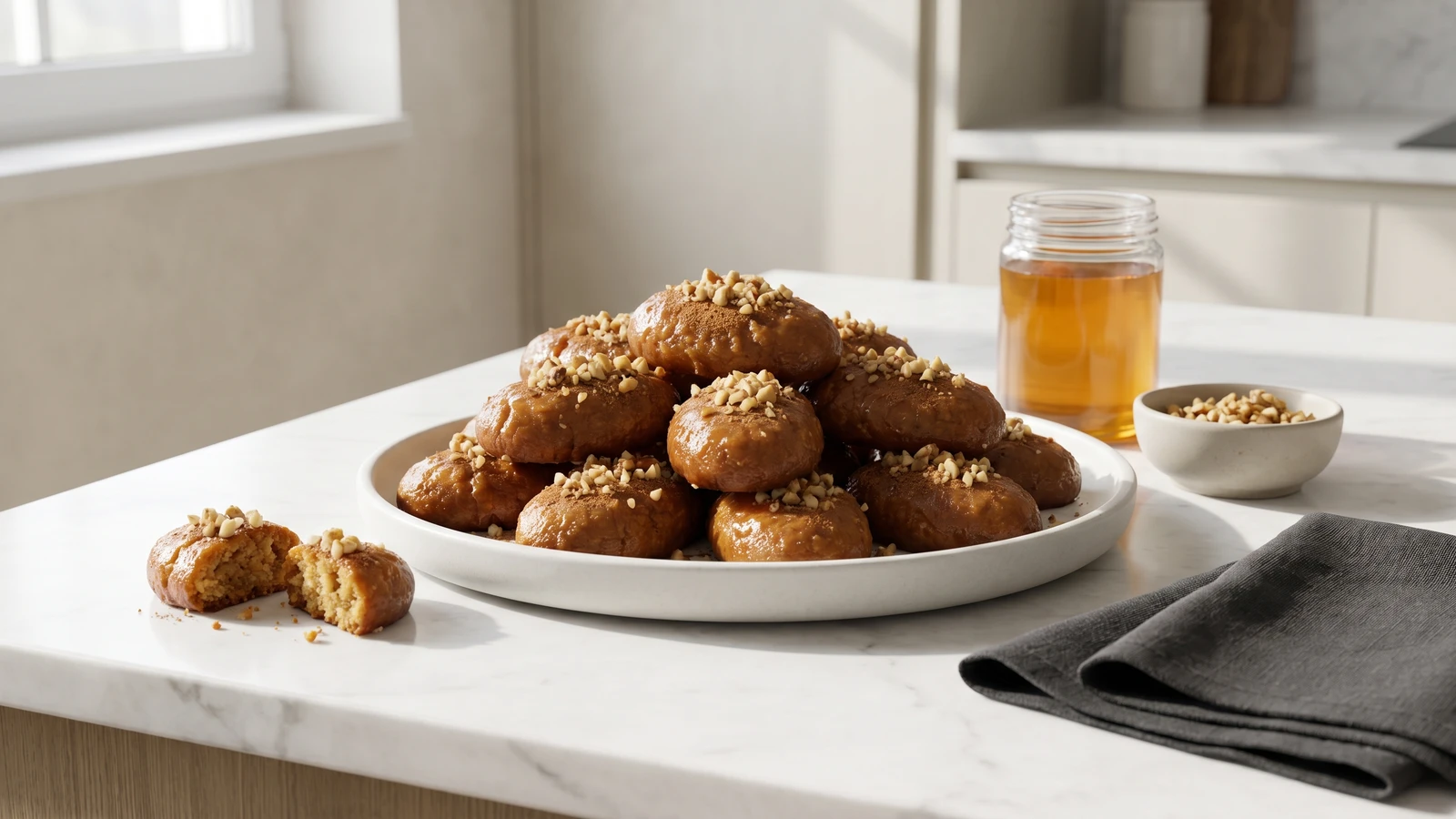
A Greek Macedonian Christmas cookie with orange, semolina, honey syrup, and walnuts. The cookie cools first, the syrup stays hot, and that is how melomakarona drink properly.
Greek Macedonian melomakarona are the Christmas honey cookies of the northern home table: oval olive-oil biscuits, ridged on a grater, scented with orange, cinnamon, and clove, then soaked and buried under walnuts. They are nistisima before the feast, no butter and no eggs, yet they taste rich because the oil carries the spice and the honey finishes the work.
The method that decides them is simple. Bake the cookies until they are deep gold and let them go completely cold. Then dip them into hot syrup, not warm syrup, not a warm cookie. The dry, cold crumb drinks the honey through the ridges and stays tender inside; warm on warm tires the surface before the center has had its share.
I keep the semolina in this version because it gives that faint sandy bite I know from Thessaloniki trays, the one that stops the cookie from becoming cake. Your grandmother cooked by eye because she'd made it a thousand times. Here are the numbers until you have.
Melomakarona sit on the Greek Christmas table partly because their dough is nistisimo, made without egg, butter, or milk, so it fits the Nativity fast that runs until Christmas. The name joins meli, honey, with makaria, an ancient and Byzantine word tied to memorial food; the honey-soaked cookie later became festive rather than funerary. In Asia Minor and Constantinopolitan families the close cousin is finikia, and the arguments over which name belongs to which cookie still follow family lines.
Quantity
500g
Quantity
160g
Quantity
2 tsp
Quantity
1/2 tsp
Quantity
2 tsp
Quantity
1/2 tsp
Quantity
240ml
Quantity
120ml
Quantity
100g
Quantity
2 oranges
finely grated
Quantity
120ml
Quantity
60ml
Quantity
1 tsp
Quantity
350ml
Quantity
300g
Quantity
300g
Quantity
1
Quantity
3
Quantity
1 wide strip
Quantity
160g
finely chopped
Quantity
1/2 tsp
| Ingredient | Quantity |
|---|---|
| all-purpose flour | 500g |
| fine semolina | 160g |
| baking powder | 2 tsp |
| fine sea salt | 1/2 tsp |
| ground cinnamon | 2 tsp |
| ground cloves | 1/2 tsp |
| mild extra virgin Greek olive oil | 240ml |
| sunflower oil or mild Greek olive oil | 120ml |
| caster sugar | 100g |
| orange zestfinely grated | 2 oranges |
| fresh orange juice | 120ml |
| brandy or cognac | 60ml |
| baking soda | 1 tsp |
| water | 350ml |
| granulated sugar | 300g |
| Greek thyme honey | 300g |
| cinnamon stick | 1 |
| whole cloves | 3 |
| orange peel | 1 wide strip |
| walnutsfinely chopped | 160g |
| ground cinnamon, for the walnut topping | 1/2 tsp |
Heat the oven to 180C, or 170C fan. Line two large baking sheets with parchment. Whisk the flour, semolina, baking powder, salt, cinnamon, and cloves in a wide bowl so the spice is evenly carried through the dough.
In a second bowl, whisk the olive oil, sunflower oil, sugar, and orange zest for about 1 minute, just until the sugar begins to dissolve and the mixture smells bright. Stir the baking soda into the orange juice over the bowl, because it will foam up, then add it with the brandy.
Add the dry mixture to the oil mixture in two additions, folding gently with your hand or a spatula. Stop as soon as no dry flour remains. Do not knead it. Melomakarona dough should be soft, oily to the touch, and able to hold an oval without cracking.
Portion the dough into 35g pieces. Roll each one into a small oval, then press the top gently against the large holes of a box grater or a ridged board. The grooves are not decoration only. They catch syrup and hold the walnuts.
Arrange the cookies 3cm apart and bake for 22 to 25 minutes, rotating the trays halfway through, until they are deep golden at the edges and firm underneath. Let them cool completely on the trays, at least 45 minutes. They must be cold before the syrup touches them.
Put the water, sugar, cinnamon stick, cloves, and orange peel in a wide shallow saucepan. Bring to a boil, then simmer for 5 minutes. Lower the heat, add the honey, and stir until it dissolves. Keep the syrup hot at the edge of a simmer.
Drop 4 or 5 cold cookies at a time into the hot syrup. Turn them once and let them drink for 25 to 30 seconds total, a little longer if you made them thicker. Cold cookie, hot syrup. That contrast is what pulls the honey through the crumb without making the outside collapse.
Lift the melomakarona out with a slotted spoon and set them on a rack over a tray for 2 minutes. Move them to a platter while still glossy. Mix the chopped walnuts with the 1/2 tsp cinnamon and press a small mound onto each cookie.
Let the cookies rest at least 4 hours before serving, overnight if you can. The syrup settles, the spice rounds out, and the semolina crumb becomes tender without losing its bite.
1 serving (about 58g)
Culinary guides, cultural storytelling, and the editorial depth that makes cooking meaningful.
Discover Culinary ExplorerChef Dimitra
Agrafa's batzina is the no-phyllo pie of Karditsa: grated courgette, feta, eggs, milk, and flour poured thin into a hot oiled tapsi.

Chef Dimitra
Zagori's flour pie skips phyllo completely: a loose egg-and-flour batter, crumbled feta, and a hot buttered tapsi that makes the edges crisp.

Chef Dimitra
Hydra and Andros give amygdalota their island surname: ground almond, sugar, egg white, and rosewater, baked pale so the center stays soft as marzipan.

Chef Dimitra
Asia Minor ekmek kataifi is built in three clear layers: crisp syruped kataifi, thick semolina custard, and cold kaimaki cream under pistachios.