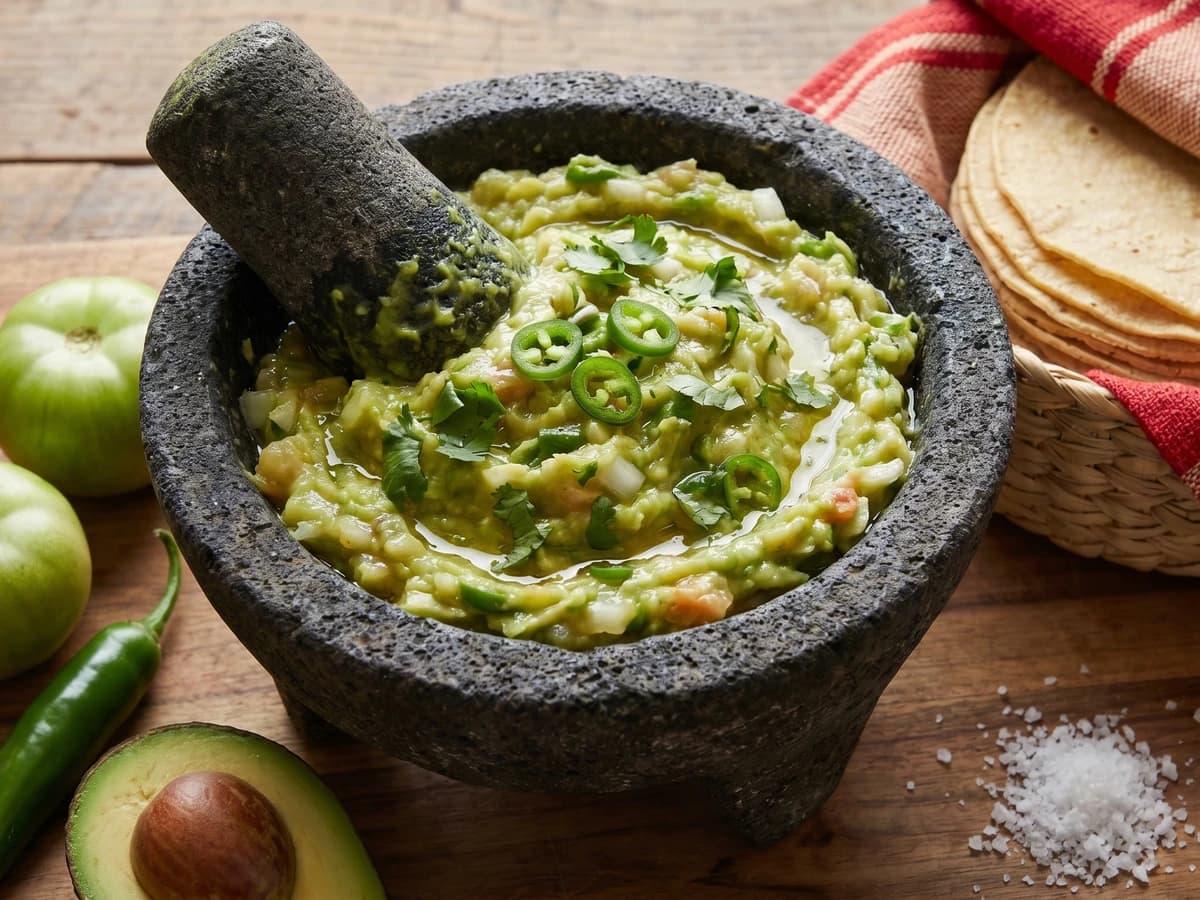
Querétaro's semidesert gordita from Tolimán, made with coarse nixtamal masa, cooked thick on a comal, and split open for frijoles con epazote, nopalitos in guajillo, and queso enchilado.
Appetizers & Snacks
Mexican
Weeknight
Comfort Food
Budget Friendly
35 min
Active Time
45 min cook•1 hr 20 min total
Yield10 gorditas
Querétaro, at Tolimán in the semidesert doorway of the Sierra Gorda, is where these gorditas live. This is Hñähñu and Otomí-Chichimeca corn country, dry, stubborn, and practical. The masa is maíz quebrado: nixtamal cooked with cal and ground coarse so the corn still has tooth. Fine tortilla masa will make a gordita, yes. It will not make this one.
I learned the hand motion from a señora near the Tolimán market who patted the masa thick, turned it slowly on the comal, and opened it with a knife while it was still flexible. She filled hers with frijol bayo and epazote, nopalitos in chile guajillo, and a little queso enchilado. No cheddar, no sour cream, no nonsense. The semidesert gives you nopal, corn, beans, chiles, and patience. That is plenty.
Do not press these thin. A tortilla is supposed to bend. A gordita de maíz quebrado is supposed to hold its pocket and show those rough grains at the edge. My mother's notebook from Jalisco had no page for this, so I wrote it after that trip, with one line underlined twice: cook the center before you split it. Cada estado, su propia cocina.
Tolimán is part of Querétaro's Otomí-Chichimeca semidesert territory, whose places of memory and living traditions were inscribed by UNESCO in 2009 as the 'Places of Memory and Living Traditions of the Otomí-Chichimecas of Tolimán: the Peña de Bernal, Guardian of a Sacred Territory.' Maíz quebrado carries a pre-Hispanic Mesoamerican technique: corn is nixtamalized with cal, rinsed, then martajado, cracked on a metate or in a mill instead of ground smooth. The result separates this central Mexican corn gordita from the wheat gorditas of the north, a useful reminder that this is a 32-state cuisine.
The technique, the tradition, and the story behind every dish.
made from white or yellow criollo nixtamal, at room temperature
warm water
Quantity
1/2 cup, plus more as needed
manteca de cerdo
Quantity
3 tablespoons
melted but not hot, for the masa
fine sea salt
Quantity
1 1/2 teaspoons, plus more to taste
dried chile guajillo
Quantity
4
stemmed and seeded
dried chile ancho
Quantity
1
stemmed and seeded
dried chile de árbol (optional)
Quantity
1
stemmed
hot water
Quantity
as needed
for soaking chiles
Roma tomatoes
Quantity
2
halved
garlic cloves
Quantity
2
unpeeled
white onion
Quantity
1/4 medium
for roasting
dried Mexican oregano
Quantity
1/2 teaspoon
nopales paddles
Quantity
4
spines removed and diced
manteca de cerdo
Quantity
3 tablespoons
divided, for the guisos and comal
white onion
Quantity
1/2 small
finely chopped
cooked frijol bayo or Flor de Mayo beans
Quantity
2 cups beans plus 1/2 cup broth
fresh epazote
Quantity
1 sprig
queso enchilado or queso fresco seco
Quantity
1/2 cup
crumbled
chopped cilantro (optional)
Quantity
for serving
lime halves (optional)
Quantity
for serving
Ingredient
Quantity
fresh masa de maíz quebradomade from white or yellow criollo nixtamal, at room temperature
2 pounds
warm water
1/2 cup, plus more as needed
manteca de cerdomelted but not hot, for the masa
3 tablespoons
fine sea salt
1 1/2 teaspoons, plus more to taste
dried chile guajillostemmed and seeded
4
dried chile anchostemmed and seeded
1
dried chile de árbol (optional)stemmed
1
hot waterfor soaking chiles
as needed
Roma tomatoeshalved
2
garlic clovesunpeeled
2
white onionfor roasting
1/4 medium
dried Mexican oregano
1/2 teaspoon
nopales paddlesspines removed and diced
4
manteca de cerdodivided, for the guisos and comal
3 tablespoons
white onionfinely chopped
1/2 small
cooked frijol bayo or Flor de Mayo beans
2 cups beans plus 1/2 cup broth
fresh epazote
1 sprig
queso enchilado or queso fresco secocrumbled
1/2 cup
chopped cilantro (optional)
for serving
lime halves (optional)
for serving
Equipment Needed
•Cast iron comal or clay comal, well seasoned
•Blender or volcanic stone molcajete for the salsa
•Wide skillet for nopales and frijoles
•Thin sharp knife for opening the gorditas
•Metate or hand-cranked nixtamal mill if making masa quebrada from scratch
Instructions
1
Season the masa
Put the masa de maíz quebrado in a wide bowl. Sprinkle in the salt, pour in the melted manteca de cerdo, and knead with your fingers. Add the warm water a tablespoon at a time until the masa feels damp and coarse but holds together when squeezed. Cracked corn drinks slowly. Cover with a kitchen towel and rest for 15 minutes.
At the molino, ask for masa quebrada, masa martajada, or masa para gorditas. Regular fine tortilla masa is smooth. This dish needs texture. A substitution is a compromise, not an upgrade.
2
Toast the salsa base
Heat a dry comal over medium. Toast the chile guajillo for about 20 seconds per side, the chile ancho for 20 to 30 seconds per side, and the chile de árbol for 8 to 10 seconds if using. They should smell deep and fruity, never scorched. Put them in a bowl and cover with hot water for 15 minutes. On the same comal, roast the tomatoes, garlic, and onion until blistered in spots. Peel the garlic.
3
Cook the nopales
Put the diced nopales in a wide skillet with a pinch of salt. Cook over medium-high heat, stirring often, until their liquid releases, thickens, and cooks away, about 8 to 10 minutes. The pieces should turn olive green with dry edges. Do not rinse them after cooking. You worked for that flavor.
4
Fry the guajillo salsa
Drain the soaked chiles. Blend them with the roasted tomatoes, peeled garlic, roasted onion, Mexican oregano, 1/2 teaspoon salt, and 1/2 cup of the chile soaking water until smooth. Melt 1 tablespoon manteca de cerdo in the skillet. Add the salsa and cook, stirring, until it darkens and small beads of fat appear at the edges, 5 to 6 minutes. Stir in the cooked nopales and simmer 4 minutes more.
5
Refry the beans
Melt 1 tablespoon manteca de cerdo in a skillet over medium heat. Add the chopped white onion and cook until translucent. Add the frijol bayo with its broth and the epazote sprig. Mash with the back of a spoon until thick and spreadable, 6 to 8 minutes. Remove the epazote. The beans must not be runny. If they leak out of the gordita, the cook was impatient.
6
Shape the gorditas
Divide the rested masa into 10 balls, about the size of a small lime. Wet your hands lightly and pat each ball into a disk 4 to 4 1/2 inches wide and about 1/2 inch thick. Smooth the cracked edges with your fingers. Keep the shaped gorditas covered while you heat the comal.
Do not press them thin. If you use a tortilla press, use it only to start the shape, then finish by hand. A gordita needs thickness so it can open into a pocket. Así se hace y punto.
7
Griddle slowly
Heat the comal over medium-low and brush it with a very thin film of manteca de cerdo. Lay on the gorditas without crowding. Cook 5 to 6 minutes on the first side, then 4 to 5 minutes on the second, flipping once or twice more until the surfaces have toasted freckles, the edges look dry, and the centers feel set when pressed. Maíz quebrado needs a slower fire than a tortilla. Rush it and the outside browns while the middle stays raw.
If the gordita darkens before the edge dries, lower the heat. The comal should cook the corn through, not punish it.
8
Split and fill
While each gordita is still warm and flexible, hold it in a clean towel and open a pocket with a thin knife, cutting only three-quarters of the way around. Spread in a spoonful of refried frijol bayo, add nopalitos in guajillo salsa, and finish with crumbled queso enchilado. Return the filled gorditas to the edge of the comal for 1 to 2 minutes if you want the outside firmer. Serve with cilantro and lime if you like. Eat them by hand over a plate. Recetas probadas y garantizadas.
Chef Tips
•The masa is the dish. If you cannot find masa de maíz quebrado, ask a tortillería or molino to grind nixtamal coarse, not fine. Say martajada. If they look confused, find another molino. Si no conoces el mercado, no conoces la cocina.
•Frijol bayo and Flor de Mayo belong to the Bajío table. Black beans are good beans, but they pull the flavor toward the Gulf and the south. Here, use the pale beans if you can.
•Chile guajillo gives color and clean red fruit. Chile ancho gives body. Chile de árbol is optional because this dish is not about proving you can suffer. Not all Mexican food is hot.
•Use manteca de cerdo. The coarse masa browns better, the beans taste complete, and the comal gives you that faint crisp edge. La manteca es el sabor.
•At Tolimán stands you will also see fillings of migajas, chicharrón prensado, rajas, and queso. This frijol, nopal, and guajillo version is the weeknight one: cheap, filling, and still regional.
Advance Preparation
•The frijol bayo can be cooked up to 3 days ahead. Keep the cooking broth because it gives the refried beans body. Water does not taste like beans. No me vengas con atajos.
•To make masa de maíz quebrado from dry corn, nixtamalize 1 pound white or yellow field corn with 1 tablespoon food-grade cal, simmer 25 minutes, soak overnight, rinse well, and grind coarse the next day. That adds an overnight rest, but it gives you the real texture.
•The guajillo salsa and nopales can be cooked one day ahead. Reheat them in a spoonful of manteca before filling the gorditas.
Frequently Asked Questions
Nutrition Information
1 serving (about 195g)
Calories
335 calories
Total Fat
11 g
Saturated Fat
4 g
Trans Fat
0 g
Unsaturated Fat
6 g
Cholesterol
10 mg
Sodium
600 mg
Total Carbohydrates
49 g
Dietary Fiber
9 g
Sugars
3 g
Protein
9 g
Where cooking meets culture.
Culinary guides, cultural storytelling, and the editorial depth that makes cooking meaningful.