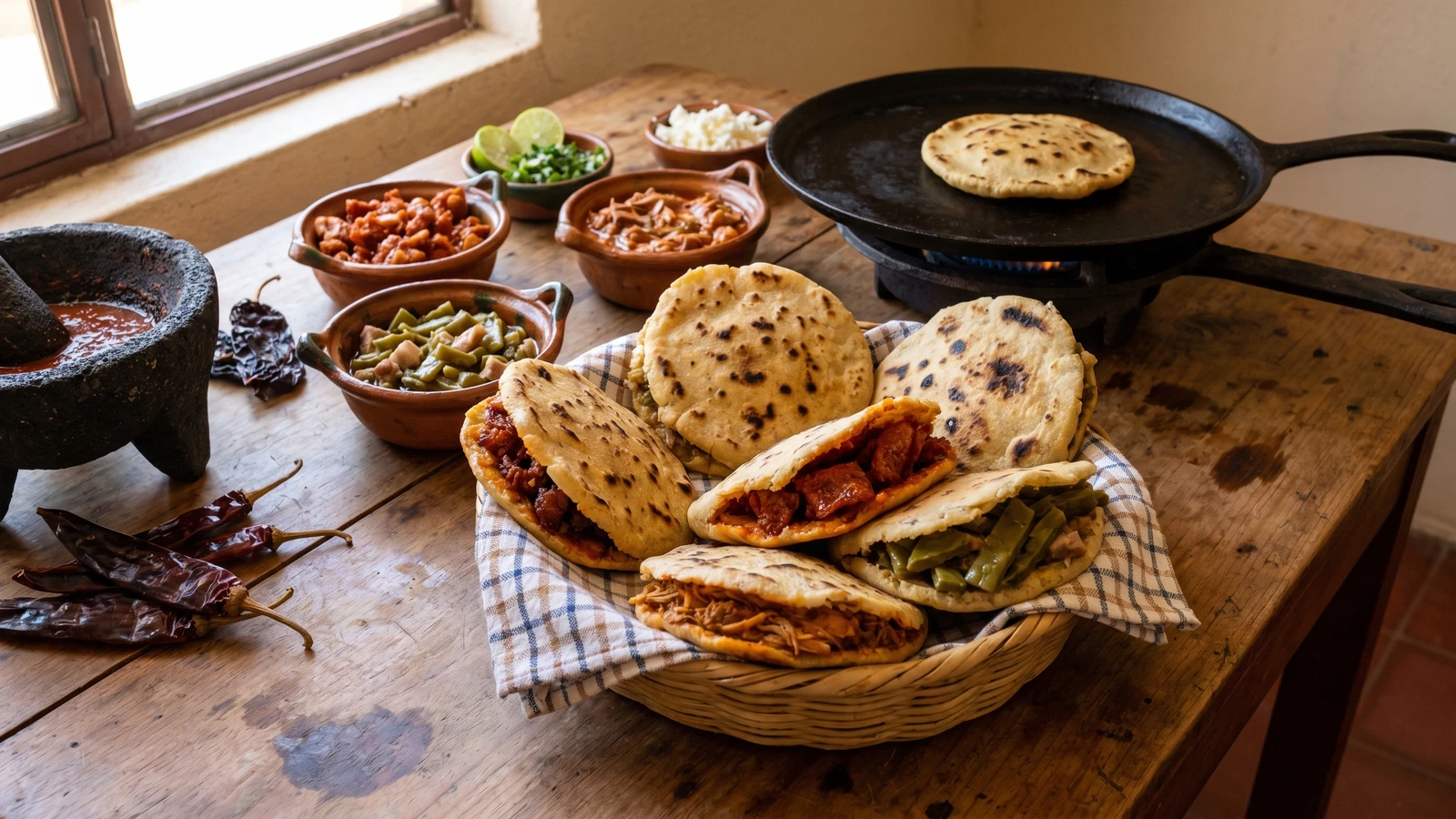
Aguascalientes gives Calvillo these thick corn gorditas, browned on the comal, opened while hot, and filled with guisos that belong to the market counter.
Appetizers & Snacks
Mexican
Weeknight
Comfort Food
Outdoor Dining
50 min
Active Time
1 hr 10 min cook•2 hr total
Yield12 gorditas
Aguascalientes, specifically Calvillo, sits in that dry Bajío country where corn, pork, nopales, and chile ancho do daily work without asking for applause. These gorditas live in the mercado and at the roadside stand, not on a white plate. You press the masa thick, cook it on the comal, open it with a small knife, and fill it with a guiso that has enough body to stay inside.
Calvillo is known for guayaba, yes, but do not reduce the town to fruit. The gorditas are its working food. At the stalls, women keep cazuelas of chicharrón rojo, tinga, rajas, frijoles, and nopales con puerco ready for the noon rush. The masa is not a tortilla. It is thicker, a little tender from manteca de cerdo, and it has to puff enough to make a pocket. If it cracks, your masa is dry. If it bends like a tortilla, you pressed it too thin.
Doña Jeni's lesson is the practical one: the filling must be seasoned more firmly than you think because the masa softens everything. Chile ancho gives the chicharrón rojo its brick color and sweet depth. Chile guajillo keeps it bright. The comal does the rest. Cada estado, su propia cocina.
Gorditas are part of Mexico's older corn-cake family, descended from pre-Columbian masa preparations cooked on clay or stone comales before the Spanish introduced pork and lard. In Aguascalientes, especially Calvillo, the modern stuffed gordita became a market and roadside food in the 20th century, built around cazuelas of guisos that could be held warm and served quickly. The state's position between Jalisco, Zacatecas, and Guanajuato explains the Bajío character of the fillings: pork, nopales, chile ancho, chile guajillo, and beans, not the northern flour tortilla tradition.
The technique, the tradition, and the story behind every dish.
•Cotton servilleta and basket for holding warm gorditas
Instructions
1
Mix the masa
Combine the masa harina, warm water, softened manteca de cerdo, and fine salt in a wide bowl. Knead with your hand for 3 to 4 minutes until the masa feels smooth and soft, like a warm earlobe. Press a little between your palms. If the edge cracks, add water one tablespoon at a time. If it sticks heavily, dust in a little more masa harina. Cover with a damp towel and rest 20 minutes.
2
Toast the chiles
Heat a dry comal over medium. Toast the chile ancho and chile guajillo separately, about 20 to 30 seconds per side, just until they darken slightly and smell deep. Do not blacken them. Burned chile makes bitter salsa and nobody at the Calvillo mercado would forgive that. Soak the toasted chiles in hot water for 15 minutes, then drain.
3
Blend the rojo
Blend the soaked chiles with the roasted tomatoes, peeled roasted garlic, roasted onion, Mexican oregano, salt, and 3/4 cup water until completely smooth. Strain if your blender leaves chile skin behind. Melt 1 tablespoon manteca de cerdo in a cazuela or skillet, pour in the salsa, and fry it 6 to 8 minutes until it thickens and the red turns brick-colored.
4
Make chicharrón rojo
Add the broken chicharrón to the fried salsa and stir until every piece is coated. Cook 5 minutes, just until the chicharrón softens but still has some chew. The filling should be thick, not soupy. A watery guiso leaks out of the gordita and makes a mess of the comal. Taste for salt and hold warm.
5
Cook the pork
Put the pork shoulder in a small pot with the half onion, garlic clove, bay leaf, salt, and enough water to cover by one inch. Simmer gently for 35 to 45 minutes, until the pork is tender but not falling apart. Lift out the pork and chop it small. Save 1/2 cup of the broth. That broth carries the pork flavor. Do not throw it away like someone who doesn't know the kitchen.
6
Finish nopales pork
Cook the diced nopales in salted water for 8 minutes, until their color turns deep green and most of the slime loosens. Drain and rinse briefly. Melt 2 tablespoons manteca de cerdo in a skillet, add the chopped onion and chile serrano, and cook until the onion softens. Add the tomato, chopped pork, nopales, cilantro, and reserved pork broth. Cook until the mixture is moist but not runny. Taste for salt.
7
Make the tinga
Blend the roasted tomatoes with the chipotle chile en adobo, adobo sauce, Mexican oregano, and salt. Melt 2 tablespoons manteca de cerdo in a skillet and cook the sliced onion until soft and lightly golden at the edges. Add the tomato-chipotle sauce and fry 5 minutes. Stir in the shredded chicken and cook until the sauce clings to the meat. Tinga should be juicy, not wet.
8
Shape the gorditas
Divide the rested masa into 12 balls, about the size of a small lime. Press each one between plastic sheets in a tortilla press to about 1/4 inch thick and 4 inches wide. Do not press them tortilla-thin. A Calvillo gordita needs enough body to split open. Smooth any cracked edges with damp fingers.
9
Cook on comal
Heat the comal over medium. Rub it lightly with manteca de cerdo. Cook the gorditas in batches for 3 to 4 minutes per side, turning once or twice, until they have brown freckles and feel set. They should puff slightly in spots. If they scorch before cooking through, the comal is too hot. Lower the heat and give the masa time.
10
Open and fill
While each gordita is still hot, hold it in a folded towel and cut a pocket along one edge with a small sharp knife. Do not cut all the way through. Fill with chicharrón rojo, tinga, or nopales con puerco. Add queso fresco if you want it, a spoon of salsa roja if the guiso asks for it, and lime at the table. Serve immediately, stacked in a basket lined with a cotton servilleta. Así se hace y punto.
Chef Tips
•Use fresh masa from a tortillería if you can get it. Ask for masa para tortillas, not masa preparada for tamales. If you use fresh masa, start with 2 pounds and knead in the manteca de cerdo and salt. Si no conoces el mercado, no conoces la cocina.
•The chicharrón must be pressed pork chicharrón, the dense kind sold in sheets or thick pieces, not airy snack chicharrones from a bag. The snack kind collapses into nothing.
•If nopales are out of season or look tired, choose another filling. Mexican cooks work with what the mercado gives them today. Use rajas con crema, frijoles refritos, or papa con chorizo instead.
•The gordita is cooked first and filled after. Some regions stuff the raw masa before cooking, but this Calvillo market style is opened like a pocket. Cada estado, su propia cocina.
•Do not replace the manteca de cerdo with butter. Butter tastes like butter. These gorditas need pork fat because the fillings are pork and chile, and the masa has to speak the same language.
Advance Preparation
•The chicharrón rojo, tinga, and nopales con puerco can be made one day ahead and refrigerated separately. Reheat gently in cazuelas with a splash of water or broth so they return to a spoonable texture.
•The masa can be mixed up to 4 hours ahead. Keep it covered with a damp towel so it does not dry out. If it cracks when you shape it, knead in a little warm water.
•Cooked unfilled gorditas can be held for 30 minutes wrapped in a servilleta, then reheated on the comal before opening and filling. Filled gorditas should be eaten right away.
Frequently Asked Questions
Nutrition Information
1 serving (about 210g)
Calories
455 calories
Total Fat
25 g
Saturated Fat
9 g
Trans Fat
0 g
Unsaturated Fat
14 g
Cholesterol
75 mg
Sodium
805 mg
Total Carbohydrates
39 g
Dietary Fiber
7 g
Sugars
5 g
Protein
21 g
Where cooking meets culture.
Culinary guides, cultural storytelling, and the editorial depth that makes cooking meaningful.