
Chef Elsa
Eiersalat (Austrian Egg Salad)
Cool, creamy Austrian egg salad with sour gherkins and tart apple in a mustard-yogurt dressing, the kind of honest Jause food that tastes like an Austrian Easter table and works beautifully all year round.
A cooking platform built around craft, culture, and the stories behind what we eat.
Created by
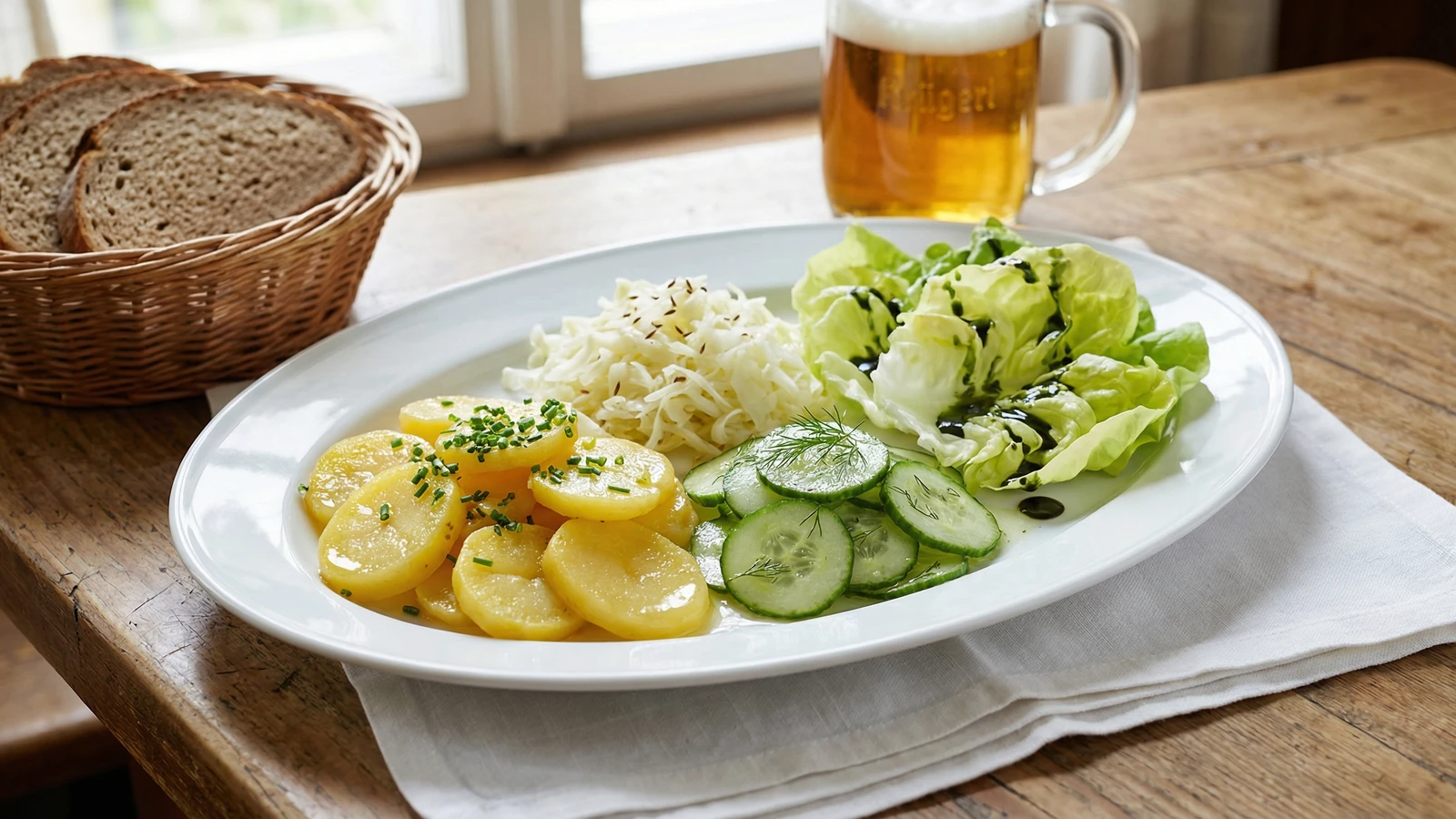
Four Austrian salads on one plate: warm potato salad dressed with beef broth, paper-thin cucumber in vinegar, caraway-scented cabbage, and tender greens with a drizzle of dark Styrian Kürbiskernöl. The Beisl tradition that turns a Schnitzel into a proper meal.
Order any main course at a Beisl in Vienna or Salzburg and the Gemischter Salat appears alongside it without you asking. It's not on the bill as an extra. It's not optional. A Schnitzel without its salad plate is like coffee without the glass of water. Incomplete. Almost rude.
Gemischter Salat translates to mixed salad, but nothing here is mixed. Four different salads sit side by side on a single plate, each dressed separately, each its own temperature and texture. Warm Erdäpfelsalat, the potato salad dressed with hot beef broth that Gretel always said was the true test of an Austrian cook. Paper-thin Gurkensalat, cool and sharp with vinegar. Caraway-scented Krautsalat that gets better the longer it sits. A few leaves of Häuptelsalat (butter lettuce) in a snappy Marinade, maybe finished with a drizzle of dark Steirisches Kürbiskernöl if the kitchen is feeling generous. Every component simple. Together, they make the main course complete.
The secret, if you can call it that, is the Marinade. Austrian salad dressing is vinegar-forward, barely any oil, a pinch of sugar for balance. If your dressing tastes like olive oil with a splash of vinegar, you've got it backwards. And the other secret is temperature: the Erdäpfelsalat must be dressed while the potatoes are still warm, with broth that's still hot. Warm starch absorbs liquid. Cold starch refuses to. Miss that window and you'll have dry, sad potatoes sitting in a puddle of broth they won't drink. I've watched guests in my restaurant in Salzburg take their first bite of properly dressed Erdäpfelsalat, the potatoes still warm, glossy with broth and mustard, and I can see the exact moment they understand that everything they thought they knew about potato salad was wrong.
The Beisl, Vienna's neighborhood tavern, takes its name from the Yiddish 'bajis' (house), and the tradition of serving a Gemischter Salat alongside every main course has been part of Beisl culture since at least the mid-19th century. Austrian Erdäpfelsalat stands apart from potato salads elsewhere in Europe through its use of hot beef broth as the primary dressing liquid, a technique that exploits the ability of warm starch to absorb flavor deeply and evenly. The insistence on keeping each salad component separate on the plate, never tossed together, reflects a Viennese culinary philosophy: every ingredient deserves its own preparation, its own dressing, and its own moment on the palate.
Quantity
750g
Quantity
200ml
heated until very hot
Quantity
1 small
very finely diced
Quantity
3 tablespoons
Quantity
2 tablespoons
Quantity
1 teaspoon
Quantity
to taste
Quantity
small bunch
finely cut
Quantity
1 large
Quantity
1 teaspoon
Quantity
2 tablespoons
Quantity
1 tablespoon
Quantity
pinch
Quantity
to taste
Quantity
1 tablespoon
chopped
Quantity
1/2 medium head, about 400g
Quantity
1 teaspoon
Quantity
2 tablespoons
Quantity
1 tablespoon
Quantity
1/2 teaspoon
Quantity
pinch
Quantity
1 head
Quantity
2 tablespoons
Quantity
1 tablespoon
Quantity
pinch each
Quantity
for drizzling
| Ingredient | Quantity |
|---|---|
| festkochende (waxy) potatoes such as Kipfler or Charlotte | 750g |
| good beef brothheated until very hot | 200ml |
| onion (for Erdäpfelsalat)very finely diced | 1 small |
| Apfelessig (apple cider vinegar, for Erdäpfelsalat) | 3 tablespoons |
| sunflower oil (for Erdäpfelsalat) | 2 tablespoons |
| medium-hot mustard | 1 teaspoon |
| salt and freshly ground black pepper | to taste |
| fresh chivesfinely cut | small bunch |
| cucumber (for Gurkensalat) | 1 large |
| fine salt (for draining cucumber) | 1 teaspoon |
| white wine vinegar (for Gurkensalat) | 2 tablespoons |
| sunflower oil (for Gurkensalat) | 1 tablespoon |
| sugar (for Gurkensalat) | pinch |
| freshly ground white pepper | to taste |
| fresh dill (for Gurkensalat) (optional)chopped | 1 tablespoon |
| white cabbage (for Krautsalat) | 1/2 medium head, about 400g |
| fine salt (for Krautsalat) | 1 teaspoon |
| white wine vinegar (for Krautsalat) | 2 tablespoons |
| sunflower oil (for Krautsalat) | 1 tablespoon |
| caraway seeds | 1/2 teaspoon |
| sugar (for Krautsalat) | pinch |
| butter lettuce (Häuptelsalat) | 1 head |
| Hesperidenessig or white wine vinegar (for greens) | 2 tablespoons |
| sunflower oil (for greens) | 1 tablespoon |
| sugar and salt (for greens) | pinch each |
| Steirisches Kürbiskernöl g.g.A. (Styrian pumpkin seed oil) (optional) | for drizzling |
Put the potatoes into a large pot of well-salted cold water, unpeeled. Bring to a boil, then reduce to a steady simmer. Cook until a knife slides in with no resistance but the potato doesn't crumble, about twenty to twenty-five minutes depending on size. Start checking early. Overcooked potatoes fall apart when you slice them and you'll end up with a paste instead of a salad. Drain and let them cool just enough to handle, five minutes at most. You want them warm, not cool.
Peel the warm potatoes using a small knife or your fingers (a clean kitchen towel helps). Slice them about four millimeters thick, directly into a wide bowl. They should still be giving off warmth. In a small saucepan, heat your beef broth until it's properly hot, not just warm. Pour the hot broth over the warm potato slices. This is the moment that makes or breaks Austrian potato salad. Warm starch opens up and drinks the broth in. Cold starch locks its doors. You'll see the slices absorb the liquid within minutes. Add the finely diced onion, mustard, vinegar, sunflower oil, salt, and pepper. Fold everything together gently with a spatula, not a spoon, so the slices stay whole. Let the salad rest at room temperature for at least thirty minutes. Longer is better. Taste and adjust the seasoning before serving, because potatoes absorb salt as they sit. Scatter the chives over the top.
Wash the cucumber but don't peel it. Slice it as thin as you possibly can. A mandoline is ideal. You're aiming for translucent, the kind of thin where you can nearly see light through each slice. If you're using a knife, take your time and focus. Thick cucumber salad is not Gurkensalat. It's something else, something less good. Put the slices in a colander set over a bowl, sprinkle with the teaspoon of fine salt, toss to distribute, and let them sit for twenty to thirty minutes. The salt draws out the water that would otherwise dilute your dressing into nothing.
After the cucumber has drained, squeeze the slices gently in handfuls to press out as much liquid as you can. Don't crush them, but be firm. Put them in a clean bowl. Add the white wine vinegar, sunflower oil, pinch of sugar, and white pepper. Toss gently. The dressing should be sharp and bright, with the sugar just rounding the edges of the vinegar, never making it sweet. Add the chopped dill if using. Taste it. The Gurkensalat should make your mouth water. Cover and refrigerate until you're ready to plate. This salad is best served cool.
Quarter the cabbage half, cut out the core, and shred it as finely as your knife and your patience allow. Thin, even ribbons. Put the shredded cabbage in a large bowl, add the teaspoon of salt, and work it through with your hands, squeezing and massaging the cabbage for two or three minutes. You'll feel it start to soften and release moisture. This is the same principle as the cucumber: drawing out water so the dressing can get in. Add the white wine vinegar, sunflower oil, caraway seeds, pinch of sugar, and a grind of black pepper. Toss well. Cover and let it sit for at least an hour. The caraway perfumes the cabbage slowly, and the vinegar softens the shreds into something silky. Krautsalat made an hour ago is good. Krautsalat made the night before is better.
Wash and dry the butter lettuce leaves carefully. Tear the larger leaves into pieces you'd want on a fork. In a small bowl, whisk together the Hesperidenessig (or white wine vinegar), sunflower oil, pinch of sugar, and pinch of salt. Taste it. It should be noticeably vinegar-forward, bright and snappy, not oily. This is Austrian Marinade: the vinegar leads, the oil follows, the sugar balances. Do not dress the leaves until the moment you're ready to plate. Butter lettuce wilts in vinegar within seconds and there's no bringing it back.
Toss the lettuce with just enough Marinade to coat each leaf lightly. Arrange the four salads in separate sections on a large oval plate or in individual small bowls on a tray. The Erdäpfelsalat goes on at room temperature, glossy and soft. The Gurkensalat comes from the fridge, cool and sharp. The Krautsalat sits at room temperature, silky and fragrant with caraway. The Häuptelsalat goes on last, freshly dressed. If you have Steirisches Kürbiskernöl, drizzle a thin stream of it over the greens or the Erdäpfelsalat. It will pool in dark green ribbons against the lettuce. Don't stir it in. Let it sit on the surface where you can taste it with each bite. Serve alongside Wiener Schnitzel, Tafelspitz, Backhendl, or any Austrian main course that's waiting for its other half. Mahlzeit!
1 serving (about 400g)
Culinary guides, cultural storytelling, and the editorial depth that makes cooking meaningful.
Discover Culinary ExplorerChef Elsa
Cool, creamy Austrian egg salad with sour gherkins and tart apple in a mustard-yogurt dressing, the kind of honest Jause food that tastes like an Austrian Easter table and works beautifully all year round.

Chef Elsa
Bitter curly endive wilted just so by a warm dressing of rendered Speck, sharp vinegar, and a touch of mustard, the kind of salad that makes a roast pork dinner feel complete.

Chef Elsa
Warm broth-soaked potatoes and crispy Speck over tender Vogerlsalat, finished with a drizzle of dark Steirisches Kürbiskernöl and a soft-boiled egg that ties the whole bowl together.

Chef Elsa
Tender Austrian green beans dressed in warm Marinade the moment they leave the pot, absorbing every drop of vinegar and oil while they cool into something far greater than the sum of their parts.