Culinary Explorer

A cooking platform built around craft, culture, and the stories behind what we eat.
Discover Culinary Explorer
Garnachas Istmeñas

Garnachas Istmeñas

Created by

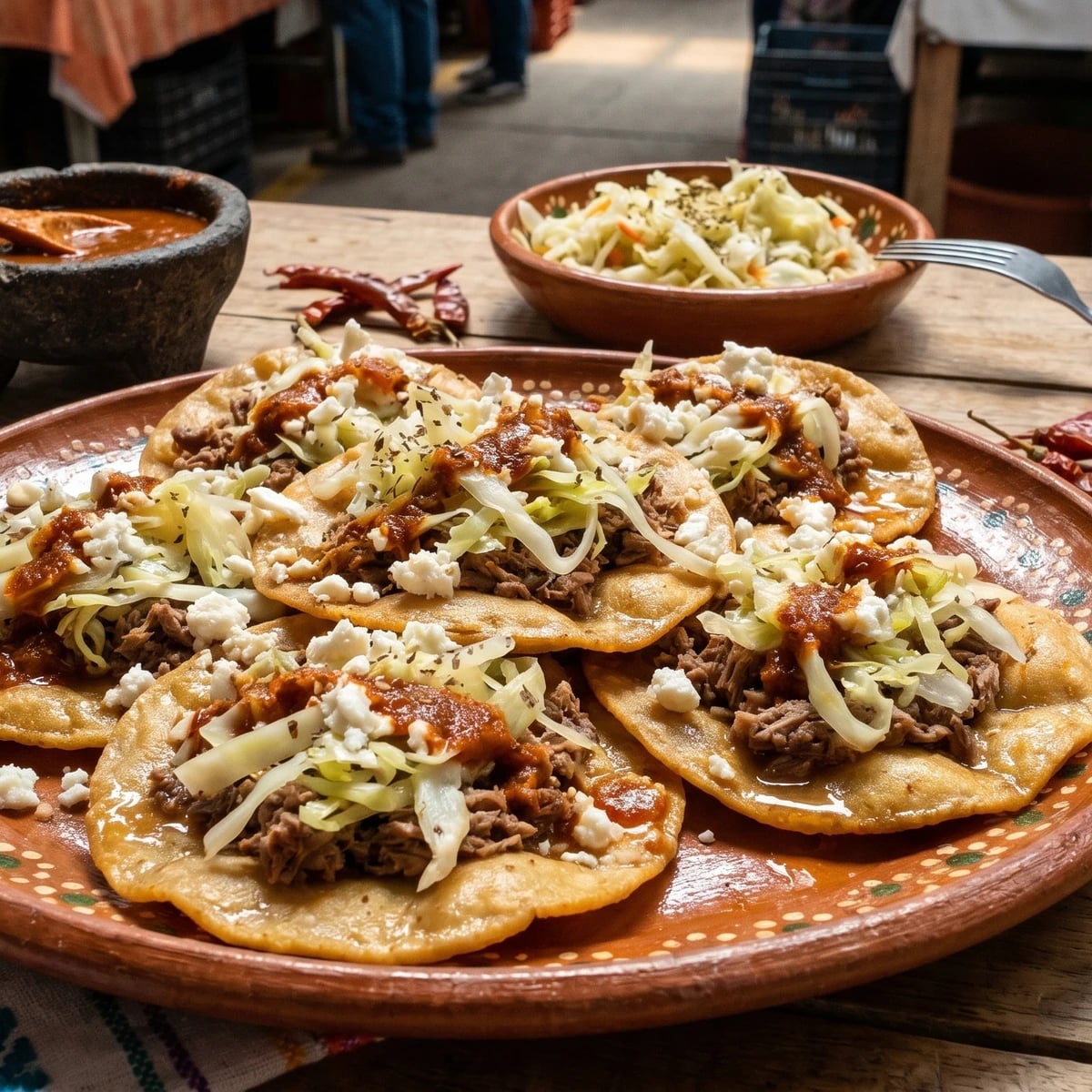
From the Zapotec market tables of Oaxaca's Isthmus, small masa discs fried golden in lard, piled with shredded beef picadillo, sharp pickled cabbage, and a salsa de chile de árbol that means business.

Appetizers & Snacks
Mexican
Game Day
Potluck
Outdoor Dining
45 min
Active Time
1 hr 30 min cook2 hr 15 min total
Yield24 garnachas, serving 6 to 8

This is from the Istmo de Tehuantepec, the narrow waist of Oaxaca where the Pacific and the Gulf almost touch. The cuisine here is not the cuisine of the Valles Centrales. Different climate, different markets, different hands. The women who run the markets in Juchitán and Tehuantepec, the Zapotec women they call Tehuanas, are the ones who perfected this dish and who still sell it from clay comales in the market halls today.

A garnacha istmeña is a small disc of masa, no bigger than the palm of your hand, with the edges pinched up to hold what goes on top. You fry it in manteca de cerdo until the bottom goes golden and crisp while the rim stays tender enough to give under your teeth. Then you pile on the shredded beef in its tomato sauce, a fistful of curtido, the sharp vinegar-pickled cabbage that cuts right through the fat, and a spoonful of salsa de chile de árbol that wakes everything up. La manteca es el sabor. The lard is not a suggestion.

I collected this recipe in Juchitán de Zaragoza from a woman who sold garnachas from a folding table outside the main market. She shaped them with one hand while she talked, pinching the edges without looking, the way you do when you've made ten thousand of something. She told me the curtido has to sit at least thirty minutes. She told me the salsa is chile de árbol, not morita, not cascabel, árbol. I wrote it all in my notebook and she checked what I wrote before I left. Recetas probadas y garantizadas.

Garnachas belong to the broader family of antojitos de masa found across Oaxaca and southern Mexico, but the istmeña version, with its distinctive curtido and salsa de chile de árbol, is specific to the Zapotec communities of the Isthmus of Tehuantepec. The Isthmus market economy, controlled for centuries by Zapotec women who serve as primary vendors, cooks, and economic agents, made the garnacha a commercial street food generations before the English-speaking world coined the term. The word 'garnacha' likely derives from a colonial-era Spanish term for a type of layered garment, a reference to the stacked components on a single masa base, and the dish shares structural lineage with sopes, picadas, and pellizcadas, all hand-shaped masa platforms whose regional variations reflect the corn culture's local genius across Mesoamerica.

The technique, the tradition, and the story behind every dish.

Discover Culinary Explorer

Ingredients

flank steak

Quantity

1 pound

in one piece

white onion

Quantity

1/2 medium

divided

garlic cloves

Quantity

5

divided

bay leaf

Quantity

1

Roma tomatoes

Quantity

4

fresh masa for tortillas (or 2 cups masa harina)

Quantity

1 pound

warm water (if using masa harina)

Quantity

1 1/4 cups

pork lard (manteca de cerdo)

Quantity

1 cup plus 3 tablespoons

divided

green cabbage

Quantity

1/4 head

shredded very fine

white vinegar

Quantity

1/3 cup

dried Mexican oregano

Quantity

1 teaspoon

dried chile de arbol

Quantity

20

stemmed

kosher salt

Quantity

to taste

queso fresco (optional)

Quantity

for serving

crumbled

Equipment Needed

  • Heavy 10-inch cast iron skillet for frying
  • Cast iron comal or heavy skillet for toasting chiles and tomatoes
  • High-powered blender
  • Slotted spoon or kitchen spider
  • Wire rack set over a sheet pan for draining

Instructions

  1. 1

    Simmer the beef

    Place the flank steak in a medium pot and cover with cold water by two inches. Add a quarter of the onion, two garlic cloves, the bay leaf, and a teaspoon of salt. Bring to a gentle simmer over medium heat. Skim the gray foam that rises in the first ten minutes. Reduce heat to low, cover partially, and cook for one hour, until the meat shreds easily with a fork. Do not boil it. A hard boil tightens the fibers and gives you stringy beef instead of tender deshebrada. Pull the meat out and let it cool enough to handle. Reserve a quarter cup of the broth for the salsa. Shred the beef with two forks, pulling along the grain into fine threads.

    Flank steak is the right cut here. It has long fibers that shred into clean threads. Chuck will work but the shred is messier and the texture is softer. The women in Juchitan use flank.
  2. 2

    Make the curtido

    While the beef simmers, shred the cabbage as fine as you can. You want ribbons thin enough to wilt slightly in the vinegar but still keep their crunch. Toss the cabbage in a bowl with the white vinegar, dried oregano, half a teaspoon of salt, and a pinch of black pepper if you like. Mix with your hands, squeezing gently so the vinegar gets into the cuts. Cover and let it sit for at least thirty minutes. The longer it sits, the more the vinegar softens the raw edge. An hour is better. Overnight is fine.

    The curtido is the counterweight to the lard and the meat. Without it, the garnacha is heavy. With it, the whole thing balances. Do not skip the curtido and do not rush it.
  3. 3

    Toast and blend the salsa

    Heat a dry comal or cast iron skillet over medium heat. Toast the chile de arbol, turning constantly with tongs, for about sixty seconds total. They go from toasted to burned in a breath, so do not walk away. The skins should darken unevenly and the kitchen should smell sharp and peppery. Toast two unpeeled garlic cloves on the same comal until blackened in spots, about five minutes, turning occasionally. Peel the garlic, then blend the toasted chiles and garlic with a quarter cup of the reserved beef broth and a half teaspoon of salt. Blend until smooth. The salsa should be thin enough to spoon but thick enough to cling. Taste it. It will be hot. That is the point.

    Chile de arbol, not morita, not cascabel, not chile seco. Arbol. It brings direct, clean heat without the smoke. The woman in Juchitan was very specific about this and she was right.
  4. 4

    Make the tomato sauce and finish the beef

    Roast the four Roma tomatoes and the remaining quarter onion on the same comal over medium-high heat, turning every few minutes, until the tomato skins blister and blacken in patches and the onion chars at the edges. This takes about eight minutes. Blend them with the remaining clove of garlic and a half teaspoon of salt until you have a slightly chunky puree. In a small skillet, melt one tablespoon of lard over medium heat. Pour in the tomato puree. It will sputter. Cook for five to seven minutes, stirring, until the sauce darkens a shade and thickens enough to coat a spoon. Add the shredded beef and stir to combine. Cook another two minutes so the meat absorbs the sauce. Taste for salt. The picadillo should be saucy but not soupy. If it looks wet, cook it a minute longer.

    Frying the tomato puree in lard before adding the meat is what gives the picadillo its depth. Raw blended tomato tastes flat. Fried tomato tastes like something a market cook would serve you.
  5. 5

    Make and shape the masa

    If using fresh masa, knead it with two tablespoons of softened lard and half a teaspoon of salt until the dough is smooth and pliable. It should feel like soft clay, not sticky, not crumbly. If using masa harina, mix it with the warm water first, let it rest five minutes, then knead in the lard and salt. Pinch off a walnut-sized piece and roll it into a ball. Press it flat between your palms into a disc about three inches across and a quarter inch thick. Pinch the edge up all the way around to form a shallow rim, like a tiny plate. Set it on a tray lined with plastic wrap. Repeat until you have about twenty-four discs. Work quickly. If the masa dries out, cover the tray with a damp towel.

    Fresh masa from a tortilleria is always better than masa harina. If you have a source, use it. If not, masa harina mixed with the lard and given a good knead will get you there. The lard in the dough is what makes the garnacha fry up crisp instead of tough.
  6. 6

    Fry the garnachas

    In a heavy cast iron skillet, melt one cup of lard over medium heat. You want about half an inch of lard in the pan. When the surface shimmers and a pinch of masa sizzles on contact, lay the garnachas in the pan, bottom side down, working in batches of five or six so they are not crowded. Fry for two to three minutes without moving them, until the bottom turns deep golden and the edges of the rim start to look set. Lift them out with a slotted spoon and drain on a wire rack, not paper towels. Paper towels make the bottom soggy. The bottom should be crisp. The pinched rim should be tender. That contrast is the whole architecture of the garnacha.

    Do not flip them. You are frying the bottom only. The rim stays soft so you can bite through it. If you fry the whole thing, you have a tostada, not a garnacha.
  7. 7

    Assemble and serve immediately

    Work quickly now. While the garnachas are still hot, spoon a generous tablespoon of the beef picadillo into each one, pressing it gently into the well. Pile a pinch of curtido on top. Drizzle or spoon a little salsa de chile de arbol over everything. Finish with crumbled queso fresco if you have it. Arrange them on a clay platter or a wide plate and put them on the table the moment they are done. Garnachas do not wait. They are eaten hot, standing at a market table or sitting at a family gathering, the lard still warm on your fingers. Saber cocinar es saber vivir.

Chef Tips

  • Fresh masa from a tortilleria makes a better garnacha than masa harina. The texture is softer, the flavor is rounder, and the dough shapes more easily. If you live near a Mexican market that grinds masa, buy it the day you are cooking. One pound is enough for about two dozen garnachas.
  • The lard for frying should be real pork lard, manteca de cerdo, not the hydrogenated blocks from the supermarket baking aisle. If you have a Mexican carniceria nearby, ask for manteca fresca. The flavor difference is not subtle. La manteca es el sabor.
  • Make the curtido first. It needs time. Thirty minutes is the minimum, but if you make it the night before and refrigerate it, the cabbage softens just enough to drape over the garnacha without losing its bite. That sharp crunch against the fried masa and the rich beef is the whole point of the dish.
  • These are market food, meant to be eaten the minute they come off the comal. If you are serving them at a gathering, fry and assemble in small batches so every guest gets them hot. A garnacha that sits for ten minutes is a soggy garnacha, and nobody in Juchitan would serve you one.

Advance Preparation

  • The beef can be simmered, shredded, and combined with the tomato sauce one day ahead. Refrigerate and reheat gently before assembling.
  • The curtido improves with time. Make it up to one day ahead and store covered in the refrigerator. It will soften slightly but hold its crunch.
  • The salsa de chile de arbol keeps refrigerated for up to five days. The heat mellows slightly but the flavor stays clean.
  • The masa must be shaped and fried fresh. There is no shortcut here. Shape the discs no more than thirty minutes before frying, and fry just before serving. No me vengas con atajos.

Frequently Asked Questions

Nutrition Information

1 serving (about 200g)

Calories
525 calories
Total Fat
35 g
Saturated Fat
14 g
Trans Fat
0 g
Unsaturated Fat
21 g
Cholesterol
72 mg
Sodium
635 mg
Total Carbohydrates
31 g
Dietary Fiber
5 g
Sugars
3 g
Protein
24 g

Note: Chef personas and recipes are created with AI assistance. Cook with care: follow safe food-handling practices, check doneness with a thermometer when needed, and adapt for allergies and your kitchen.

Where cooking meets culture.

Culinary guides, cultural storytelling, and the editorial depth that makes cooking meaningful.

Discover Culinary Explorer

More from Oaxacan Appetizers & Snacks

Browse the full collection