Culinary Explorer

A cooking platform built around craft, culture, and the stories behind what we eat.
Discover Culinary Explorer
Gaori-hoe-muchim (Spicy Stingray Salad)

Gaori-hoe-muchim (Spicy Stingray Salad)

Created by

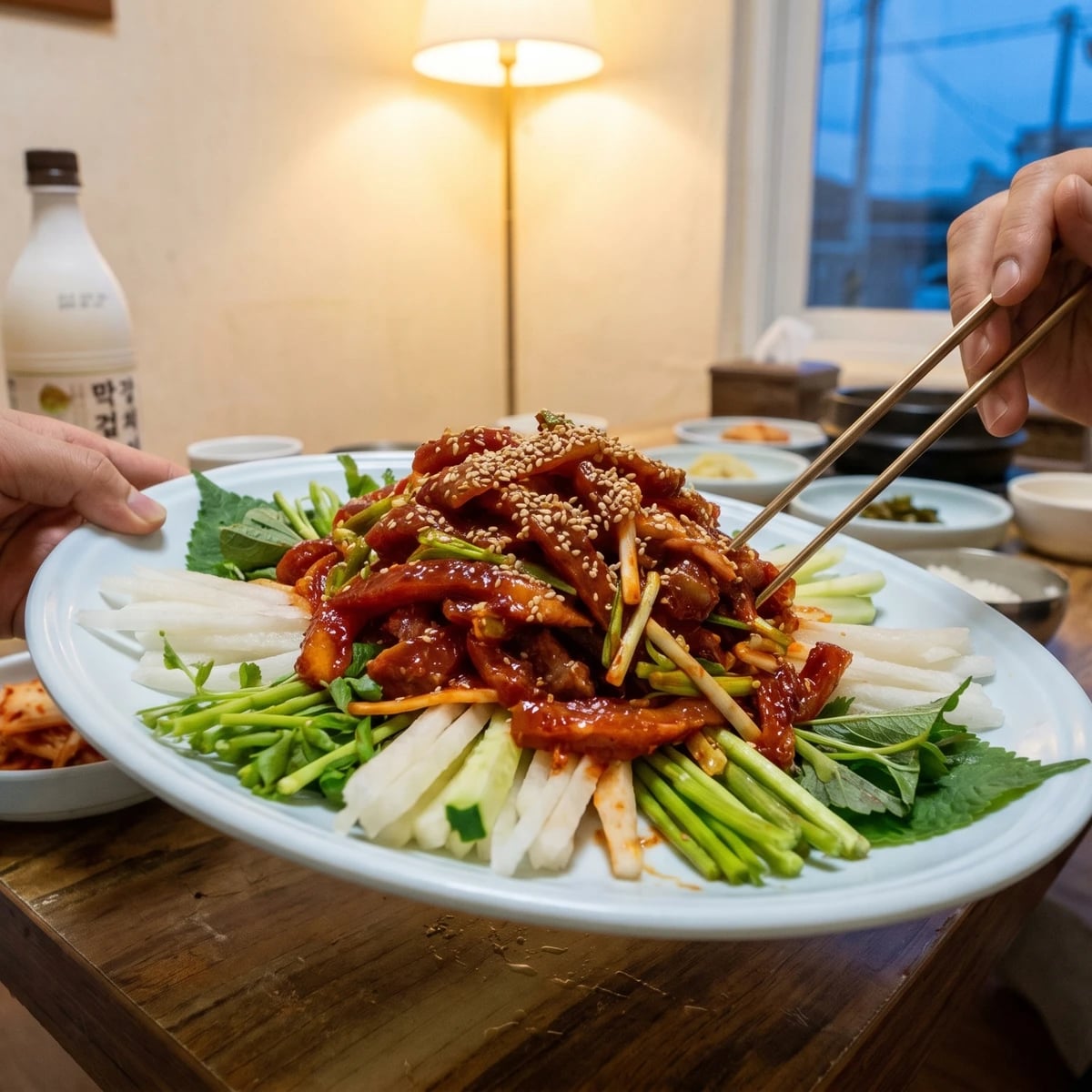
Chewy raw stingray sliced thin against the grain, tossed at the last moment with radish, cucumber, minari, and a sharp sweet-sour gochujang dressing from the Jeolla table.

Salads
Korean
Dinner Party
Special Occasion
45 min
Active Time
0 min cook1 hr 15 min total
Yield4 servings as a shared salad

The first lesson in gaori-hoe-muchim is not the sauce. It is the knife. Slice the ray thin and across the grain, and it gives you that firm, springy chew Jeolla cooks value. Slice it thick or with the grain, and the table will grow quiet for the wrong reason.

This is a special-occasion muchim, a dressed salad meant to wake up a dinner table, not a soft side dish to sit politely beside rice. The vegetables must stay crisp, the ray must stay cold, and the sauce must be sour enough to carry the chew without burying it. Gochujang is not a blanket. It is a dressing, and a dressing has to leave the main ingredient visible.

My teacher would make us drain the salted radish twice and then ask why the plate still leaked. We learned by 눈동냥, 귀동냥, borrowing with the eyes and ears, because she did not explain a lesson until our hands had failed once. I am kinder than she was, so I am telling you now: dry fish, squeezed radish, cold vegetables, last-minute tossing. That is the whole discipline.

Buy the fish from someone you trust, and reject any piece with a hard ammonia smell. This is not bravery. It is cooking. Write down the vinegar and sugar balance after you taste it, because one gochujang is sweeter than the next, and the same good plate should be possible twice.

Gaori-hoe-muchim belongs strongly to Korea's southwestern coastal cooking, especially Jeolla, where skate and ray have long been valued for their firm flesh and distinctive chew. It sits beside better-known hongeo dishes from areas such as Heuksando and Mokpo, though gaori-hoe-muchim is usually a fresh or lightly vinegar-firmed raw salad rather than the deeply fermented hongeo-samhap served with kimchi and pork. The sweet-sour gochujang style reflects modern hoe-muchim practice, where raw seafood is mixed with vegetables and cho-gochujang instead of served plain with dipping sauce.

The technique, the tradition, and the story behind every dish.

Discover Culinary Explorer

Ingredients

very fresh skate or ray wing

Quantity

500g

skin and cartilage trimmed, parasite-destroyed if served raw

coarse sea salt

Quantity

1 tablespoon

for drawing moisture from the fish

rice vinegar

Quantity

3 tablespoons

for firming the fish

Korean radish (mu)

Quantity

250g

peeled and julienned

fine sea salt

Quantity

1 teaspoon

for salting the radish

cucumber

Quantity

1 small

seeded and cut into thin half-moons

onion

Quantity

1/2 small

thinly sliced

minari (Korean water dropwort)

Quantity

60g

cut into 2-inch lengths

scallions

Quantity

3

cut into 2-inch lengths

perilla leaves (optional)

Quantity

6

thinly sliced

gochujang (Korean red chili paste)

Quantity

4 tablespoons

gochugaru (Korean chili flakes)

Quantity

2 tablespoons

preferably medium-coarse

rice vinegar

Quantity

3 tablespoons

maesil-cheong (green plum syrup)

Quantity

1 1/2 tablespoons

or 1 tablespoon sugar

soy sauce

Quantity

1 tablespoon

garlic

Quantity

2 teaspoons

minced

ginger

Quantity

1 teaspoon

grated

toasted sesame oil

Quantity

2 teaspoons

toasted sesame seeds

Quantity

1 tablespoon, plus more for garnish

sugar (optional)

Quantity

1 teaspoon

only if needed after tasting

Equipment Needed

  • Very sharp slicing knife
  • Large stainless mixing bowl
  • Fine colander
  • Clean kitchen towel or several layers of paper towel
  • Wide serving plate

Instructions

  1. 1

    Check the fish

    Smell the skate or ray before you cut it. It should smell clean and faintly of the sea, not sharp with ammonia. Ray spoils loudly, and no amount of gochujang will make a tired fish respectable. If you are serving it raw, buy from a fishmonger who can confirm it was handled for raw consumption or frozen for parasite control. Keep it cold the whole time.

  2. 2

    Slice the ray

    Pat the ray dry and slice it across the grain into pieces about 5cm long, 1.5cm wide, and 3mm thick. This is the step the dish lives or dies by. Cut with the grain and it chews like rope; cut thin across the grain and the fish keeps its proper spring.

  3. 3

    Firm the fish

    Toss the sliced ray with 1 tablespoon coarse sea salt and let it stand in a stainless bowl for 10 minutes. Rinse quickly under very cold water, drain well, then toss with 3 tablespoons rice vinegar and rest 15 minutes in the refrigerator. The salt draws out excess moisture, and the vinegar tightens the flesh so it stays chewy instead of slack. Drain again and squeeze gently in a clean towel.

  4. 4

    Salt the radish

    Toss the julienned radish with 1 teaspoon fine sea salt and leave it 15 minutes, just until it bends. Squeeze out the liquid firmly. If you skip this, the radish waters down the sauce and the whole plate turns loose at the bottom.

  5. 5

    Cut the vegetables

    Seed the cucumber and slice it thin, then cut the onion, minari, scallions, and perilla leaves. Keep the vegetables cold and dry. Muchim is not a stew; every piece should stay crisp enough to answer the chew of the ray.

  6. 6

    Mix the sauce

    In a large bowl, stir together the gochujang, gochugaru, 3 tablespoons rice vinegar, maesil-cheong, soy sauce, garlic, ginger, sesame oil, and sesame seeds. Taste it before it touches the fish. It should be bright, sour first, then sweet, then hot. Add the extra 1 teaspoon sugar only if your vinegar is very sharp. Do not bury the ray under sweetness.

  7. 7

    Toss by hand

    Add the drained ray to the sauce and fold it through with your hand or chopsticks until every slice is coated. Add the radish, cucumber, onion, minari, scallions, and perilla last, then toss only 20 to 30 seconds. The vegetables go in last because salt and vinegar pull water from them quickly. 손맛 is real; I measure it anyway, so you know what your hand is trying to do.

  8. 8

    Serve at once

    Mound the salad on a wide plate, scatter a little more sesame over the top, and serve immediately with rice, makgeolli, or a table of banchan. If it must wait, hold the dressed ray and cut vegetables separately, then toss at the table. This dish rewards the cook who waits until the last minute.

Chef Tips

  • For raw serving, ask specifically for skate or ray wing suitable for raw preparation, or use product frozen according to parasite-control standards. If your fishmonger hesitates, make a cooked gaori-muchim instead: blanch the sliced ray in barely simmering water for 20 to 30 seconds, chill it immediately, drain hard, then season the same way.
  • Do not buy ray with a strong ammonia smell. Skate and ray naturally contain urea, but a sharp smell means the fish is old or badly handled. My teacher would have sent it back without a word.
  • Minari gives this dish its clean green snap. If you cannot find it, use a small handful of watercress stems or Korean chives, but do not replace it with a mountain of lettuce. Lettuce collapses and waters the plate.
  • The sauce should taste a little too strong before tossing, because the fish and vegetables dilute it. Still, keep restraint. If all you taste is gochujang and sugar, you have made red sauce with seafood in it, not gaori-hoe-muchim.

Advance Preparation

  • The sauce can be mixed up to 2 days ahead and refrigerated. Let it stand 10 minutes at room temperature before tossing so it loosens enough to coat the fish evenly.
  • The radish can be julienned and salted up to 4 hours ahead, then squeezed dry and refrigerated. Keep it separate from the sauce.
  • Slice and firm the ray no more than 2 hours before serving, and keep it covered in the coldest part of the refrigerator. Toss the salad only at the last minute.

Frequently Asked Questions

Nutrition Information

1 serving (about 245g)

Calories
195 calories
Total Fat
3 g
Saturated Fat
1 g
Trans Fat
0 g
Unsaturated Fat
2 g
Cholesterol
65 mg
Sodium
1750 mg
Total Carbohydrates
24 g
Dietary Fiber
4 g
Sugars
13 g
Protein
28 g

Note: Chef personas and recipes are created with AI assistance. Cook with care: follow safe food-handling practices, check doneness with a thermometer when needed, and adapt for allergies and your kitchen.

Where cooking meets culture.

Culinary guides, cultural storytelling, and the editorial depth that makes cooking meaningful.

Discover Culinary Explorer

More from Saengchae, Geotjeori & Fresh Muchim

Browse the full collection