
Chef Jeong-sun
Changnan-jeot (Salted Pollack Tripe)
A bracing Korean jeotgal of pollack intestines, cleaned with coarse salt, fermented cold until firm and savory, then dressed lightly with gochugaru, garlic, sesame, and scallion for rice.
A cooking platform built around craft, culture, and the stories behind what we eat.
Created by
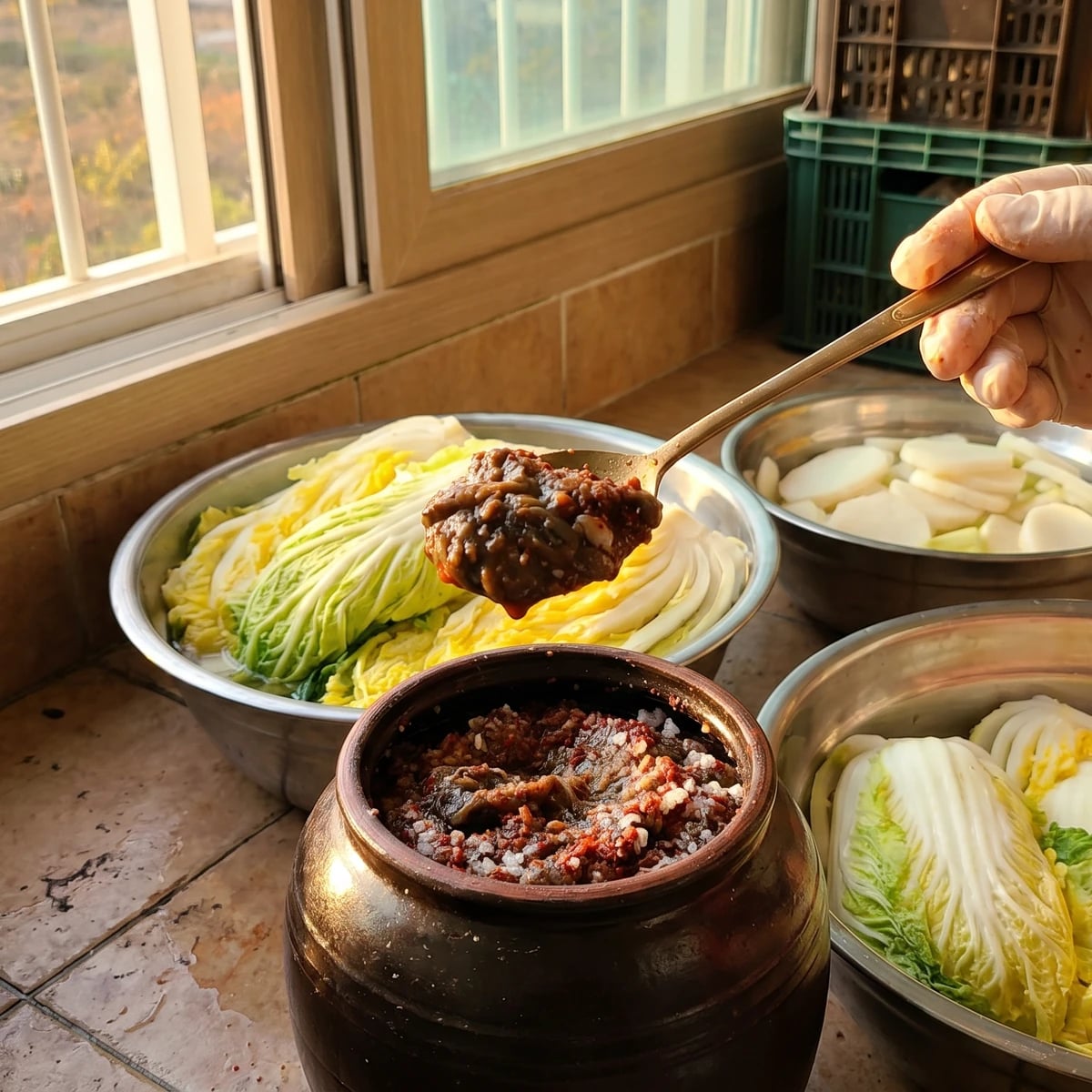
A southern jeotgal of salted hairtail innards, aged cold until deep and sharp, made safely in a jar and used by the teaspoon to give kimchi, stews, and ssamjang their ocean backbone.
Galchi-sokjeot begins at the fish counter, not at the stove. If the hairtail isn't fresh enough for the seller to meet your eye, don't make this dish today. Cook the month you're standing in: hairtail is strongest in the southern markets from summer into autumn, and that is when Jeju and Honam kitchens have the most reason to salt what the fish gives them.
People hear innards and think this is rough food. It isn't rough. It is exacting. You remove the gall bladder because bitterness spreads faster than apology. You salt by weight because a handful from one cook is safety, and from another cook is trouble. For 400 grams of cleaned innards, Notebook 31 says 100 grams coarse salt. That number matters.
This is not a condiment you spoon onto everything to prove bravery. A teaspoon can season a pot of kimchi stew. A tablespoon can deepen a batch of winter kimchi. Minced with garlic, scallion, gochugaru, and a little sesame oil, it becomes the sharp thing beside hot rice that makes everyone reach for one more spoonful. The smell is strong. The work is stronger.
I won't tell you this is easy, because that would be disrespectful to the fish and to you. Keep it cold, keep it clean, keep it measured. Then write down the week you opened it and how much you used in your kimchi. Memory is a borrowed bowl.
Galchi-sokjeot belongs to the southern coast, especially Jeju and the Honam provinces, where hairtail has long been an ordinary market fish and fresh catch was preserved with heavy salting before refrigeration. Like other jeotgal, it became less a food eaten by the bowl than a seasoning base for kimchi, soups, and dipping pastes, carrying deep seafood savor in a small measure. Its use in red kimchi belongs to the later history of Korean kimchi, after chili peppers entered Korean cooking from the Americas several centuries ago and seafood jeotgal became part of the fermented seasoning paste in many southern households.
Quantity
400g
from about 6 large very fresh hairtail, gall bladders removed
Quantity
500ml
Quantity
15g
for the 3 percent rinsing brine
Quantity
100g, or 25 percent of the cleaned innards by weight
Quantity
1 tablespoon
Quantity
2 tablespoons
for a small seasoned table portion
Quantity
1 teaspoon
Quantity
1 small clove
minced
Quantity
1 teaspoon
finely chopped
Quantity
1/2 teaspoon
| Ingredient | Quantity |
|---|---|
| cleaned hairtail innardsfrom about 6 large very fresh hairtail, gall bladders removed | 400g |
| ice-cold water | 500ml |
| sea saltfor the 3 percent rinsing brine | 15g |
| coarse Korean sea salt | 100g, or 25 percent of the cleaned innards by weight |
| soju or clear rice liquor (optional) | 1 tablespoon |
| mature galchi-sokjeot (optional)for a small seasoned table portion | 2 tablespoons |
| gochugaru (Korean chili flakes) (optional) | 1 teaspoon |
| garlic (optional)minced | 1 small clove |
| scallion (optional)finely chopped | 1 teaspoon |
| toasted sesame oil (optional) | 1/2 teaspoon |
Buy hairtail innards only from fish that are very fresh, with clean ocean smell and firm silver skin on the whole fish. Ask the fishmonger to reserve the innards from the same morning's hairtail, and keep them on ice until you get home. If the fish was not commercially frozen for parasite control, freeze the cleaned innards at minus 20 degrees C for 7 days if your freezer reliably reaches that temperature. If it does not, use the finished jeotgal only in cooked soups and stews.
Wash a 500ml glass jar, lid, and fermentation weight with hot soapy water, rinse well, then pour boiling water over them and let them air-dry completely. Water left in the jar weakens the salt ratio, and the salt ratio is the wall that keeps this preserve safe.
Put on gloves. Pick through the innards and remove every green, black, or dark bitter gall bladder, along with any torn pieces stained with bile. Keep clean liver, stomach, intestine, roe, or milt if they smell fresh. Split thick stomach pieces and rinse out any contents. My teacher made us do this without talking. 눈동냥, 귀동냥, borrowing with the eyes and ears. One missed gall bladder can bitter the whole jar.
Dissolve 15g sea salt in 500ml ice-cold water to make a 3 percent brine. Swish the trimmed innards gently in this brine for 30 seconds, then lift them out and drain in a sieve for 10 minutes. Do not soak them in plain water. Plain water pulls out flavor and softens the texture, while light brine cleans without stripping the fish.
Weigh the drained innards. Use coarse salt equal to 25 percent of that weight: for 400g innards, use 100g salt. Toss the innards with two-thirds of the salt until every surface is gritty and coated. Put the remaining salt in the jar in layers, a little on the bottom, innards in the middle, and the last salt on top. 손맛 is real, and I still measure it. Too little salt invites spoilage; too much salt stops the ferment from becoming deep.
Press the salted innards firmly into the jar with a clean spoon or gloved hand, removing air pockets. Pour the soju over the top if using. It is not there to perfume the jeotgal; it rinses the surface and gives a little protection at the start. Set a small fermentation weight or a boiled flat stone on top so the innards stay under the brine that forms.
Cover the jar and set it in the refrigerator, ideally 2 to 5 degrees C, for 6 weeks. For the first 3 days, loosen the lid once a day to release pressure, then tighten it again. After the first week, stir once a week with a clean spoon and press everything back under the brine. Traditional crocks sat in cool outdoor air, but a modern refrigerator is the honest vessel for a home kitchen.
After 4 weeks it can be used, but 6 to 8 weeks gives better depth. The finished galchi-sokjeot should smell strong, salty, and marine, not rotten or sweet. The liquid will be dark amber-brown, and the solids will have softened into a loose paste. Discard the whole jar if you see fuzzy mold, pink growth, slimy foam, or a smell like sewage. Do not rescue bad jeotgal with more salt.
Transfer to smaller sterilized jars if you like, pressing the solids below their brine each time. Keep refrigerated and use within 6 months. Always use a clean spoon. One dirty spoon is enough to ruin what six weeks made.
For a small table portion, mince 2 tablespoons mature galchi-sokjeot with 1 teaspoon gochugaru, 1 minced small garlic clove, 1 teaspoon chopped scallion, and 1/2 teaspoon toasted sesame oil. Eat that mixture the same day with hot rice, boiled pork, or lettuce wraps. Do not stir sesame oil and fresh aromatics into the storage jar. They are for tonight's bowl, not for keeping.
1 serving (about 21g)
Culinary guides, cultural storytelling, and the editorial depth that makes cooking meaningful.
Discover Culinary Explorer
Chef Jeong-sun
A bracing Korean jeotgal of pollack intestines, cleaned with coarse salt, fermented cold until firm and savory, then dressed lightly with gochugaru, garlic, sesame, and scallion for rice.

Chef Jeong-sun
Soft strips of broth kelp cured in soy, vinegar, and a little sweetness, a quiet make-ahead banchan that teaches the stock pot not to waste what still has flavor.

Chef Jeong-sun
Mountain bellroot pounded flat, dried until tacky, then buried in a restrained gochujang cure; scrape away the old paste, dress with sesame, and serve a few aromatic strips with rice.

Chef Jeong-sun
A make-ahead bellflower root pickle with a clean bitter edge, cured until chewy and seasoned with restraint so the doraji still tastes like itself.