
Chef Jeong-sun
Changnan-jeot (Salted Pollack Tripe)
A bracing Korean jeotgal of pollack intestines, cleaned with coarse salt, fermented cold until firm and savory, then dressed lightly with gochugaru, garlic, sesame, and scallion for rice.
A cooking platform built around craft, culture, and the stories behind what we eat.
Created by
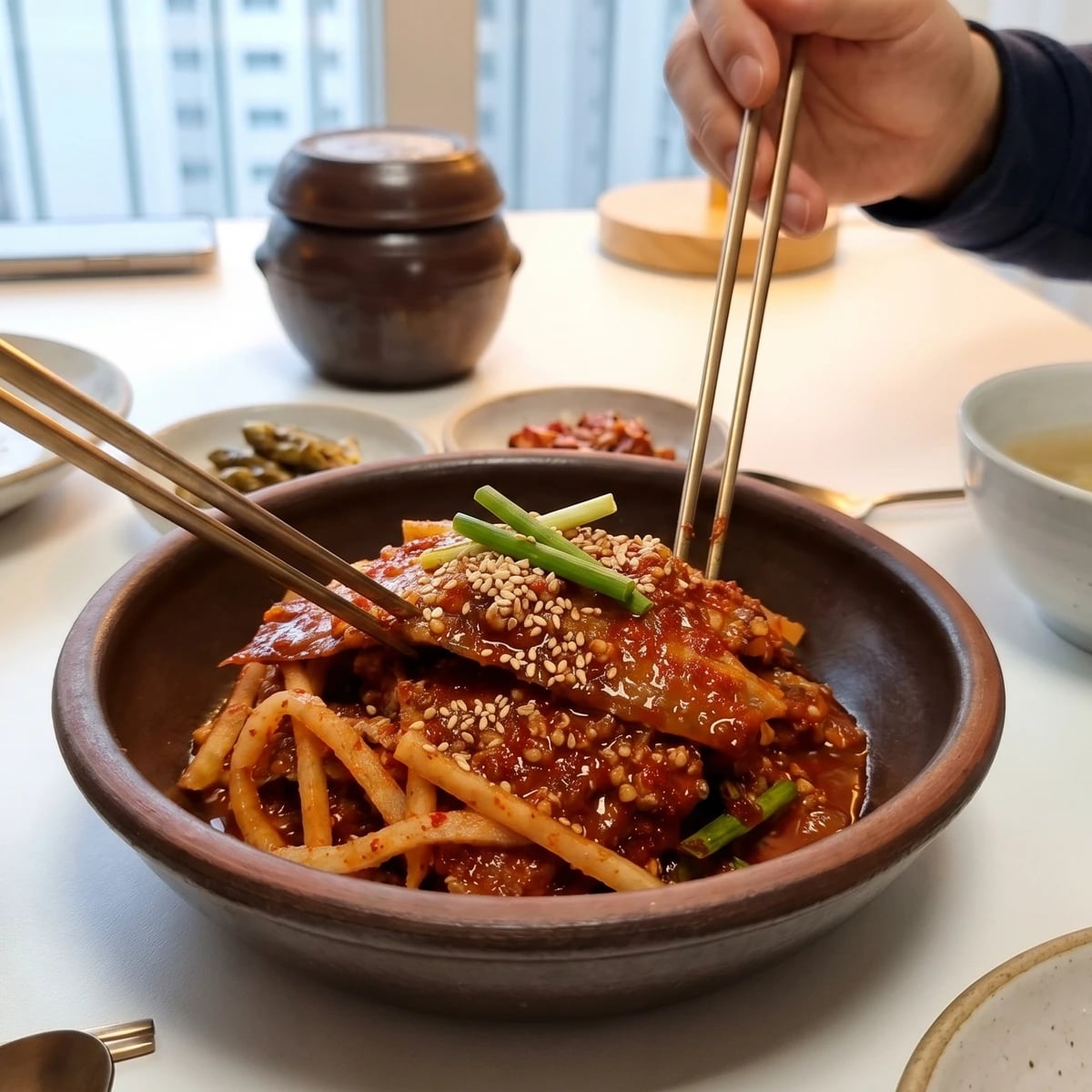
A northern winter preserve of dried flatfish, millet, malt, and radish, fermented until the bones soften and the fish turns chewy, savory, and lightly tart.
Gajami-sikhae lives or dies by proportion. Too little salt and the fish is unsafe. Too much malt and it turns sweet and slack. Too much gochugaru and all you taste is red. This is why I write the numbers down. 손맛 is real, and I still measure it, so it can be handed on.
This is not the sweet rice drink called sikhye. Sikhae, with that small difference in the mouth, is a fermented fish preserve from the colder northern table, made when winter air helped the cook. Dried flatfish is mixed with cooked millet, barley malt, radish, garlic, ginger, and chili, then left until the grain feeds the fermentation and the malt begins its quiet work on the bones. You eat it as banchan, a little at a time, with hot rice or tucked beside bossam, not by the bowlful.
I won't tell you this is quick. Tonight it asks you to rinse, salt, steam millet, cool it properly, cut radish evenly, and keep the jar clean. The vessel can be a glass jar instead of an onggi crock. That corner is safe to modernize. The salt, the cooling, and the cold storage are not corners at all, so don't cut them.
Gajami-sikhae is closely tied to Hamgyong-do cooking, where cold winters, preserved fish, and hardy grains shaped the table; refugees from the North carried the dish south after the Korean War, especially to coastal communities such as Sokcho's Abai Village. Sikhae belongs to a broader Korean family of grain-assisted fermented fish preserves, distinct from the sweet rice drink sikhye, and barley malt is valued because its enzymes help soften small bones over time. Modern home versions rely on refrigeration after a short room-temperature start, replacing the steady cold of old northern storage rooms.
Quantity
500g
bone-in, skin-on, cut into 2-inch pieces
Quantity
2 tablespoons
for salting the fish, plus more only if needed
Quantity
1/2 cup
rinsed
Quantity
2/3 cup
for steaming the millet
Quantity
250g
peeled and cut into 2-inch matchsticks
Quantity
1 tablespoon
for salting the radish
Quantity
5 tablespoons
Quantity
3 tablespoons
Quantity
4 tablespoons
sifted
Quantity
3 tablespoons
Quantity
2 tablespoons maesil-cheong or 1 tablespoon sugar
Quantity
6 cloves
minced
Quantity
20g
finely grated
Quantity
3
cut into 1-inch lengths
Quantity
1 tablespoon
for serving
| Ingredient | Quantity |
|---|---|
| dried flatfish or flounderbone-in, skin-on, cut into 2-inch pieces | 500g |
| coarse sea saltfor salting the fish, plus more only if needed | 2 tablespoons |
| foxtail milletrinsed | 1/2 cup |
| waterfor steaming the millet | 2/3 cup |
| Korean radishpeeled and cut into 2-inch matchsticks | 250g |
| coarse sea saltfor salting the radish | 1 tablespoon |
| coarse gochugaru (Korean chili flakes) | 5 tablespoons |
| fine gochugaru (Korean chili powder) | 3 tablespoons |
| barley malt powder (yeotgireum-garu)sifted | 4 tablespoons |
| fish sauce or clear anchovy sauce | 3 tablespoons |
| maesil-cheong (green plum syrup) or sugar | 2 tablespoons maesil-cheong or 1 tablespoon sugar |
| garlicminced | 6 cloves |
| fresh gingerfinely grated | 20g |
| scallionscut into 1-inch lengths | 3 |
| toasted sesame seeds (optional)for serving | 1 tablespoon |
Rinse the dried flatfish quickly under cold running water, then pat it very dry. Taste a tiny flake. If it is already firmly salty, use only 1 tablespoon salt in this step. If it tastes mostly plain, use the full 2 tablespoons. Salt is not decoration here; it is part of the preservation.
Toss the fish with the measured salt and let it sit in a colander over a bowl for 1 hour. The fish should firm up and give off a little liquid. Rinse once, briefly, then dry it thoroughly with towels. Wet fish ferments unevenly and makes a muddy seasoning.
Put the rinsed millet and 2/3 cup water in a small pot. Bring to a boil, cover, lower the heat, and cook 15 minutes. Turn off the heat and let it stand 10 minutes, covered. Spread it on a tray until fully cool. Warm millet in a fish ferment is careless cooking.
Toss the radish matchsticks with 1 tablespoon coarse sea salt and leave them 30 minutes. Drain, squeeze lightly, and do not rinse unless they taste harshly salty. The radish should bend but still snap under the teeth, because it has to stay alive against the soft fish and millet.
In a large stainless bowl, mix the coarse gochugaru, fine gochugaru, sifted barley malt powder, fish sauce, maesil-cheong or sugar, garlic, and ginger. Let it sit 10 minutes so the chili blooms and the malt hydrates. The paste should be thick and brick red, not loose.
Add the fish, cooled millet, drained radish, and scallions to the seasoning. Mix with a gloved hand until every piece of fish is coated and the millet is distributed evenly. Do not mash. You want the grain to cling, not turn to porridge.
Pack the mixture into a clean 1.5-liter glass jar or small onggi, pressing out air pockets as you go. Leave at least 1 inch of headspace. Wipe the rim clean and cover loosely for the first day, because fermentation needs room to move.
Leave the jar at cool room temperature, 18 to 20 degrees C, for 24 hours. If your kitchen is warmer than 22 degrees C, give it only 12 hours before refrigerating. You should see the color deepen and smell cleanly sour, savory, and fishy in the right way, never rotten or fizzy-sweet.
Move the jar to the refrigerator and ferment 4 to 7 days before eating. Stir once a day with a clean spoon, pressing the surface flat again afterward. The flatfish should turn chewy-tender, the millet slightly tangy, and the small bones soft enough to eat. If you see mold, smell spoilage, or feel slime, throw it away. 정성이 첫째예요. Sincerity comes first, and that includes knowing when not to serve a thing.
Serve cold in small portions, with toasted sesame seeds if you like. It belongs beside hot rice, bossam, or a plain soup that will not fight it. Keep the jar refrigerated and always use a clean spoon.
1 serving (about 100g)
Culinary guides, cultural storytelling, and the editorial depth that makes cooking meaningful.
Discover Culinary Explorer
Chef Jeong-sun
A bracing Korean jeotgal of pollack intestines, cleaned with coarse salt, fermented cold until firm and savory, then dressed lightly with gochugaru, garlic, sesame, and scallion for rice.

Chef Jeong-sun
Soft strips of broth kelp cured in soy, vinegar, and a little sweetness, a quiet make-ahead banchan that teaches the stock pot not to waste what still has flavor.

Chef Jeong-sun
Mountain bellroot pounded flat, dried until tacky, then buried in a restrained gochujang cure; scrape away the old paste, dress with sesame, and serve a few aromatic strips with rice.

Chef Jeong-sun
A make-ahead bellflower root pickle with a clean bitter edge, cured until chewy and seasoned with restraint so the doraji still tastes like itself.