
Chef Fai
Dry Egg Noodles (Ba Mee Haeng)
The four pillars live at the bottom of the bowl before the noodles ever touch it: nam pla for salt, sugar for sweet, vinegar for sour, chili for heat. Every noodle cart in Bangkok runs on this principle.
A cooking platform built around craft, culture, and the stories behind what we eat.
Created by
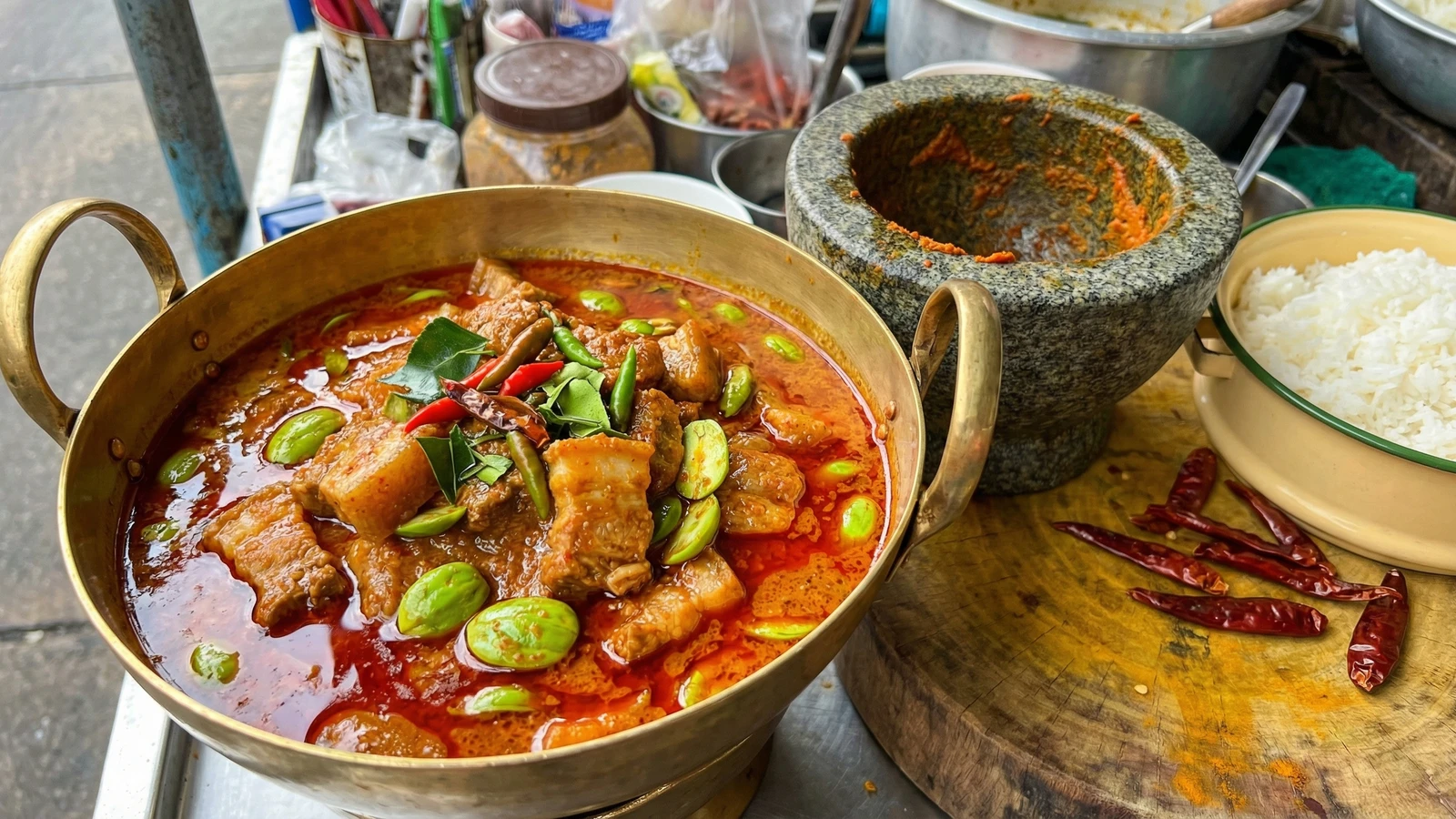
Twenty dried chilies pounded into a paste so red it stains the granite. Southern Thai gaeng prik is the kreung tam pushed to its most extreme expression: chili IS the curry, and the South does not apologize.
Twenty dried chilies. That's the starting point. Not five. Not ten. Twenty. If that number makes you nervous, this isn't your curry yet. Come back when you're ready. The South doesn't hold back, and neither does this paste.
Ajarn always said the kreung tam is everything. In Central Thai cooking, the paste is a balanced chorus of aromatics: galangal, lemongrass, cilantro root, chilies, all sharing the stage. In the South, the chilies take over. Gaeng prik means "chili curry," and the name is the recipe. The kreung tam is a mountain of dried long red chilies (prik haeng) pounded with shallots, garlic, kapi (shrimp paste), and the ingredient that stamps every Southern paste as Southern: fresh turmeric (kamin). That golden root is everywhere down there. It stains the mortar, stains your hands, stains the curry a deep burnt orange that no Central Thai curry matches.
The four pillars still hold, but the South bends them. Fish sauce for salt, always. Palm sugar for sweet, barely, just enough to round the edges. Sour plays a supporting role here, not the lead it plays in gaeng som or gaeng luang. And spice? Spice is the point. The dried chilies deliver a heat that builds and builds: not the sharp, bright punch of fresh bird's eye chilies, but a slow, rolling, full-body burn that comes from the dried prik haeng. Different physics. Dried chilies have lost their water, so the capsaicin is concentrated. The heat is deeper, wider, and it stays.
I learned this curry from a vendor in Nakhon Si Thammarat who laughed when I asked how many chilies she used. She held up two fistfuls and said, "This many." No measuring. No recipe card. She knew the principle: the chili is the curry. Everything else supports it. Pork belly because fat carries the capsaicin across your tongue. Coconut cream because the fat tempers the heat just enough to let the other flavors register. Sataw (stink beans) because their sulfuric, bitter crunch is the South's signature vegetable, and nothing else tastes like them on earth. Principles, not recipes. The South just turns the dial to eleven.
Southern Thai cuisine (อาหารปักษ์ใต้) is the spiciest regional kitchen in Thailand, shaped by the Malay Peninsula's geography, its Muslim and Buddhist communities, and the abundance of seafood, coconut, and turmeric along the Andaman and Gulf coasts. Gaeng prik is one of several Southern curries where dried chilies dominate the paste in quantities that far exceed Central Thai norms, a reflection of the region's historical role as a spice trade corridor. Fresh turmeric (kamin) serves as the botanical marker that distinguishes virtually all Southern kreung tam from their Central counterparts, where turmeric appears rarely.
Quantity
20
stems removed, seeds shaken out, soaked in warm water 15 minutes
Quantity
5
soaked with the long chilies
Quantity
8
peeled and sliced
Quantity
10 cloves
peeled
Quantity
2 stalks
outer layers removed, sliced thin
Quantity
3-inch piece
sliced thin
Quantity
2-inch piece
sliced, or substitute 1 teaspoon dried turmeric
Quantity
1 teaspoon
Quantity
1 tablespoon
Quantity
1 teaspoon
Quantity
400ml
thick first press
Quantity
200ml
Quantity
400g
skin on, sliced into thin bite-sized strips
Quantity
150g
pods split, beans removed and halved lengthwise
Quantity
4
torn
Quantity
2 tablespoons
Quantity
1 teaspoon
Quantity
for finishing
Quantity
for serving
| Ingredient | Quantity |
|---|---|
| dried long red chilies (prik haeng)stems removed, seeds shaken out, soaked in warm water 15 minutes | 20 |
| dried bird's eye chilies (prik khi nu haeng)soaked with the long chilies | 5 |
| shallots (hom daeng)peeled and sliced | 8 |
| garlic (kratiam)peeled | 10 cloves |
| lemongrass (takhrai)outer layers removed, sliced thin | 2 stalks |
| galangal (kha)sliced thin | 3-inch piece |
| fresh turmeric (kamin)sliced, or substitute 1 teaspoon dried turmeric | 2-inch piece |
| white peppercorns (prik thai khao) | 1 teaspoon |
| shrimp paste (kapi) | 1 tablespoon |
| salt | 1 teaspoon |
| coconut cream (hua kathi)thick first press | 400ml |
| thin coconut milk (hang kathi) | 200ml |
| pork belly (moo sam chan)skin on, sliced into thin bite-sized strips | 400g |
| stink beans (sataw)pods split, beans removed and halved lengthwise | 150g |
| kaffir lime leaves (bai makrut)torn | 4 |
| fish sauce (nam pla) | 2 tablespoons |
| palm sugar (nam tan pip) | 1 teaspoon |
| fresh bird's eye chilies (prik khi nu) | for finishing |
| steamed jasmine rice | for serving |
Remove the stems from all the dried chilies. Shake out most of the seeds. Don't obsess over getting every seed, but removing the bulk reduces bitterness without killing heat. Soak the prik haeng and prik khi nu haeng together in warm water for 15 minutes until they're soft and pliable. Drain them well and squeeze out excess water. If they're waterlogged, your paste will be loose and won't fry properly.
Start with the hardest ingredients. White peppercorns and salt go into the granite mortar (krok hin) first. Pound until the peppercorns are cracked and powdered. Add the lemongrass and galangal. Pound to a fibrous pulp. Next, the fresh turmeric. This is where the paste turns gold. Pound it in until the color is even. Now the garlic and shallots: pound them to a rough, wet mass. Add the drained chilies, all of them, and pound. This is the work. The dried chilies are tough even after soaking, and there are twenty-five of them. Your arm will burn. Keep going. Pound until the paste is thick, rough-textured, and deeply red-orange. Finally, add the kapi and pound it through. The paste should smell like the back of a Southern market stall: smoky, pungent, golden, alive.
Pour the thick coconut cream (hua kathi) into a wok or heavy-bottomed pot over medium-high heat. Stir it slowly and continuously. After 5 to 7 minutes, the cream will split: the oil will separate and pool on the surface in glistening patches, and the solids will start to look grainy and slightly golden. This is called "cracking" the coconut cream, and it's a fundamental Southern Thai technique. If you skip it and dump the paste into cold coconut milk, the curry tastes flat and greasy. The cracked oil is your cooking fat. That's where the paste goes next.
Add the entire kreung tam to the cracked coconut cream. Stir it in and let it fry. This is the moment. The paste should sizzle aggressively when it hits the oil. The color will deepen from red-orange to a dark, brick-like crimson. The aroma will fill the room: dried chili, turmeric, shrimp paste, and coconut fat all hitting the heat together. Fry the paste for 3 to 4 minutes, stirring constantly, until the oil separates again and rises to the surface. You'll see red-orange pools of chili oil floating. That's your signal. The paste is cooked.
Add the pork belly strips to the wok. Toss them through the fried paste so every piece is coated. Let the pork cook in the paste for 3 minutes, stirring occasionally. The fat on the pork will start to render and become translucent at the edges. The meat will absorb the paste. This is why pork belly works: the fat layers carry the chili heat across your palate in a way that lean meat can't. Fat is a flavor vehicle. The South knows this.
Pour in the thin coconut milk (hang kathi). Stir once to combine. Add the torn kaffir lime leaves. Bring the curry to a gentle boil, then reduce to a simmer. Let it cook for 10 to 12 minutes, until the pork belly is tender and the sauce has thickened slightly. The curry should be rich and glossy, not watery. If it's too thick, add a splash more thin coconut milk. If it's too thin, simmer longer. Taste now. The heat will be rolling in. Good.
Add the halved stink beans (sataw) to the curry. They need only 2 to 3 minutes. You want them cooked but still firm, with a crunch and that unmistakable sulfuric bite. Season with the fish sauce and palm sugar. The fish sauce is your salt pillar. The palm sugar is barely there: one teaspoon to round the edges, not to sweeten. Taste and adjust. The balance here is: heat first, salt second, a whisper of sweet, and the bitter-sulfuric funk of the sataw cutting through everything.
Bruise a few fresh bird's eye chilies (prik khi nu) and drop them into the curry. They add a bright, sharp counterpoint to the deep, slow burn of the dried chilies in the paste. Ladle the curry over steamed jasmine rice. The sauce should pool around the rice, red-orange and glistening with coconut oil and chili fat. The pork belly should be tender. The sataw should be bright green against the dark curry. This is Southern Thai food. It hits you like the midday sun in Songkhla: total, relentless, and beautiful. Fai Thai, baby.
1 serving (about 300g)
Culinary guides, cultural storytelling, and the editorial depth that makes cooking meaningful.
Discover Culinary ExplorerChef Fai
The four pillars live at the bottom of the bowl before the noodles ever touch it: nam pla for salt, sugar for sweet, vinegar for sour, chili for heat. Every noodle cart in Bangkok runs on this principle.

Chef Fai
The kreung tam fried in cracked coconut cream until the oil bleeds red. That's the technique. Concentrated, semi-dry, spooned thick over crispy fish. This is what happens when the four pillars meet restraint.

Chef Fai
Isan foraging in a bowl: wild taro stems stripped of their sting, simmered in padaek broth with a pounded chili paste and yanang leaf extract. The land feeds you if you know the rules.

Chef Fai
Lanna's kreung tam breaks from Central Thai rules: ginger over galangal, cumin and coriander from Burmese spice routes, tamarind for sour instead of lime. The North has its own system, and this curry is its crown.