
Chef Fai
Dry Egg Noodles (Ba Mee Haeng)
The four pillars live at the bottom of the bowl before the noodles ever touch it: nam pla for salt, sugar for sweet, vinegar for sour, chili for heat. Every noodle cart in Bangkok runs on this principle.
A cooking platform built around craft, culture, and the stories behind what we eat.
Created by
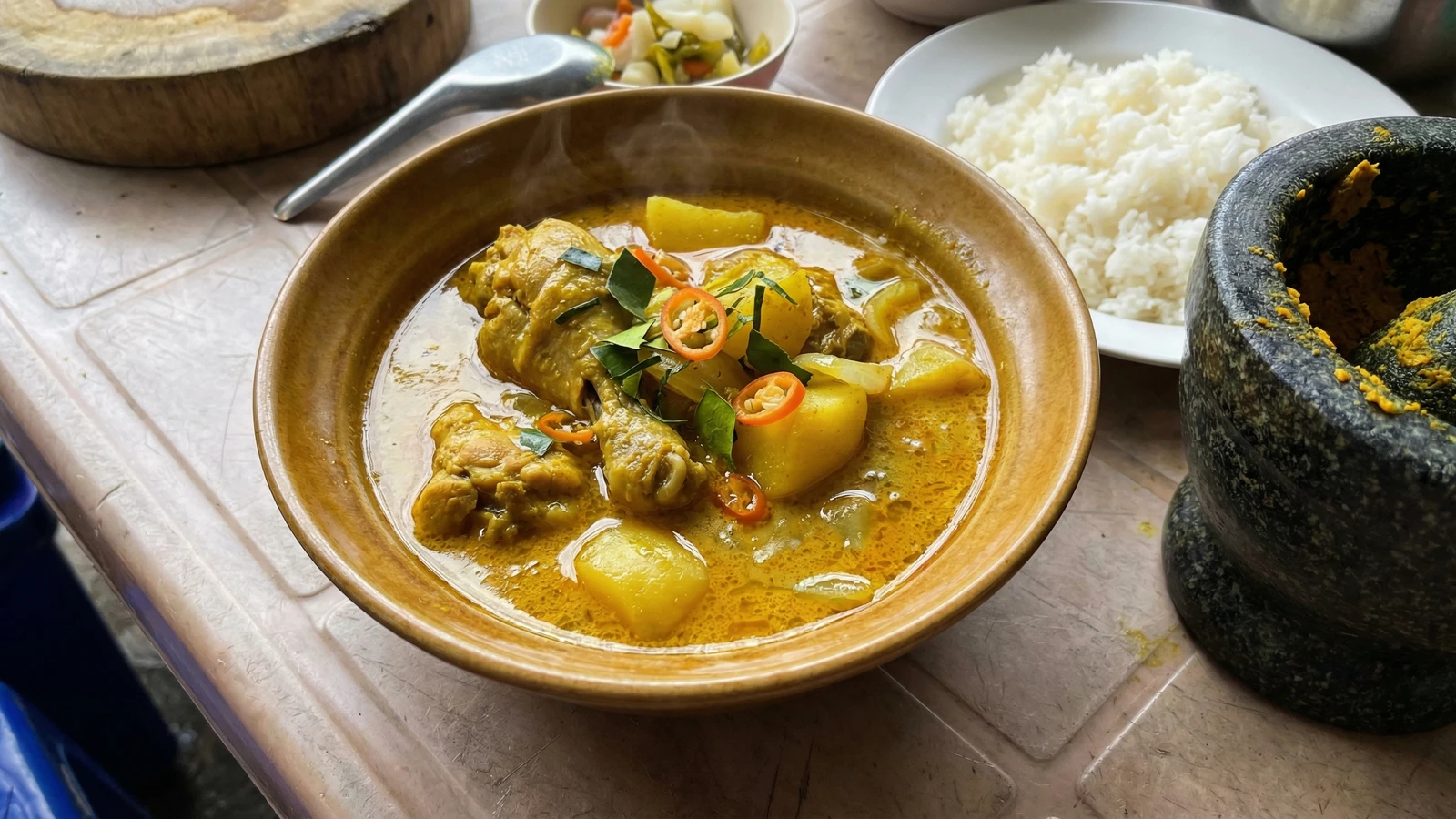
The spice trade built this curry: turmeric, cumin, coriander seed pounded into a kreung tam that's unmistakably Thai. Indian spices, Thai principles, four pillars intact.
Every Thai curry starts in the mortar. Gaeng kari is no exception. But this kreung tam tells a different story than green or red curry. You'll pound turmeric, cumin, and coriander seed alongside lemongrass, galangal, and shrimp paste. Indian spices meeting Thai aromatics in the same krok. That's not fusion. That's centuries of trade routes doing what trade routes do: carrying ingredients across borders until local cooks make them their own.
Ajarn always said the kreung tam is the identity of the dish. Change the paste, change the curry. Green curry paste has fresh green chilies. Red has dried red chilies. Yellow has turmeric. Lots of it. Fresh turmeric root, pounded until the paste turns the color of a monk's robe, staining your mortar, your pestle, your fingers. That golden color isn't decoration. It's the signature. If your gaeng kari isn't deeply, almost aggressively yellow, you didn't use enough.
Here's what people get wrong about gaeng kari: they think mild means simple. It's not. The mildest heat in the Thai curry system doesn't mean the least complex. Dry-roast the coriander and cumin seeds before they go into the mortar. That step releases volatile oils and creates new flavor compounds through the Maillard reaction. The seeds should smell warm, nutty, almost sweet. Then you pound them with the chilies, the garlic, the shallots, the lemongrass, the galangal, the fresh turmeric, the cilantro root, the shrimp paste. Nine ingredients again. The system at work.
Crack the coconut cream. Fry the paste in the thick head of the cream until the oil separates and the kitchen smells like a spice market on fire. Then the chicken, the potatoes, the onion, the thin coconut milk. Fish sauce for salt. Palm sugar for sweet. The four pillars hold, even when the spice palette borrows from another tradition. That's what makes Thai food a system and not just a collection of recipes.
The word "kari" derives from the Tamil "kari," pointing directly to Indian trade influence on Central Thai cuisine. Yellow curry likely entered the Thai repertoire through centuries of contact with Indian merchants in Bangkok and the Gulf coast, absorbing turmeric, cumin, and coriander seed into the existing kreung tam framework. Unlike Massaman (which carries Persian and Malay Muslim influences via the southern peninsula), gaeng kari represents a more direct Indian-to-Central-Thai adaptation, with potatoes and onions reflecting Indian curry conventions that Thai cooks adopted and governed with their own four-pillar seasoning system.
Quantity
7
seeded, soaked in warm water 15 minutes
Quantity
1 tablespoon
dry-roasted
Quantity
1 teaspoon
dry-roasted
Quantity
1 teaspoon
Quantity
4
roughly chopped
Quantity
6 cloves
Quantity
2 stalks
tender inner part only, sliced thin
Quantity
3 slices
1/4 inch thick
Quantity
3 tablespoons
sliced
Quantity
3
scraped and chopped
Quantity
1 teaspoon
Quantity
1 teaspoon
Quantity
1 teaspoon
Quantity
400ml
Quantity
400ml
Quantity
500g
cut into bite-sized pieces
Quantity
300g
peeled, cut into 2cm cubes
Quantity
1 medium
quartered
Quantity
2 tablespoons
Quantity
1 tablespoon
Quantity
for serving
| Ingredient | Quantity |
|---|---|
| dried red chilies (prik chi fa haeng)seeded, soaked in warm water 15 minutes | 7 |
| coriander seeds (look pak chi)dry-roasted | 1 tablespoon |
| cumin seeds (yira)dry-roasted | 1 teaspoon |
| white peppercorns (prik thai khao) | 1 teaspoon |
| shallotsroughly chopped | 4 |
| garlic | 6 cloves |
| lemongrass (takhrai)tender inner part only, sliced thin | 2 stalks |
| galangal (kha)1/4 inch thick | 3 slices |
| fresh turmeric (kha min)sliced | 3 tablespoons |
| cilantro roots (rak pak chi)scraped and chopped | 3 |
| kaffir lime zest (phiw makrut) | 1 teaspoon |
| shrimp paste (kapi) | 1 teaspoon |
| salt | 1 teaspoon |
| coconut cream (hua kathi) | 400ml |
| coconut milk (hang kathi) | 400ml |
| bone-in chicken thighscut into bite-sized pieces | 500g |
| waxy potatoespeeled, cut into 2cm cubes | 300g |
| onionquartered | 1 medium |
| fish sauce (nam pla) | 2 tablespoons |
| palm sugar (nam tan pip) | 1 tablespoon |
| steamed jasmine rice | for serving |
Set a dry pan over medium heat. Add the coriander seeds and cumin seeds. Shake the pan constantly. Within two minutes you'll smell it: warm, nutty, almost like toasted bread. That's the volatile oils releasing. When the seeds darken one shade and the aroma fills the kitchen, they're done. Pull them off the heat immediately. Cumin goes from toasted to burnt in seconds. Grind the toasted spices and peppercorns to a powder in the mortar. Set aside.
Start with the drained chilies and salt in the granite mortar. Pound to break them down into fibrous strands. Add the ground toasted spices. Pound until incorporated. Now the garlic, shallots: pound to a rough paste. Then the lemongrass, galangal, fresh turmeric, cilantro roots, and kaffir lime zest. Pound each addition until it merges with the mass before adding the next. The turmeric will stain everything golden. Good. That's the point. Finish with the shrimp paste. Pound until you have a smooth, fragrant paste the color of saffron. The kitchen should smell like a spice market. If it doesn't, keep pounding.
Pour the thick coconut cream into a heavy-bottomed pot or wok over medium heat. Stir occasionally. After five or six minutes, you'll see the cream start to separate: the clear coconut oil will pool at the edges and the surface will look broken, almost curdled. That's what you want. That's "cracking" the cream. The oil separates from the solids and becomes the frying medium for your paste. If it doesn't crack, your coconut cream has stabilizers in it. Use a better brand next time.
Add three to four tablespoons of the kreung tam to the cracked coconut cream. Stir it into the oil. Fry for three to four minutes, stirring constantly. The paste will darken slightly and the oil will turn golden-orange from the turmeric. The aroma shifts from raw to cooked: deeper, rounder, with the cumin and coriander blooming in the hot fat. When you see oil pooling around the edges of the paste and the whole thing smells intoxicating, the paste is cooked. This step is the difference between a curry that tastes like raw spices and one that tastes like a curry.
Add the chicken pieces to the pot. Toss them through the fried paste and coconut oil until every piece is coated in that golden paste. Cook for three minutes, turning the pieces so the paste sears onto the surface. The chicken doesn't need to cook through here. It just needs a coat of armor.
Add the potatoes and onion quarters. Stir once. Pour in the thin coconut milk. Bring to a gentle simmer, not a rolling boil. Boiling breaks coconut milk and makes the curry greasy and thin. A gentle simmer keeps the liquid creamy and emulsified. Let it cook for twenty minutes. The potatoes should be tender when pierced with a knife, the chicken cooked through, the broth golden and fragrant.
Add the fish sauce and palm sugar. Stir to dissolve the sugar. Taste. The curry should be: rich and creamy first, gently spiced second, salty from the nam pla, sweet from the palm sugar just rounding the edges. The heat is a background warmth, not a punch. That's gaeng kari. Adjust. More fish sauce if it tastes flat. A pinch more sugar if it's too sharp. Ladle over jasmine rice. Serve immediately while the curry is still hot enough to steam.
1 serving (about 375g)
Culinary guides, cultural storytelling, and the editorial depth that makes cooking meaningful.
Discover Culinary ExplorerChef Fai
The four pillars live at the bottom of the bowl before the noodles ever touch it: nam pla for salt, sugar for sweet, vinegar for sour, chili for heat. Every noodle cart in Bangkok runs on this principle.

Chef Fai
The kreung tam fried in cracked coconut cream until the oil bleeds red. That's the technique. Concentrated, semi-dry, spooned thick over crispy fish. This is what happens when the four pillars meet restraint.

Chef Fai
Isan foraging in a bowl: wild taro stems stripped of their sting, simmered in padaek broth with a pounded chili paste and yanang leaf extract. The land feeds you if you know the rules.

Chef Fai
Lanna's kreung tam breaks from Central Thai rules: ginger over galangal, cumin and coriander from Burmese spice routes, tamarind for sour instead of lime. The North has its own system, and this curry is its crown.