
Chef Lupita
Acambaritas de Acámbaro
Guanajuato's daily bread from Acámbaro, a small glazed roll built on pata, enriched with manteca de cerdo, and baked until the top shines lightly for merienda.
A cooking platform built around craft, culture, and the stories behind what we eat.
Created by
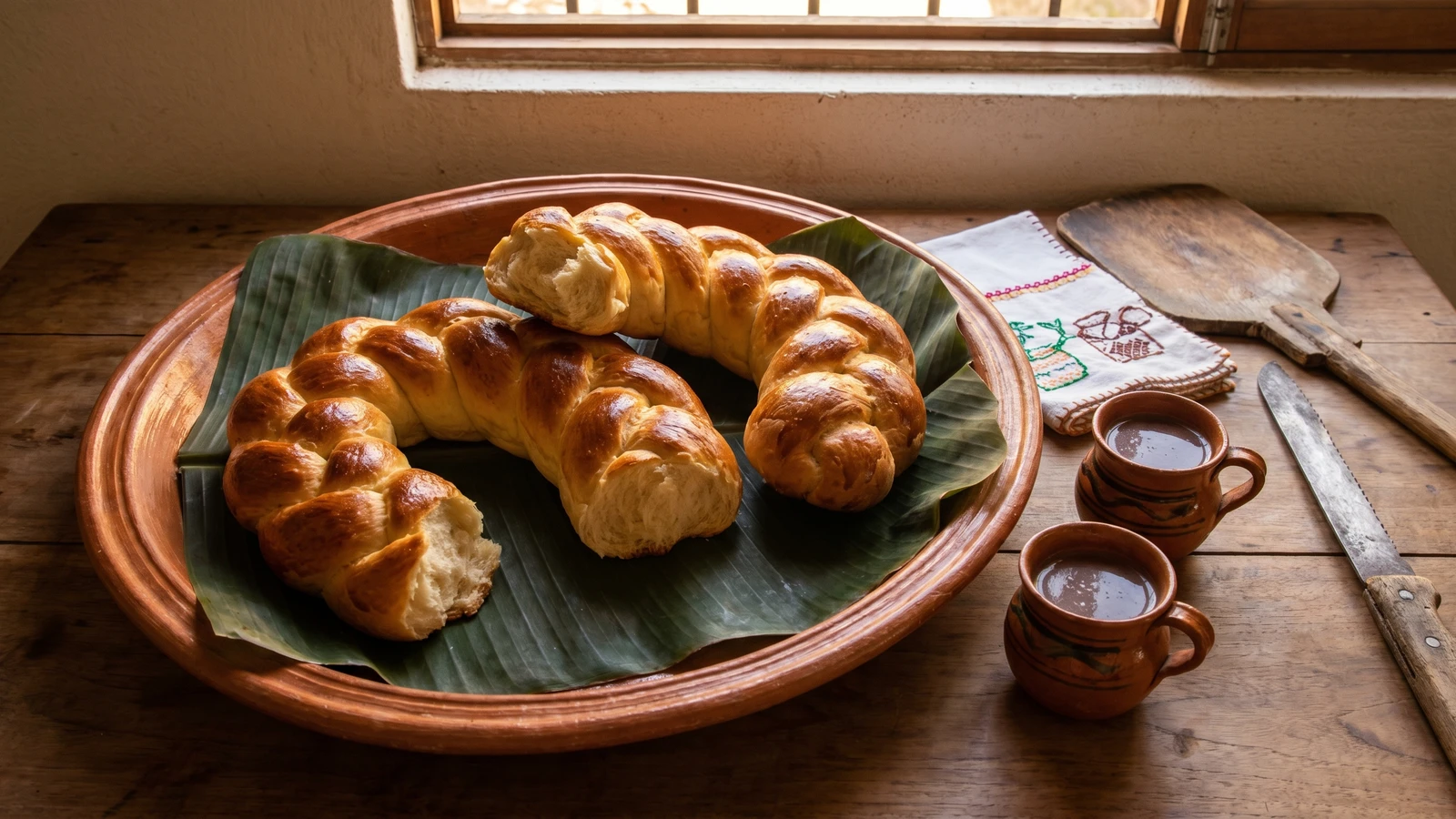
Tabasco's pan de riñón from Frontera is an enriched wheat braid curved into a kidney shape, the sweet bread of Centla holidays, family visits, and coffee at the river table.
Tabasco, Centla, the port of Frontera where the Grijalva opens toward the Gulf: that is where pan de riñón lives. This is not a concha, not a rosca, not a generic sweet braid with a pretty name. The kidney curve is the identity. A Frontera cook sees that shape and knows the bread before she smells it.
Wheat does not belong naturally to the wetlands of Tabasco. It arrived by sacks through trade, by river, by port, and the women of Frontera made it their own with eggs, sugar, butter, and manteca de cerdo. The banana leaf under the dough is not decoration. It protects the bottom, perfumes the crust lightly, and reminds you where you are cooking. Cada estado, su propia cocina.
The work is in the dough and the braid. Enriched dough asks for patience because fat slows the rise and humidity in Tabasco changes everything. Do not drown the dough in flour because your hands are nervous. Let it rest, knead it until it turns smooth, braid it with a firm hand, then curve it into that riñón shape. This is a bread made by feel as much as by measurement.
There are no chiles here. Not every Mexican dish announces itself with chile and lime. This is a 32-state cuisine, and in Frontera, the holiday table can smell like golden wheat, vanilla, egg wash, and a wood-fired horno. Saber cocinar es saber vivir.
Local accounts in Frontera, Tabasco, trace pan de riñón back more than 150 years, to the port-era bakeries of Centla when wheat flour, sugar, cacao, timber, and other goods moved along the Gulf and Grijalva trade routes. The bread belongs to Tabasco's panadería tradition, distinct from older corn and cacao preparations such as pozol, totoposte, and waj. Its name comes from the curved kidney outline, and Frontera bakers distinguish it from a plain trenza by that shape as much as by the enriched dough.
Quantity
1 large piece
wiped clean and cut to fit a half sheet pan
Quantity
1 cup
warmed to about 100F
Quantity
2 1/4 teaspoons
Quantity
1 teaspoon
Quantity
4 3/4 cups
plus more only for dusting
Quantity
1/2 cup
Quantity
1 1/4 teaspoons
Quantity
3
room temperature
Quantity
1 tablespoon
Quantity
6 tablespoons
softened
Quantity
3 tablespoons
room temperature
Quantity
1
beaten with 1 tablespoon whole milk
Quantity
1 tablespoon
Quantity
2 tablespoons
Quantity
2 tablespoons
| Ingredient | Quantity |
|---|---|
| fresh banana leafwiped clean and cut to fit a half sheet pan | 1 large piece |
| whole milkwarmed to about 100F | 1 cup |
| active dry yeast | 2 1/4 teaspoons |
| granulated sugar for blooming yeast | 1 teaspoon |
| bread flour or all-purpose wheat flourplus more only for dusting | 4 3/4 cups |
| granulated sugar | 1/2 cup |
| fine sea salt | 1 1/4 teaspoons |
| large eggsroom temperature | 3 |
| Mexican vanilla extract | 1 tablespoon |
| unsalted buttersoftened | 6 tablespoons |
| manteca de cerdoroom temperature | 3 tablespoons |
| large egg for egg washbeaten with 1 tablespoon whole milk | 1 |
| whole milk for egg wash | 1 tablespoon |
| granulated sugar for syrup | 2 tablespoons |
| water for syrup | 2 tablespoons |
Pass the banana leaf quickly over a gas flame or across a hot dry comal until it turns glossy and flexible. Do not char it. Line a half sheet pan with the softened leaf, trimming it so it sits flat. This is how the bottom of the bread stays protected and takes on that faint green aroma without being wrapped like a tamal.
Stir the warm milk, active dry yeast, and 1 teaspoon sugar together in a small bowl. Let it stand for 8 to 10 minutes, until foamy on top. If it stays flat, your yeast is dead or your milk was too hot. Start again. Bread does not forgive dead yeast.
In a large bowl or the bowl of a stand mixer, combine the flour, 1/2 cup sugar, and salt. Add the yeast mixture, 3 eggs, and Mexican vanilla. Mix until a rough dough forms. Knead for 4 minutes, then add the softened butter and manteca de cerdo in small pieces. Keep kneading until the dough turns smooth, elastic, and slightly tacky, about 10 minutes in a mixer or 15 minutes by hand. La manteca es el sabor, and here it gives the crumb tenderness that butter alone does not.
Shape the dough into a ball and place it in a lightly greased bowl. Cover with a clean cloth and let it rise in a warm spot until doubled, 1 1/2 to 2 hours. In a humid Frontera kitchen, the dough may feel softer than you expect. That is normal. Add flour only if it is truly unworkable, not because you want a dry dough that behaves like clay.
Turn the risen dough onto a lightly floured table and press out the air gently. Divide it into 6 equal pieces. Roll each piece into a rope about 18 inches long, keeping the center slightly thicker than the ends. Make two 3-strand braids, pinching the ends closed. Curve each braid into a kidney shape, rounded on one side and tucked inward on the other, then tuck the ends underneath so the shape holds. Así se hace y punto.
Set the two shaped loaves on the banana leaf-lined pan, leaving space between them. Cover loosely and let them proof for 45 to 60 minutes, until puffy and almost doubled. Press one loaf lightly with a fingertip. The dent should fill back slowly. If it springs back fast, wait. If it collapses, you waited too long.
Heat the oven to 350F. If you have a baking stone, put it on the middle rack and heat it for 30 minutes so it acts more like the floor of a panadería horno. Home ovens are not Frontera wood-fired ovens, but you can still respect the method by giving the bread steady bottom heat.
Brush the loaves gently with the beaten egg and milk. Do not flood the creases of the braid. Bake for 25 to 30 minutes, rotating the pan once, until the ridges are deep golden, the low spots are honey-colored, and the bread sounds hollow when tapped underneath. If you use a thermometer, the center should read about 190F.
While the bread bakes, simmer 2 tablespoons sugar with 2 tablespoons water for 1 minute, just until clear. Brush this thin syrup over the loaves as soon as they come out of the oven. Use a light hand. You want shine, not a sticky candy shell. Let the bread rest at least 30 minutes before slicing so the crumb settles instead of tearing.
Slice thickly and serve at the table with coffee, hot chocolate, or cacao atole in jícaras. This is a family bread, not an individual pastry. Put the loaves in the center and let people cut what they want. Recetas probadas y garantizadas.
1 serving (about 85g)
Culinary guides, cultural storytelling, and the editorial depth that makes cooking meaningful.
Discover Culinary ExplorerChef Lupita
Guanajuato's daily bread from Acámbaro, a small glazed roll built on pata, enriched with manteca de cerdo, and baked until the top shines lightly for merienda.

Chef Lupita
Michoacan's Tinguindin aguacatas are flat, leaf-scored sweet breads made with harina de trigo, piloncillo, anise, and manteca de cerdo, shaped by hand for the wood oven.

Chef Lupita
From Ajijic on Lake Chapala, Pan Tachihual is a lightly sweet wedding loaf built with harina de trigo, harina de maiz, piloncillo, manteca, anise, and the old Guadalajara pata.

Chef Lupita
Comitán's pan de yema shaped into little pigs, birds, and rabbits, a Chiapas bakery bread rich with egg yolks, manteca de cerdo, and anís, baked golden on hoja de plátano.