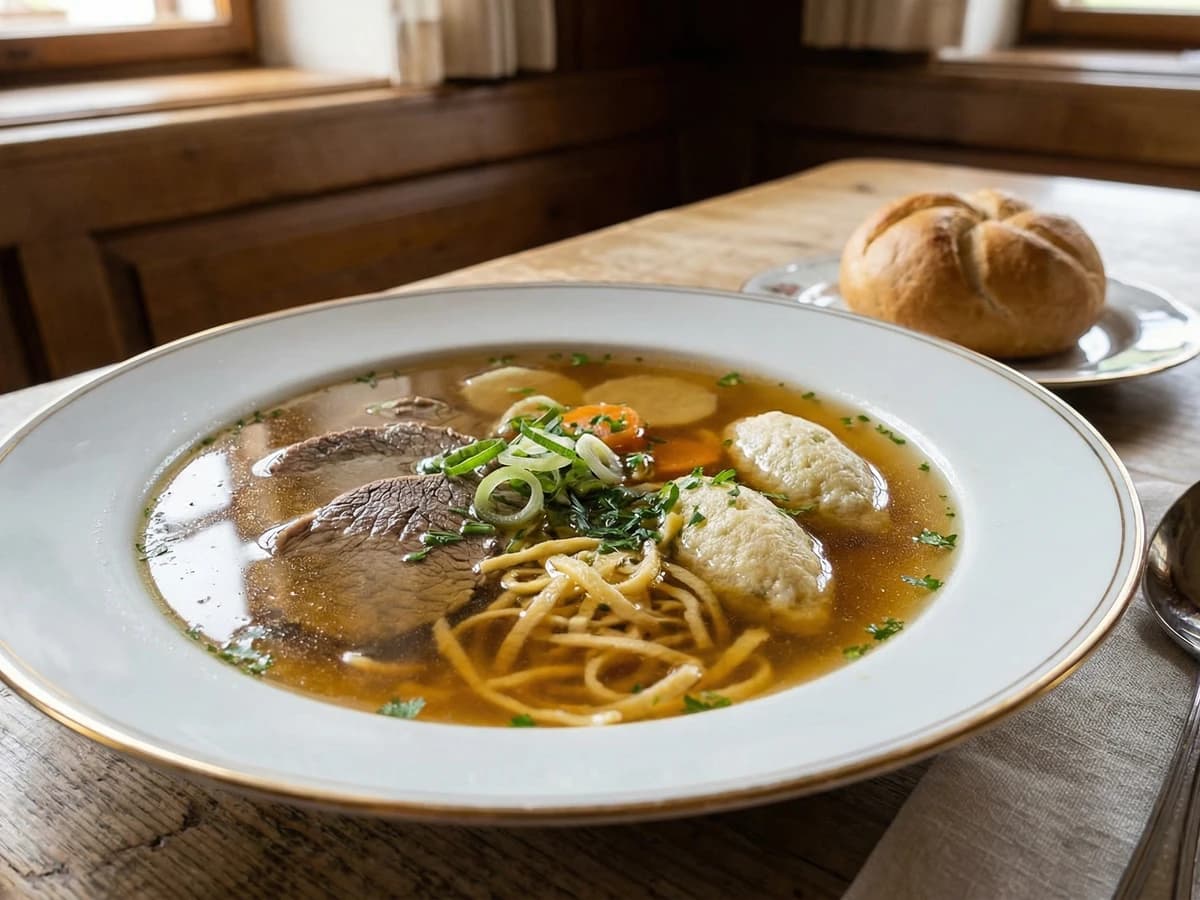
Clear, golden Rindssuppe ladled over herb-flecked pancake ribbons, the opening course that tells you everything about whether an Austrian cook takes their kitchen seriously.
Soups & Stews
Austrian
Weeknight
Comfort Food
30 min
Active Time
2 hr 30 min cook•3 hr total
Yield6 servings
Gretel always said you can judge an Austrian kitchen by its broth. Not by its Torte, not by its Schnitzel. By its broth. If the Rindssuppe is clear and golden and honest, the rest will follow. If it's cloudy and thin and tastes like it came from a packet, save yourself the trouble and leave.
Frittatensuppe was the first proper dish I learned to make on my own. Not with Gretel watching, not with my grandmother Eva guiding my hands, but alone in my flat during my first year at GAFA in Vienna. I had a single pot, a cheap pan, and homesickness that hit like weather. So I made broth. I stood in the Naschmarkt on a Tuesday morning buying marrow bones from a butcher who looked at me like I was someone's lost granddaughter, and I carried them home on the U-Bahn in a paper bag that leaked. The broth simmered all afternoon while I studied. The Frittaten took ten minutes. When I sat down to eat it that evening, I was back in Eva's kitchen in Kent, five years old, watching Gretel taste from a wooden spoon and nod.
The beauty of this dish is that it hides nothing. The broth is transparent. You can see straight through to the bottom of the bowl. Every shortcut shows. Every hour of patience shows too. The Frittaten, those thin herb-flecked pancakes rolled tight and sliced into ribbons, float in the liquid and drink it up slowly, turning from firm to silky as you eat. It's the most honest soup I know.
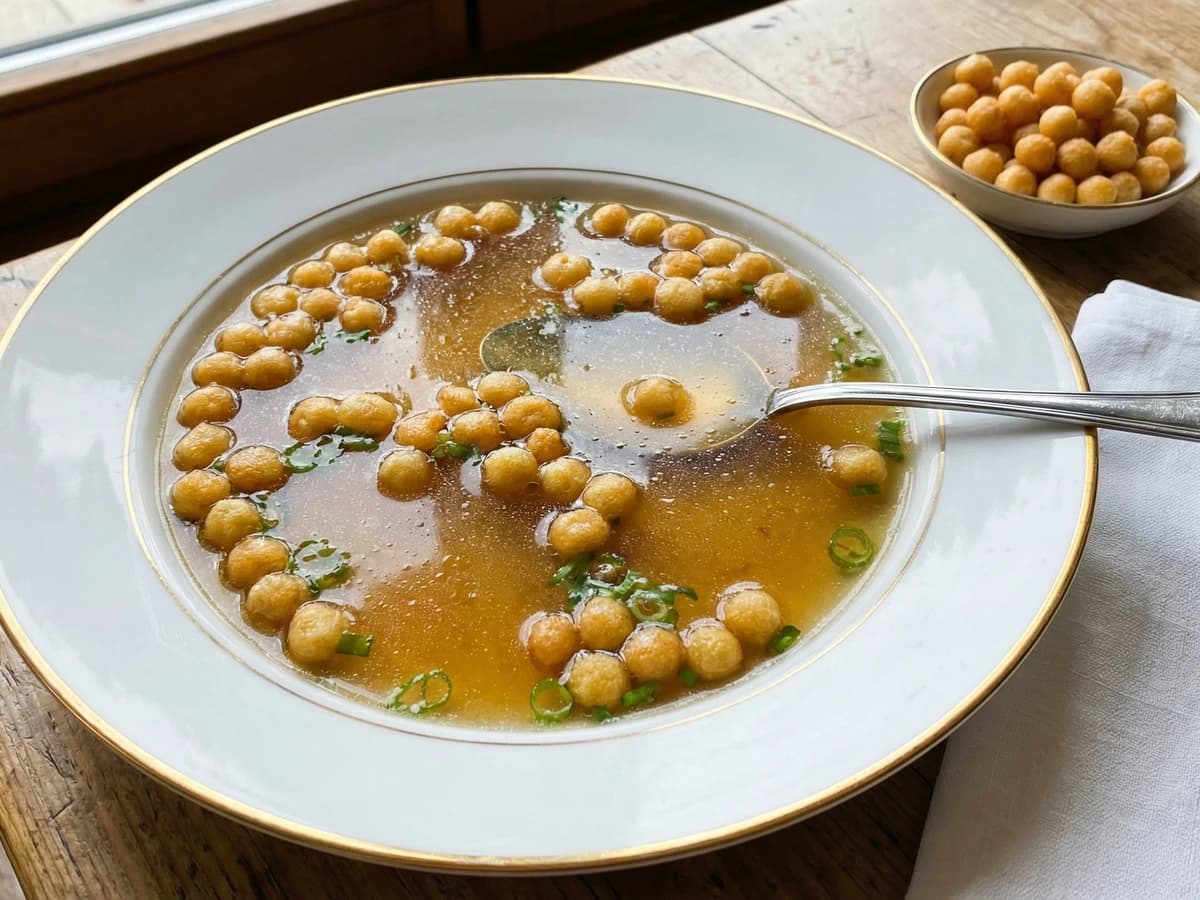
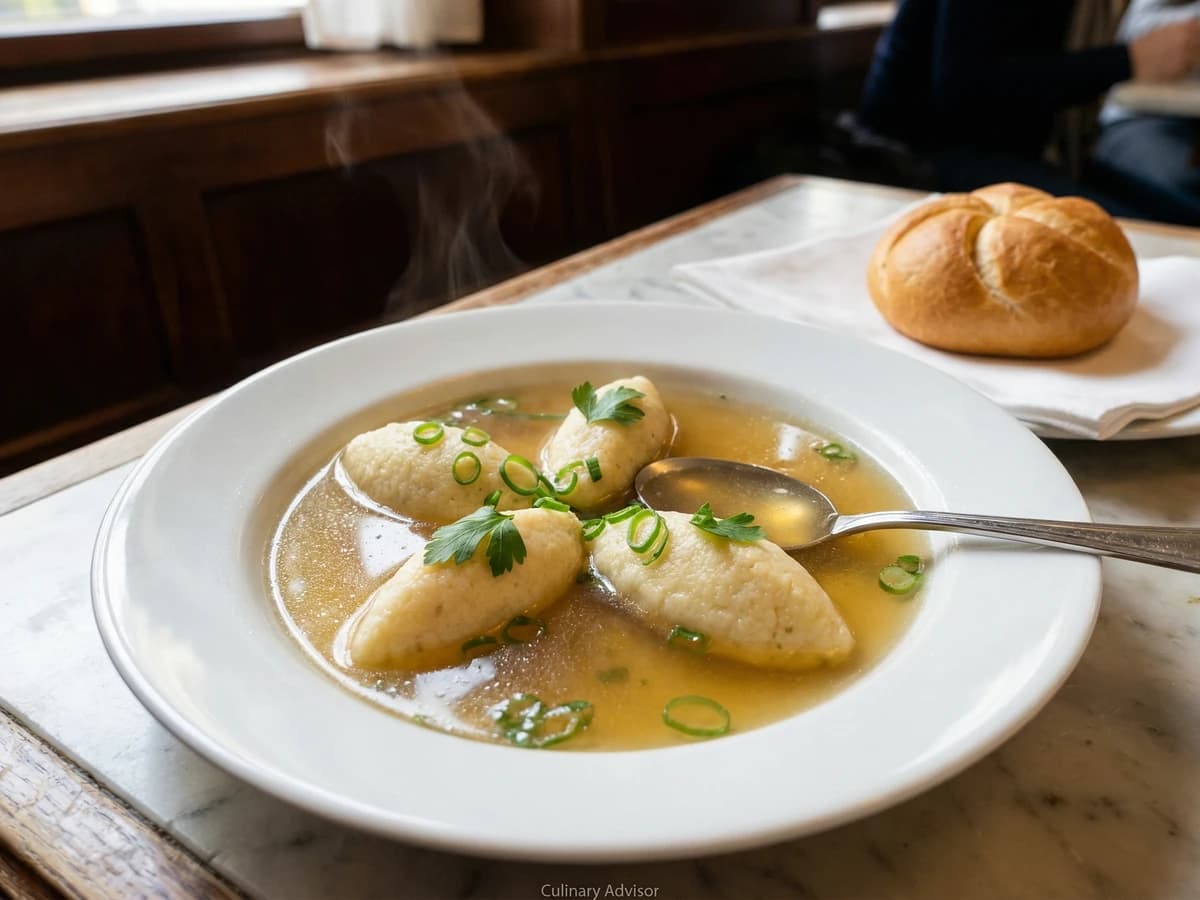
Frittatensuppe takes its name from the Italian frittata, one of many culinary borrowings that flowed into Viennese kitchens through centuries of Habsburg rule over northern Italy. The tradition of clear beef broth served with an elaborate garnish, known as Einlage, became central to Viennese Bürgerliche Küche in the 19th century, when a proper midday meal always opened with soup. The choice of Einlage said something about the occasion: Leberknödel for a hearty Sunday, Griesnockerl for something lighter, and Frittaten for the everyday elegance that Viennese cooks considered their birthright.
The technique, the tradition, and the story behind every dish.
Place the beef bones and shin in your largest pot and cover with three liters of cold water. This has to be cold. Cold water extracts proteins slowly, which means you can skim them off as foam and end up with a clear, luminous broth. Hot water shocks the proteins into the liquid where they stay suspended, and you get murky, dull soup that no amount of straining will fix. Set the pot over medium heat and bring it to a gentle simmer. Don't walk away yet.
Ask your butcher to split the marrow bones. The exposed marrow renders into the broth and gives it a richness and body you cannot get from meat alone.
2
Skim with patience
As the water heats, gray foam will rise to the surface. Skim it with a ladle or large spoon. Keep skimming. More will come. After about twenty minutes, the foam will turn from gray to white and slow down. That's when you know the broth is clean. This is the most important step in the whole recipe and the one most people rush past. Gretel always said: the difference between phony soup and real soup is patience. She meant it.
3
Add the Suppengrün
Once the broth is skimmed clean, add the carrots, parsnip, celeriac, charred onion, leek, lovage (or celery), peppercorns, bay leaves, parsley sprigs, and salt. The charred onion is doing two jobs: it gives the broth that deep amber-gold color, and it adds a faint smoky sweetness you'd miss if it weren't there. Reduce the heat until you see lazy, occasional bubbles breaking the surface every few seconds. Not a simmer. Barely a tremor. Let it cook uncovered for two to two and a half hours.
Lovage (Liebstöckel) is the herb that makes Austrian broth taste like Austrian broth. It's common in gardens across Austria but harder to find elsewhere. If you can't get it, use celery stalks with their leaves. It's not the same, but it fills the same seat at the table.
4
Make the Frittaten batter
While the broth does its slow work, make the pancake batter. Whisk the eggs, flour, milk, salt, and nutmeg together until completely smooth. No lumps. The batter should be thin and pourable, like single cream. It should coat the back of a spoon lightly and run off in a clean stream. Now stir in the chopped parsley and chives. The herbs are not decoration. They give the Frittaten their character, little green flecks visible through the golden pancake. Let the batter rest for fifteen minutes. The gluten needs to relax or the pancakes will be rubbery instead of tender.
If your batter seems too thick, add milk a tablespoon at a time. You want these pancakes paper-thin. A thick batter fights you in the pan and produces chewy strips that overwhelm the broth instead of floating in it.
5
Fry paper-thin pancakes
Heat a non-stick pan (24cm is ideal) over medium heat. Add just enough butter or oil to coat the surface in a thin, glistening film. Lift the pan off the heat, pour in a small ladleful of batter, and immediately tilt the pan in a circle so the batter runs to the edges in an even, paper-thin layer. Set it back on the heat. Cook until the underside is lightly golden and the edges start to lift away from the pan, about sixty seconds. Flip it gently and cook the other side for thirty seconds more. The pancake should be thin enough that you can almost see through it. Stack the finished pancakes on a plate and let them cool completely. You should get five or six from this batter.
6
Strain the broth
After two hours or more, the broth should be deeply golden and fragrant. Your kitchen will smell like a Sunday you haven't had yet. Strain it through a fine-mesh sieve lined with muslin or a clean tea towel into a clean pot. Press nothing. Let gravity do the work. Pushing on the vegetables clouds the liquid, and you didn't spend two hours being patient just to ruin it in the last thirty seconds. Discard the spent bones and vegetables. They've given everything they have. Taste the broth. Adjust the salt. It should taste clean, beefy, and deeply satisfying on its own.
7
Slice the Frittaten
Take the cooled pancakes, stack them two or three at a time, and roll them into a tight cylinder. With a sharp knife, slice the roll into strips about half a centimeter wide. They'll unfurl into ribbons. Some will be neat, some ragged. That's fine. They're going into soup, not a beauty contest. Divide the Frittaten strips among six warm soup bowls.
8
Ladle and serve
Bring the strained broth back to a gentle simmer. Ladle it hot over the Frittaten in each bowl. The pancake strips will unfurl and float, drinking up the golden liquid, softening at the edges while keeping a little structure in the center. Scatter fresh chive rings generously across the surface. Serve immediately, while the broth still shimmers. Mahlzeit!
Chef Tips
•The herbs in the batter are what separate Frittatensuppe from ordinary pancake soup. Use fresh flat-leaf parsley and chives, chopped fine enough that they distribute evenly through the thin batter. Dried herbs won't do it. They sit on the surface like dust and taste like nothing.
•Don't salt the broth heavily at the start. The liquid reduces as it simmers and concentrates everything, including the salt. Season at the end, once you've strained it and know what you're working with. You can always add more. You can't take it back.
•If your broth is good but not quite golden enough, you didn't char the onion hard enough. Next time, press the cut side directly onto a dry, screaming-hot cast iron pan until it's nearly black. Don't be gentle about it.
•Frittaten should be thin. I mean paper-thin. If your pancakes are thick enough to eat on their own with jam, they're Palatschinken, not Frittaten. Pour less batter and tilt faster.
Advance Preparation
•The Rindssuppe can be made up to three days ahead. Refrigerate it and the fat will solidify on the surface into a protective layer. Lift it off before reheating. The broth often tastes even better the next day.
•Frittaten can be made a full day ahead, stacked and wrapped in cling film in the fridge. Cold pancakes are actually easier to roll tightly and slice cleanly. Slice them just before serving.
•If you're making this for a dinner party, do the broth and the pancakes the day before. On the night, all you need is fifteen minutes to reheat, slice, and assemble. Your guests will think you spent the afternoon in the kitchen.
Frequently Asked Questions
Nutrition Information
1 serving (about 450g)
Calories
250 calories
Total Fat
12 g
Saturated Fat
6 g
Trans Fat
0 g
Unsaturated Fat
6 g
Cholesterol
125 mg
Sodium
1000 mg
Total Carbohydrates
22 g
Dietary Fiber
1 g
Sugars
2 g
Protein
15 g
Where cooking meets culture.
Culinary guides, cultural storytelling, and the editorial depth that makes cooking meaningful.