
Chef Takumi
Agedashi Tofu (揚げ出し豆腐)
Agedashi tofu looks like a fryer test. It is only drained tofu, potato starch, clean oil, and a hot dashi broth waiting nearby.
A cooking platform built around craft, culture, and the stories behind what we eat.
Created by
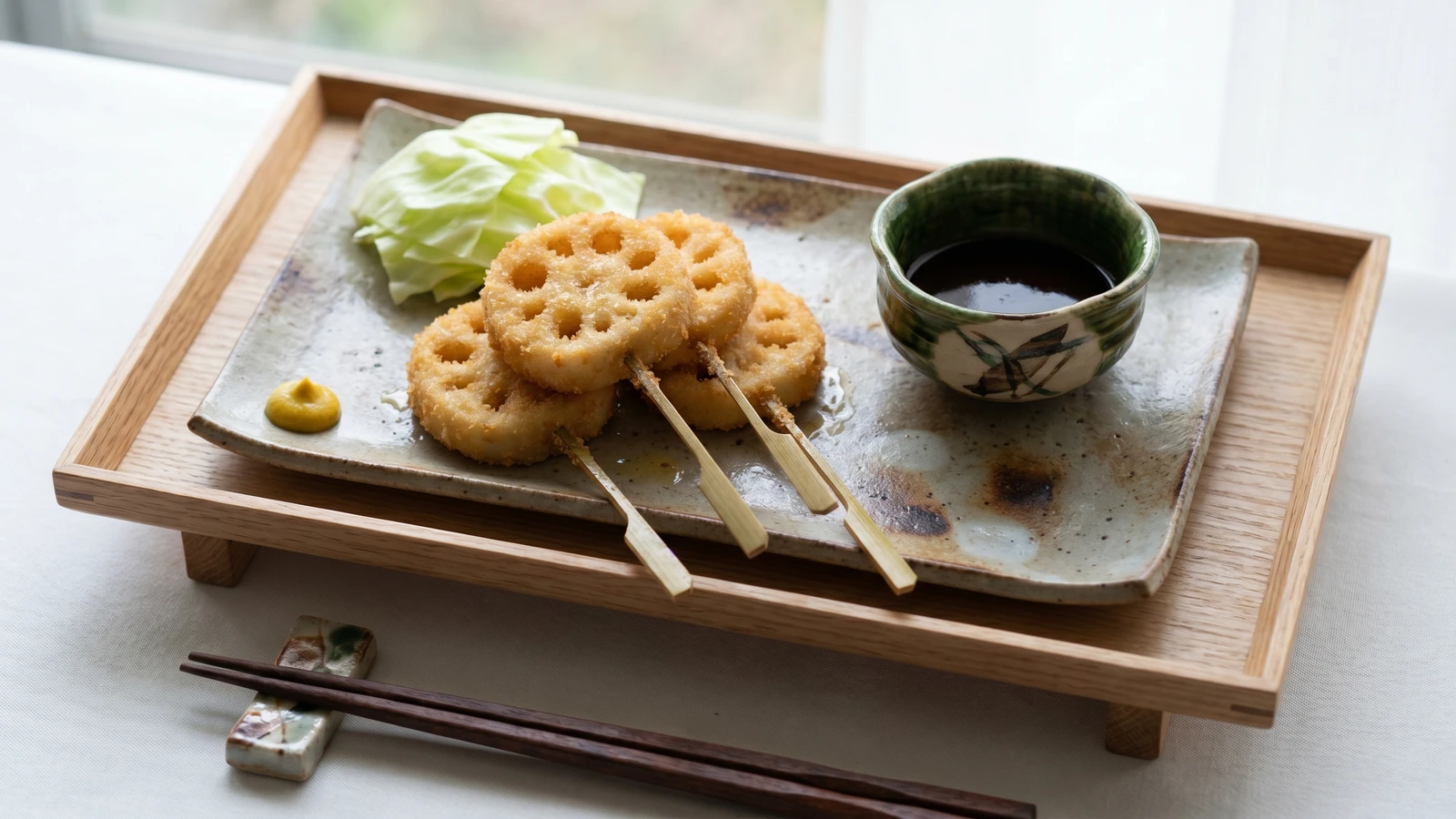
Thick slices of lotus root make the finest vegetable kushikatsu: crisp panko outside, tender inside, and those clean holes showing you did nothing more complicated than cut it well.
Renkon makes its own pattern. Slice through a lotus root and it gives you a white wheel full of clean holes, which is why we don't hide it under a heavy crust or a muddy sauce. In late autumn and winter, when renkon is at its prime, those slices fry up crisp at the rim and softly sweet inside. The ingredient has already done half the arranging for you, a rare kindness from a vegetable with such serious architecture.
People get nervous around kushikatsu because skewers and deep oil sound like shop work. They aren't. The method is plain: slice thick, dry well, coat lightly, fry at a steady heat. The one detail that decides it is the cut. Too thin and the lotus root becomes all crunch; too thick and the panko browns before the center relaxes. Aim for 8 to 10 millimeters, enough body for tenderness and enough edge for crispness.
The holes matter too. Let the batter pass through them, then tap away the excess so panko clings to the rims without plugging every opening. That is how the holes turn lacy instead of bready. Serve the skewers with a thin kushikatsu sauce and cabbage leaves, the way we do it in Osaka: dip once, eat while the coating still answers under your teeth, and leave it room on the plate. Honmono doesn't need to make a speech.
Kushikatsu is most closely tied to Osaka's Shinsekai district, where inexpensive skewered cutlets became a working-class snack in the early Shōwa period. Daruma, founded in Shinsekai in 1929, is often cited as the shop that established the local style: small skewers fried quickly, dipped in a communal pot of thin sauce, and governed by nidozuke kinshi, the no double-dipping rule. Renkon also appears in osechi ryōri because its holes suggest seeing clearly into the year ahead, which made it a natural vegetable skewer once lotus root entered the fry basket.
Quantity
450g (about 1 medium section)
peeled and sliced 8 to 10 mm thick
Quantity
3 cups
for soaking
Quantity
1 teaspoon
for soaking
Quantity
1/4 cup
for dusting
Quantity
1/2 cup
for batter
Quantity
1
Quantity
1/2 cup
Quantity
1/4 teaspoon
Quantity
1 1/2 cups
Quantity
about 4 cups, enough for 5 cm depth
for deep-frying
Quantity
1/2 cup
Quantity
1 tablespoon
Quantity
2 tablespoons
Quantity
1 teaspoon
Quantity
1 teaspoon
Quantity
a small handful
Quantity
to taste
| Ingredient | Quantity |
|---|---|
| fresh lotus root (renkon)peeled and sliced 8 to 10 mm thick | 450g (about 1 medium section) |
| cold waterfor soaking | 3 cups |
| rice vinegarfor soaking | 1 teaspoon |
| all-purpose flourfor dusting | 1/4 cup |
| all-purpose flourfor batter | 1/2 cup |
| large egg | 1 |
| cold water or cold dashi | 1/2 cup |
| fine sea salt | 1/4 teaspoon |
| panko | 1 1/2 cups |
| neutral oil, such as rice bran or canolafor deep-frying | about 4 cups, enough for 5 cm depth |
| usutā sōsu (Japanese Worcestershire-style sauce) | 1/2 cup |
| tonkatsu sauce | 1 tablespoon |
| dashi or water | 2 tablespoons |
| soy sauce | 1 teaspoon |
| sugar | 1 teaspoon |
| raw cabbage leaves (optional) | a small handful |
| karashi (Japanese mustard) (optional) | to taste |
Combine the usutā sōsu, tonkatsu sauce, dashi or water, soy sauce, and sugar in a small pan. Warm it only until the sugar dissolves, then cool it. Kushikatsu sauce should be thinner than tonkatsu sauce, so it slips into the crust instead of sitting heavily on top. Divide it into small cups for serving; at a shop the shared sauce pot comes with nidozuke kinshi, the no double-dipping rule, and at home separate cups keep the same good manners.
Trim the ends of the lotus root and peel it lightly. Slice it into rounds 8 to 10 mm thick; if the root is wide, cut the rounds into half-moons so they sit neatly on the skewer. Put the slices in the cold water with the rice vinegar for 10 minutes. The brief soak clears surface starch, checks a little astringency, and keeps the flesh pale. Leave it much longer and you start washing away the sweetness you came for.
Drain the renkon and lay the slices on a clean towel. Pat both faces dry, and touch the towel to the holes as well. Water under batter spits in the oil and pushes the coating away, so drying is not tidying, it's technique. Thread one round, or two half-moons, onto each bamboo skewer through the solid rim between the holes. Don't drive the skewer through the center. The holes are the point.
Put the dusting flour in one shallow tray and the panko in another. In a bowl, whisk the egg with the cold water or dashi and the salt, then stir in the batter flour just until it loosens into a pourable batter. A few small lumps are harmless. Overmix and the flour turns elastic, which gives you a bready shell instead of a light one.
Dust each renkon skewer lightly with flour and shake off the excess. Dip it into the batter, then hold it over the bowl and tap once or twice so the batter drains from the holes. Press it into the panko, coating the flat faces and rims without packing every opening full of crumbs. Those open holes are why we chose renkon; plug them and it could be any fried vegetable, which would be a small tragedy but still dinner.
Pour the oil into a deep heavy pot or tempura nabe to a depth of about 5 cm. Heat it to 170 to 175°C. Without a thermometer, dip in the tip of a dry bamboo chopstick; small steady bubbles should gather around it. Oil that is too cool drinks into the panko, and oil that is too hot browns the outside before the lotus root softens inside.
Lower in 2 or 3 skewers at a time and fry for 3 to 4 minutes, turning once, until the panko is pale gold and the holes look crisp and lacy. Keep the oil steady between batches. Lift the skewers to an abura-kiri draining rack, or a wire rack set over a tray. A rack lets oil fall away and keeps the underside crisp; paper towels trap moisture under the crust.
Arrange the skewers with raw cabbage leaves, the sauce cups, and a little karashi if you like its heat. Dip once, or spoon sauce over each skewer just before eating. Don't drown it. The sauce should sharpen the sweet, clean taste of the renkon, not become a hiding place. Serve while the coating still answers under your teeth.
1 serving (about 220g)
Culinary guides, cultural storytelling, and the editorial depth that makes cooking meaningful.
Discover Culinary ExplorerChef Takumi
Agedashi tofu looks like a fryer test. It is only drained tofu, potato starch, clean oil, and a hot dashi broth waiting nearby.

Chef Takumi
Aspara-bacon is late-spring asparagus treated with common sense: thin bacon, hot grill, and a last brush of shōyu and mirin so the spear stays sweet while the wrap crisps.

Chef Takumi
This is Osaka street food at its plainest and best: good beef cut small, a thin batter, fine panko, hot beef tallow, and one clean dip in sauce.

Chef Takumi
Buta-bara is not a trick of the grill. Good pork belly, even cutting, steady heat, and the patience to let the fat turn glossy do most of the work.