
Chef Klaus
Badische Dinnele
The Baden flatbread that keeps its bread body: sour cream, onion, and Speck on a yeast dough baked hard and hot until the edges blister.
A cooking platform built around craft, culture, and the stories behind what we eat.
Created by
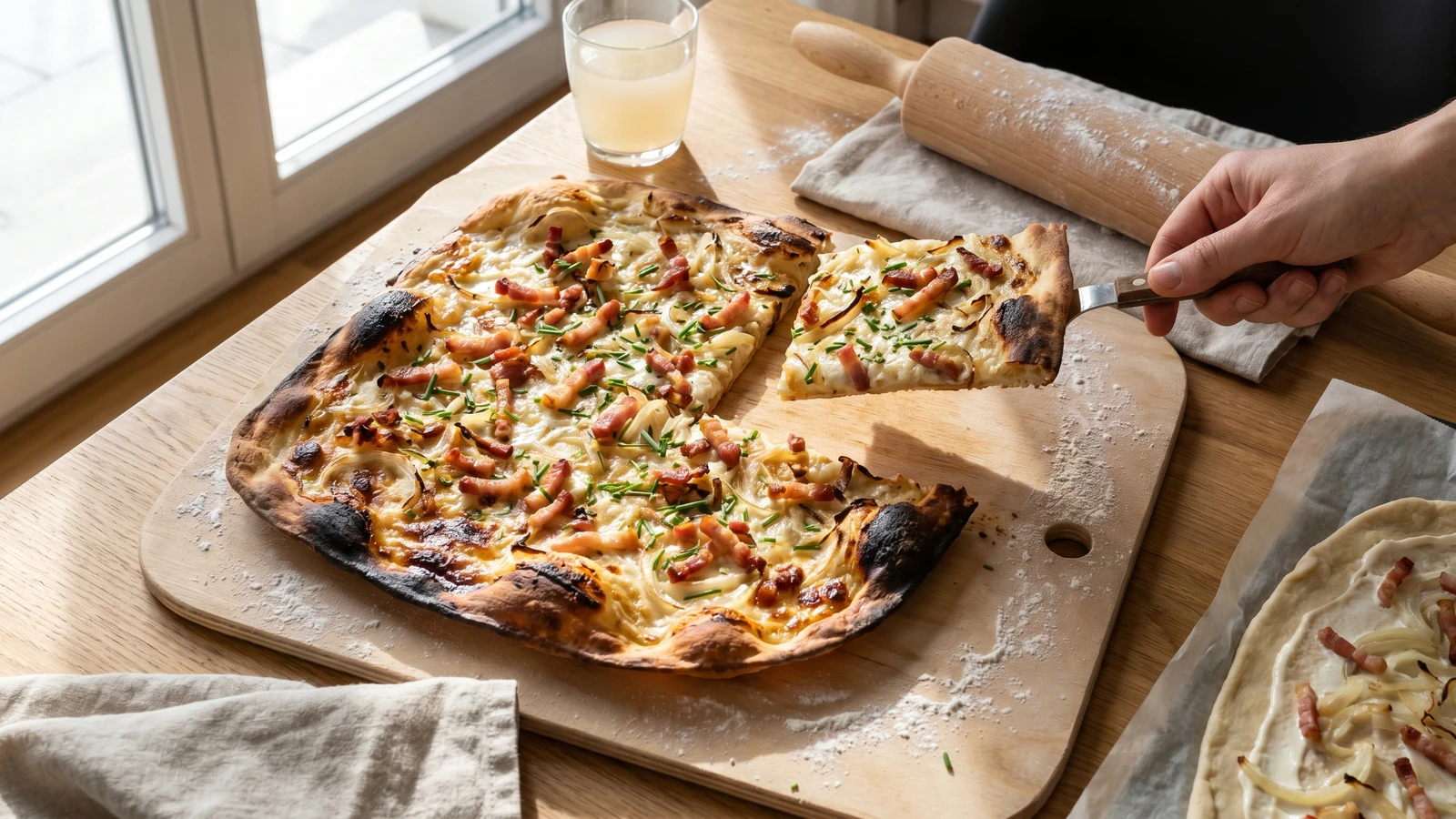
Baden's border tart is bread-oven food: paper-thin dough, sour cream, onion, and bacon, fired hard so the edge blisters before the topping dries out.
Flammkuchen belongs to the Upper Rhine, strongest in Baden, the Palatinate, and across the border in Alsace, where the old bread oven decided the meal. The baker slid in a thin tart to test the oven heat before the loaves. If it scorched in a minute, too hot. If it sat there pale, not ready. Good Flammkuchen still carries that rule: fierce heat, thin dough, no heaviness.
The regions argue over the dairy and the dough. Alsace leans on crème fraîche and fromage blanc, Baden often uses Schmand, the sour cream with more backbone, and the Palatinate wants it beside Federweißer, the young fermenting wine of autumn. Some cooks use a yeast dough. I don't here. For the crisp, thin border tart, oil dough is enough, because the topping is rich and the base should crack clean under the teeth, not chew like pizza.
The one technique that decides it is rolling. Roll the dough so thin you can almost see the board through it, then bake it on a preheated steel, stone, or heavy tray at the hottest setting your oven gives. Thick dough bakes slowly, the onions weep, and the dairy turns dull before the edge blisters. Thin dough and hard heat make the whole thing work in minutes.
Use good smoked bacon, slice the onion thin, and don't bury the tart. Weggeworfen wird nichts: keep the bacon rind for the next lentil soup if your butcher leaves it on. This is food for a weeknight, a wine table, or a board passed outside while people stand around pretending they'll only have one piece.
Flammkuchen, also called Flammenkuchen or Alsatian tarte flambée, comes from the bread-oven kitchens of the Upper Rhine, where a thin dressed dough was used to judge the heat of a wood-fired oven before the main bread went in. The dish is shared across Alsace, Baden, the Palatinate, and Saarland, and its name refers to the flames licking the oven roof, not to alcohol being set alight. Its strongest season at the table is early autumn, when wine regions serve it with Federweißer, the cloudy new wine that is still fermenting.
Quantity
300g
plus more for rolling
Quantity
1/2 teaspoon
Quantity
2 tablespoons
Quantity
150ml
Quantity
200g
Quantity
100g
Quantity
1/4 teaspoon
Quantity
to taste
freshly ground
Quantity
2 medium
sliced very thin
Quantity
150g
cut into thin lardons
Quantity
1 tablespoon
chopped
| Ingredient | Quantity |
|---|---|
| plain flourplus more for rolling | 300g |
| fine salt | 1/2 teaspoon |
| neutral oil or mild rapeseed oil | 2 tablespoons |
| lukewarm water | 150ml |
| crème fraîche or Schmand | 200g |
| fromage blanc or quark | 100g |
| freshly grated nutmeg | 1/4 teaspoon |
| black pepperfreshly ground | to taste |
| onionssliced very thin | 2 medium |
| smoked streaky bacon or Speckcut into thin lardons | 150g |
| chives (optional)chopped | 1 tablespoon |
Mix the flour and salt, then stir in the oil and lukewarm water until a rough dough forms. Knead it for 5 minutes until smooth and elastic; the kneading gives the dough enough strength to roll thin without tearing. Cover it and rest it for 30 minutes, because rested gluten rolls out flat instead of springing back at you.
Put a baking steel, pizza stone, or heavy upside-down tray on the top third rack and heat the oven to 250C, or as hot as it will go, for at least 30 minutes. The surface must be hot before the dough lands, because the base has to set fast while the dairy stays creamy and the onion just softens.
Stir the crème fraîche with the fromage blanc or quark, nutmeg, and black pepper. Keep the salt light or leave it out, because smoked bacon brings enough. Slice the onions thin so they cook in the few minutes the tart has in the oven; thick onion stays raw while the edge burns.
Divide the dough into 4 pieces and roll each one on a floured sheet of baking paper into a long oval or rough rectangle, as thin as you can get it without holes. This is the whole dish. Thick dough holds moisture and turns bready; thin dough blisters at the edge and cooks before the topping has time to split.
Spread a thin layer of the dairy mixture right to near the edge, then scatter over onion and bacon in a loose, even layer. Don't make a mountain. A heavy topping traps water, and then you've made a wet flatbread with ambition. Das ist kein Bierzelt.
Slide the tart, still on its paper, onto the hot steel or tray and bake for 6 to 9 minutes, until the rim is blistered dark in spots, the bacon has browned at the edges, and the dairy is set but still glossy. Watch the first one closely. Every home oven lies differently.
Pull it onto a board, scatter with chives if you're using them, and cut it at once. Flammkuchen waits for nobody; the base is crispest in the first minutes, and the whole pleasure is eating it by hand while the next one bakes. Schön ist, was schmeckt.
1 serving (about 250g)
Culinary guides, cultural storytelling, and the editorial depth that makes cooking meaningful.
Discover Culinary ExplorerChef Klaus
The Baden flatbread that keeps its bread body: sour cream, onion, and Speck on a yeast dough baked hard and hot until the edges blister.

Chef Klaus
The farmhouse loaf that made sense of a weekly oven firing: rye for keeping, wheat for lift, sourdough for the crumb, and a dark crust that earns its crack.

Chef Klaus
The Bavarian pretzel lives by its lye bath: a pale dough goes in, a dark glossy Breze comes out, with thin arms, a proud belly, and salt that bites clean.

Chef Klaus
A Bavarian wheat-rye loaf for the Brotzeit board, mild from ripe sourdough, dark-crusted from a fierce first heat, and firm enough to carry cold cuts without sagging.