
Chef Graziella
Baccalà alla Vicentina
The patient, milk-braised salt cod of the Veneto, where hours of gentle heat transform preserved fish into something silken and profound. Vicenza guards this recipe jealously, and with good reason.
A cooking platform built around craft, culture, and the stories behind what we eat.

Created by
The great liver dish of Venice, where onions melt into silk over an hour of patient stirring, and the liver cooks in barely two minutes. Timing is everything. Restraint is love.
Venice has always understood that liver requires two things: sweetness to balance its mineral depth, and speed to preserve its tenderness. The onions provide the first. Your attention provides the second.
The onions must cook for an hour, perhaps longer. They should become so soft they nearly dissolve, so sweet they taste of caramel. This cannot be rushed. If you try to hurry the onions, they will brown before they sweeten, and the dish will fail. An hour at the stove for the onions. Two minutes for the liver. This proportion tells you everything about where the work lies.
The liver itself should be sliced thin as paper and cooked so briefly that it remains pink at the center. Overcooked liver is leather. There is no recovering from it. You must stand at the stove, you must pay attention, and you must remove the liver the moment it stiffens. Venetians have made this dish for centuries. They learned through repetition what I am telling you now: the difference between sublime and inedible is thirty seconds.
Fegato alla Veneziana appears in Venetian cooking manuscripts as early as the Renaissance, when the Republic's spice trade made exotic seasonings available but local cooks chose restraint instead. The slow-cooked onion technique likely developed among the working families of the Rialto market, where organ meats were affordable and onions were abundant. By the 18th century, it had become Venice's signature liver preparation, served in osterie throughout the city.
Quantity
1 1/2 pounds
sliced very thin
Quantity
4 tablespoons
Quantity
3 tablespoons
Quantity
1 pound
sliced 1/4 inch thick
Quantity
1/3 cup
Quantity
2 tablespoons
chopped fine
Quantity
to taste
Quantity
to taste
freshly ground
| Ingredient | Quantity |
|---|---|
| white or yellow onionssliced very thin | 1 1/2 pounds |
| unsalted butter | 4 tablespoons |
| extra virgin olive oil | 3 tablespoons |
| calf's liversliced 1/4 inch thick | 1 pound |
| dry white wine | 1/3 cup |
| flat-leaf parsleychopped fine | 2 tablespoons |
| kosher salt | to taste |
| black pepperfreshly ground | to taste |
Cut the onions in half from root to tip, then slice them as thin as you possibly can, following the natural curve of the onion. The slices should be nearly transparent. Thick slices will not melt properly and will leave you with a different, lesser dish.
In a large skillet, melt 3 tablespoons of the butter with 2 tablespoons of the olive oil over medium-low heat. When the butter foam subsides, add all the onions and a generous pinch of salt. Stir to coat the onions with the fat. Reduce the heat to low.
Cook the onions slowly, stirring every few minutes, for at least one hour. The onions should never sizzle aggressively. They should barely whisper. If they begin to color before they are completely soft, reduce the heat further and add a tablespoon of water. When finished, the onions will be golden, impossibly soft, and sweet enough to eat with a spoon. They will have reduced to perhaps one quarter of their original volume.
While the onions cook, prepare the liver. Remove any membrane or tubes. Slice the liver into pieces roughly 3 inches long and no thicker than 1/4 inch. Pat each slice completely dry with paper towels. Wet liver will steam instead of sear.
When the onions are melted and golden, transfer them to a warm plate and cover loosely. Do not wash the skillet. The fond left behind is flavor.
Add the remaining tablespoon each of butter and olive oil to the skillet. Raise the heat to high. When the butter foam subsides and the fat is nearly smoking, add the liver slices in a single layer. Do not crowd the pan. Work in batches if necessary. Let the liver cook undisturbed for 45 seconds to one minute, until the bottom is browned.
Turn the liver slices. They should be deeply browned on the seared side. Cook the second side for 30 to 45 seconds. The liver should remain pink inside. The moment the slices stiffen slightly, transfer them to the plate with the onions.
Pour the wine into the hot skillet. It will sizzle violently. Scrape up any browned bits with a wooden spoon. Let the wine reduce by half, about one minute. Return the onions to the skillet and stir to coat them with the pan juices. Return the liver to the skillet and turn the slices gently in the onions. The residual heat will finish warming everything without overcooking the liver.
Taste and adjust salt. Add several grinds of black pepper and the chopped parsley. Toss once more. Transfer immediately to warm plates. Serve at once. Liver waits for no one.
1 serving (about 250g)
Culinary guides, cultural storytelling, and the editorial depth that makes cooking meaningful.
Discover Culinary ExplorerChef Graziella
The patient, milk-braised salt cod of the Veneto, where hours of gentle heat transform preserved fish into something silken and profound. Vicenza guards this recipe jealously, and with good reason.

Chef Graziella
The thick, rough pasta of the Veneto dressed with slow-braised duck, a dish that proves why this region's cooking stands apart from everything else called Italian.

Chef Graziella
A Venetian Lenten dish of startling depth: fat whole-wheat noodles tangled with onions cooked to silk and anchovies dissolved to nothing. Three ingredients. One hour. Umami before we had the word.
Chef Graziella
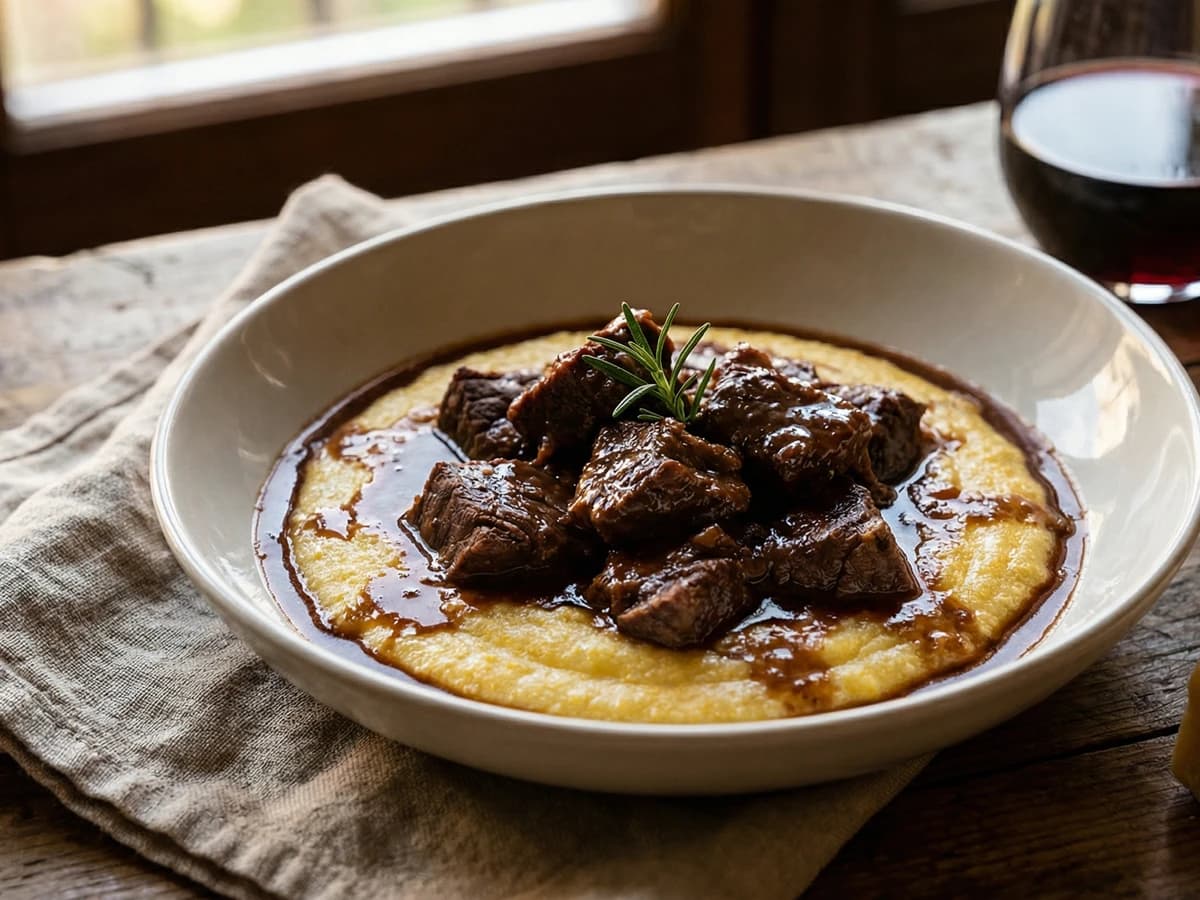
Verona's ancient braise, older than Italy itself, where beef surrenders to Amarone over hours of patient simmering until wine and meat become inseparable. Served always with soft polenta, as the Veronese have done for generations beyond counting.