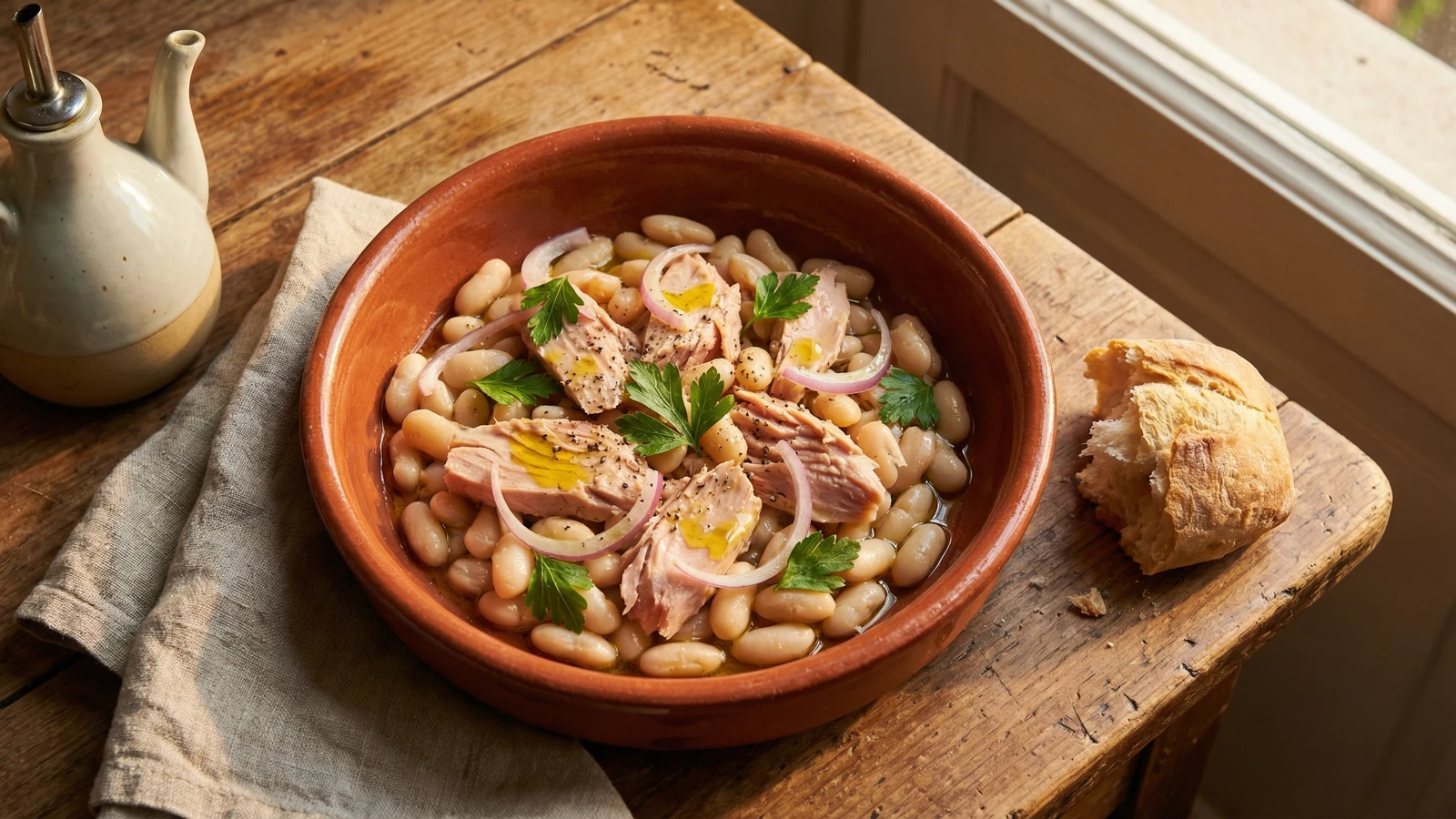
The bean and tuna salad of Tuscany, where four ingredients become dinner. This is what Italian home cooks have made for generations when the pantry seems bare and the day is too warm for the stove.
Salads
Italian, Tuscan
Quick Meal
Weeknight
Potluck
20 min
Active Time
0 min cook•20 min total
Yield4 servings
Fagioli e tonno is proof that the Italian pantry can produce dinner when it seems there is nothing to cook. Beans from the cupboard. Tuna from the jar. An onion. Oil. That is all. What sounds like desperation is, when properly made, something people request.
The beans must be cannellini, the white kidney beans that Tuscans love so much that other Italians call them mangiafagioli, the bean eaters. The tuna must be Italian, packed in olive oil, not the watery stuff in cans. The onion must be sliced thin and handled correctly. The oil must be your best. There is nowhere to hide.
This is not a recipe that rewards additions. I have seen versions with capers, with olives, with tomatoes, with celery, with lemon, with herbs beyond a few parsley leaves. Every addition dilutes the purity of what you started with. The original three ingredients, dressed with oil and perhaps a touch of vinegar, need nothing else. What you keep out is as significant as what you put in.
Tuscan farmers and fishermen have made fagioli e tonno since preserved tuna became affordable in the 19th century. The dish spread from coastal towns inland, where beans were plentiful and protein was not. It remains what Tuscan home cooks make on hot summer evenings when no one wants to stand at the stove.
The technique, the tradition, and the story behind every dish.
Slice the red onion as thin as your knife skills allow. Soak the slices in a bowl of cold water for 15 minutes, then drain and pat thoroughly dry. This mellows the raw bite while preserving the crunch. Tuscans are not shy about raw onion, but they are sensible about it.
If your onion is particularly sharp, add a splash of vinegar to the soaking water. This tames the sulfur compounds without cooking the onion.
2
Prepare the beans
If using canned beans, drain and rinse them thoroughly under cold water. Spread them on a clean kitchen towel and pat dry. Wet beans dilute the dressing and make the salad watery. If you have cooked beans from scratch, drain them while still slightly warm. Warm beans absorb the dressing better than cold ones.
3
Prepare the tuna
Drain the tuna, reserving a tablespoon of the packing oil. Break the tuna into large, irregular chunks with a fork. Do not shred it into mush. You want substantial pieces that hold their own against the beans. The texture contrast matters.
Quality Italian tuna packed in olive oil costs more than the water-packed variety. This is not the place to economize. The oil carries flavor; the water carries nothing.
4
Dress the salad
Place the beans in a wide, shallow serving bowl. Add the olive oil and the reserved tablespoon of tuna oil. Add the vinegar. Season generously with salt and several grinds of black pepper. Toss gently with your hands or two spoons. The beans should glisten but not swim.
5
Add tuna and onion
Scatter the tuna chunks and drained onion slices over the dressed beans. Toss once more, gently, to distribute. The tuna should remain in visible pieces, not disappear into the beans. Taste for salt. Beans absorb salt readily; you may need more than you think.
6
Finish and serve
Scatter the parsley leaves over the top. Drizzle with additional olive oil. Serve at room temperature. Never cold from the refrigerator. Cold deadens the flavor of the oil and mutes the beans. If made ahead, remove from the refrigerator 30 minutes before serving.
Chef Tips
•Seek Italian tuna packed in olive oil. Brands from Sicily or Calabria are excellent. The difference between quality tuna and the supermarket variety is the difference between making this dish worth eating and not.
•If you cook beans from scratch, season the cooking water with a bay leaf, a few sage leaves, and garlic cloves. Drain the beans while slightly warm. They absorb dressing better than cold beans and the texture is superior to anything from a can.
•This salad improves after 30 minutes at room temperature as the beans absorb the dressing. But it does not improve after a day. Make it the day you plan to eat it.
•Tuscans would never refrigerate this salad. If you must, bring it fully to room temperature before serving. Cold oil tastes dull and the beans become starchy.
Advance Preparation
•The salad can be assembled up to 2 hours ahead and left at room temperature, covered loosely.
•If refrigerated, remove 30 minutes before serving and taste for seasoning. Cold food needs more salt.
Frequently Asked Questions
Nutrition Information
1 serving (about 270g)
Calories
435 calories
Total Fat
20 g
Saturated Fat
3 g
Trans Fat
0 g
Unsaturated Fat
16 g
Cholesterol
40 mg
Sodium
740 mg
Total Carbohydrates
32 g
Dietary Fiber
8 g
Sugars
1 g
Protein
31 g
Where cooking meets culture.
Culinary guides, cultural storytelling, and the editorial depth that makes cooking meaningful.