
Chef Lupita
Birria Tacos with Consome
Jalisco's goat birria, born around Cocula and carried into Guadalajara's markets, slow-braised in ancho, guajillo, cascabel, and chile de arbol, then tucked into corn tortillas crisped in its own red fat.
A cooking platform built around craft, culture, and the stories behind what we eat.
Created by
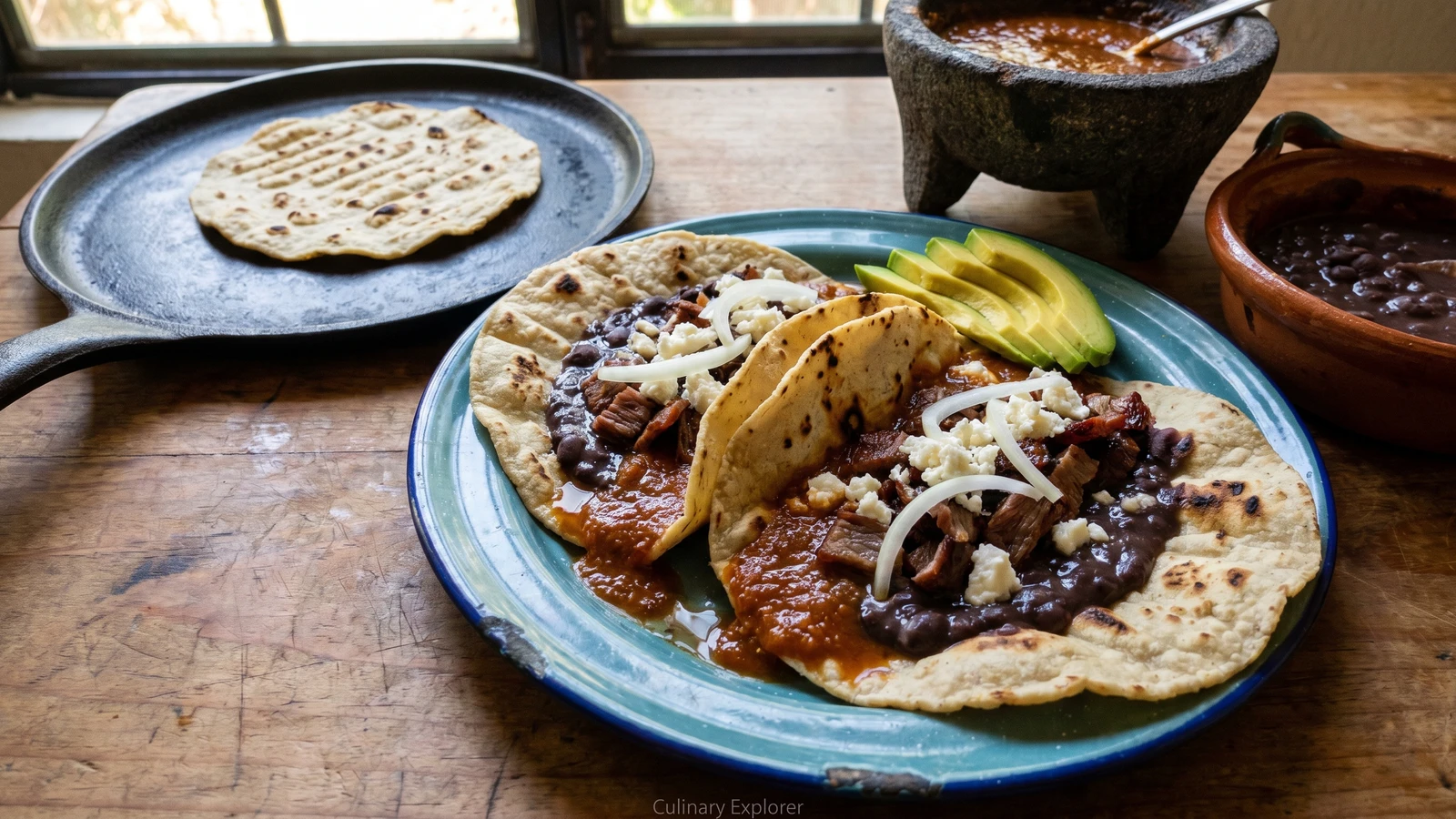
Northern Veracruz crushes its tortillas open on the comal and calls them estrujadas: torn ridges built to catch a cascabel-and-peanut salsa, dark cecina off the asador, refried black beans, queso fresco, and cool avocado.
This is from the Huasteca veracruzana, the north of Veracruz where the state pulls away from the Gulf and climbs into green hill country it shares with Hidalgo and San Luis Potosi. Not the port. Not Xalapa. The Huasteca keeps its own kitchen, and estrujadas are one of its everyday glories.
Estrujar means to crush, to wring. You press the tortilla by hand, cook it on a hot comal, and the moment it comes off you crush it open between your fingers so the layers tear and pucker. Those torn ridges are not a mistake. They are the entire point. They grab the salsa, the bean, and the rendered fat the way a flat tortilla never could. A smooth tortilla carries food. An estrujada holds it.
The salsa is not the guajillo and ancho of the central highlands. The Huasteca cooks with chile cascabel for body and chiltepin for the spark, with jitomate charred on the comal, and with peanut ground right into the sauce. Cecina, thin beef salted and cooked dark. Frijoles negros, never pinto, this far east. Queso fresco and aguacate to settle it all down. Three roots sit on this one plate: the indigenous corn and chile and peanut, the Spanish cattle and salt and cheese, and the African presence the Gulf coast of Veracruz carries in its blood and its cooking. La Tercera Raiz, right there in your hand.
I learned estrujadas in a market kitchen in Tantoyuca from a woman who pressed forty tortillas without once looking down at her hands. She crushed each one straight off the comal, burned her fingertips, and waved me off when I winced. 'Asi se hace,' she said, and went right back to talking about her grandchildren. That is how it is done. Saber cocinar es saber vivir.
The Huasteca is a cultural region older than any modern state line, spanning parts of Veracruz, Hidalgo, San Luis Potosi, Tamaulipas, Puebla, and Queretaro, named for the Huastec (Teenek) people who have farmed its corn for roughly three thousand years. The chiltepin in its salsas is the wild ancestor of all domesticated chiles, a pea-sized pod foraged rather than farmed, while the peanut ground into Huasteca sauces, known in Nahuatl as 'tlalcacahuatl' or earth cacao, was cultivated in Mesoamerica long before the conquest. Veracruz is also the heart of Mexico's Tercera Raiz, the African heritage carried in through the colonial port, a history recognized in the national consciousness only in recent decades and still legible in the foodways, music, and communities of the Gulf coast.
Quantity
1 pound
picked over and rinsed
Quantity
1/2 medium
left whole
Quantity
4 cloves
Quantity
2 sprigs
Quantity
about 6 tablespoons, divided, plus more for the comal
Quantity
to taste
Quantity
8
stemmed and seeded
Quantity
6 to 10, to taste
Quantity
3
Quantity
1/3 cup
skins on
Quantity
3 cloves
Quantity
1/4 medium
Quantity
1 1/4 pounds
Quantity
2 cups (or 1 1/2 pounds fresh masa)
Quantity
about 1 1/4 cups
Quantity
1 cup
crumbled
Quantity
2
sliced
Quantity
for serving
| Ingredient | Quantity |
|---|---|
| dried black beans (frijoles negros)picked over and rinsed | 1 pound |
| white onion (for the beans)left whole | 1/2 medium |
| garlic (for the beans) | 4 cloves |
| fresh epazote | 2 sprigs |
| manteca de cerdo (lard) | about 6 tablespoons, divided, plus more for the comal |
| kosher salt | to taste |
| dried chile cascabelstemmed and seeded | 8 |
| dried chiltepin | 6 to 10, to taste |
| ripe plum tomatoes (jitomate) | 3 |
| raw peanuts (cacahuate)skins on | 1/3 cup |
| garlic (for the salsa) | 3 cloves |
| white onion (for the salsa) | 1/4 medium |
| cecina de res (thin salted beef) | 1 1/4 pounds |
| masa harina (or fresh masa from a tortilleria) | 2 cups (or 1 1/2 pounds fresh masa) |
| warm water (if using masa harina) | about 1 1/4 cups |
| queso frescocrumbled | 1 cup |
| ripe avocados (aguacate)sliced | 2 |
| thinly sliced white onion (optional) | for serving |
Put the rinsed beans in a heavy olla or stockpot with the half onion, the 4 garlic cloves, and one sprig of epazote. Cover with cold water by three inches. No salt yet. Salt early and the skins turn tough and split before the inside softens. Bring to a boil, then drop to a low simmer, partly covered, for about an hour and a half, adding hot water as needed to keep the beans swimming. They are done when one crushes to cream against the roof of your mouth. Now salt the pot and add the second sprig of epazote. In the Huasteca the bean is black, never pinto, this far east.
Melt 3 tablespoons of the manteca in a wide skillet or cazuela over medium heat. Ladle in the beans with a little of their broth and mash them with a bean masher or the back of a wooden spoon. Keep working them until you have a thick, glossy paste that pulls away from the bottom of the pan in a sheet. La manteca es el sabor. The beans should be loose enough to spread but stiff enough to sit on a tortilla without running off the edge. Keep them warm.
Heat a dry comal over medium. Toast the cascabel 20 to 30 seconds a side, until they smell toasty and darken a shade, never black. Cascabel is round and hollow and it rattles, that is the seed you already took out. Pull them off and toast the chiltepin for just a few seconds, they are tiny and fierce and they burn in a blink. Last, toast the peanuts, shaking the comal, until the skins darken and the kitchen smells roasted. Set the chiles and peanuts aside. On the same comal, char the whole tomatoes, turning them, until the skins blister and blacken in patches and the flesh goes soft.
Cover the toasted cascabel with hot water, not boiling, and soak 15 minutes until soft and pliable. Boiling water cooks the skin and turns the salsa bitter. Drain. Into the blender put the soaked cascabel, the chiltepin, the charred tomatoes with their skins, the toasted peanuts, the 3 garlic cloves, and the quarter onion. Add 1/2 cup fresh water and blend to a puree that still has a little grain to it. The peanut is there to give body, you do not want it perfectly smooth. Heat 2 tablespoons manteca in a skillet until it shimmers, pour in the salsa, stand back because it will sputter, and fry it 8 to 10 minutes, stirring, until it darkens to brick red and a film of fat rises to the surface. That film is how you know the raw edge is gone. Salt to taste.
Wipe the comal with a little manteca and set it over medium-high. Lay the cecina out flat. It is thin and already salted, so it needs only a minute or two a side. You want dark caramelized edges and a little char, not a pale gray slab. Pull it off, rest it a minute, then chop it into rough ribbons. Taste a piece. If it reads very salty, that is the cecina doing its job. The bean and the avocado are there to balance it.
If using masa harina, mix it with the warm water and knead 2 minutes into a smooth dough with the feel of soft clay. Press a little ball flat with your thumb, if the edges crack, the masa is dry and needs a spoonful more water. Rest it 10 minutes. Divide into 12 balls. Line a tortilla press with a cut plastic bag, press each ball into a round about 5 inches across, and cook on a hot comal, about 45 seconds on the first side and a minute on the second, until brown freckles appear and the tortilla puffs. Fresh masa from a tortilleria beats any harina if you can get it. The tortilla has to be fresh and hot for what comes next. A day-old tortilla will not estrujar.
This is the dish, so pay attention. The second a tortilla comes off the comal, while it is hot and pliable, crush it. Grab it and squeeze, crumple it half-closed in your hand so the puffed layers tear open and the surface ridges up into folds and pockets. Use a folded cloth if your fingers cannot take the heat. The senoras in Tantoyuca just use their hands and do not flinch. Those torn ridges are the entire reason this dish exists, they catch the bean and the salsa the way a smooth tortilla never will. Work one at a time and dress it right away while it is hot.
Open the crushed tortilla on a warm peltre or clay plate. Spread it with a spoonful of the hot refried black beans, pushing them down into the torn ridges. Spoon the brick-red cascabel-peanut salsa over the top, then pile on a tangle of the chopped cecina. Crumble queso fresco over everything and lay two or three slices of avocado alongside. Add raw onion if you like and keep more salsa on the table. Eat with your hands, immediately, while the tortilla is still hot and the beans are still soft. Recetas probadas y garantizadas.
1 serving (about 670g)
Culinary guides, cultural storytelling, and the editorial depth that makes cooking meaningful.
Discover Culinary ExplorerChef Lupita
Jalisco's goat birria, born around Cocula and carried into Guadalajara's markets, slow-braised in ancho, guajillo, cascabel, and chile de arbol, then tucked into corn tortillas crisped in its own red fat.

Chef Lupita
Sonora's working morning burrito: chicharrón de cáscara stewed in chile colorado with diced potato, rolled tight in a paper-thin tortilla sobaquera and eaten standing up at the carreta.

Chef Lupita
Mocorito's pork chilorio, shredded and confited in lard with chile ancho and pasilla, rolled into a thin handmade flour tortilla. The burrito Sinaloa sends out into the world.

Chef Lupita
Sonora's morning burrito of mashed pinto frijoles puercos and melted queso asadero, wrapped in a paper-thin sobaquera and seared on the comal until the cheese pulls in long strings.