
Chef Juliana
Açaí com Camarão do Pará
You think açaí belongs with banana and granola because that's the version that traveled. In Pará, thick unsweetened açaí sits beside shrimp, rice, and farinha. Anota aí: same fruit, different meal.
A cooking platform built around craft, culture, and the stories behind what we eat.
Created by
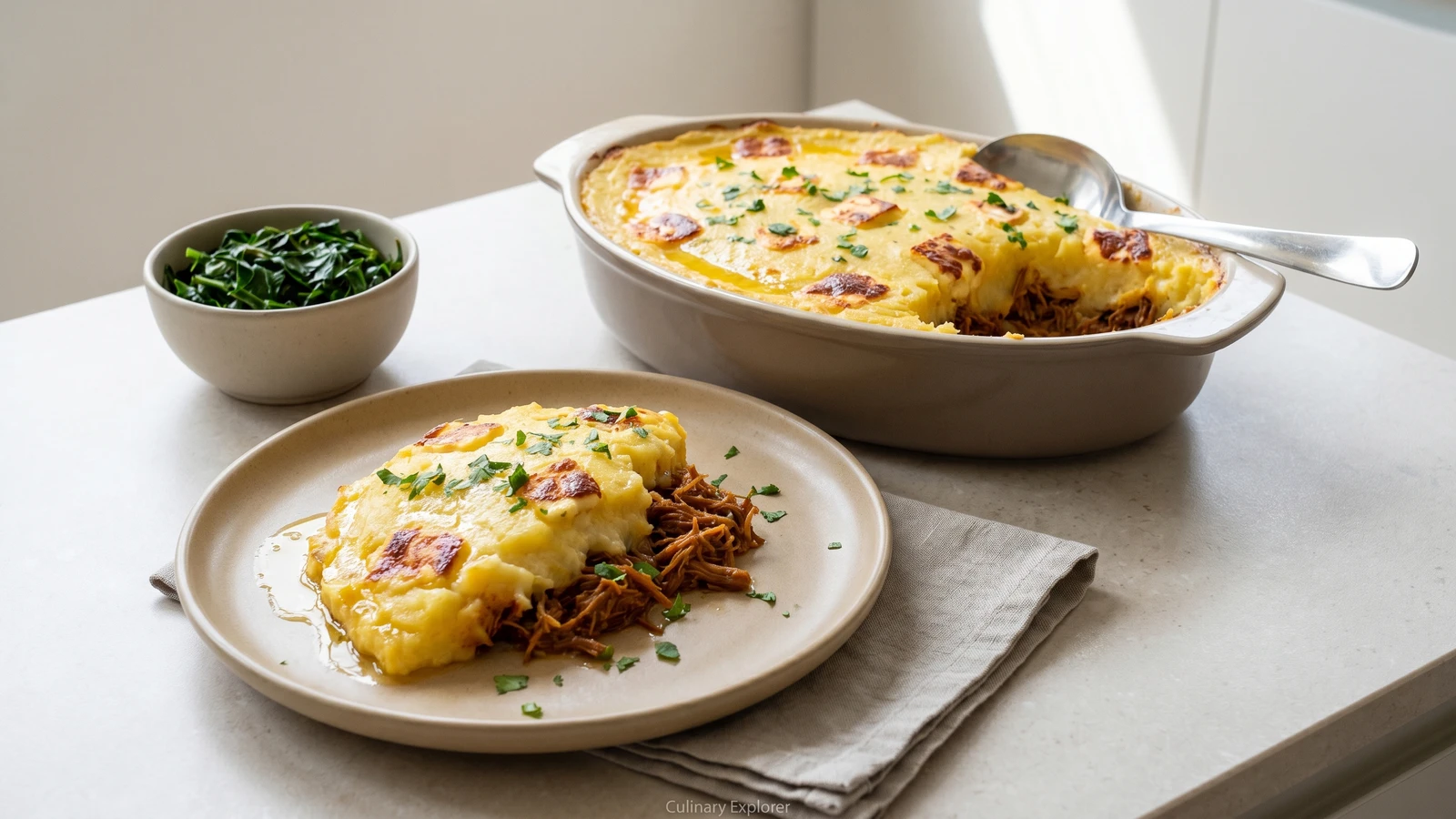
You don't need courage for this, just layers: carne de sol pulled fine, macaxeira mashed smooth, queijo coalho on top, and dinner solved without a packet in sight.
You may be looking at carne de sol and macaxeira thinking, isso não é pra mim. I know that sentence. I said it to a lot of pans before I learned to cook as a grown woman, with my cheap caderno open and onions burning while I pretended everything was under control. Cozinhar não é dom, é um aprendizado. Anota aí.
This is the kind of dish that looks more difficult than it is, which is exactly the nonsense a gente needs to desmontar. You cook the macaxeira until it gives up under a fork, because a purê only gets smooth when the root is truly tender. You refoga onion and garlic in butter and a little oil, because flavor starts there, not in a powder. You pull the carne de sol into fine strands so every bite carries salt, fat, and chew without one rude chunk taking over the plate.
Escondidinho sits happily inside the pê-efe logic, even when it's baked in one dish: the meat is there, the cassava stands in for the starch, and you bring rice, feijão, and something green to the table if you want the whole Brazilian plate singing. Serve it with arroz soltinho and couve refogada, or with a salad sharp enough to cut the richness. This is comida de verdade, generous and practical, the sort of pan you can bake tonight and reheat tomorrow without anyone feeling punished.
The shortcut I allow: buy carne de sol already dessalted if your butcher sells it honestly. The cost is that you don't control the salt as well. The shortcut I refuse: seasoning packet in the filling. That's not saving time, that's paying someone to make onion and garlic disappear.
Escondidinho is strongly associated with the Northeast of Brazil, especially Pernambuco and neighboring states, where macaxeira, also called mandioca or aipim in other regions, meets salted and cured meats in everyday home cooking and bar food. Carne de sol is not the same as carne seca or charque: it is salted more lightly and cured for a shorter time, traditionally staying moister, while carne seca and charque are drier, saltier preservation methods. The cure-dry-pound-stretch grammar of sertão cooking is scarcity turned into intelligence, and the people who carry that tradition are the sertanejos, not someone in a city kitchen pretending to own it.
Quantity
1 pound
cut into large pieces
Quantity
8 cups, plus more if needed
Quantity
2 pounds
cut into chunks
Quantity
2 teaspoons, divided, plus more to taste
Quantity
3 tablespoons
divided
Quantity
1/2 cup
warm, plus more if needed
Quantity
1/2 cup
warm
Quantity
2 tablespoons
Quantity
1 large
thinly sliced
Quantity
4 cloves
minced
Quantity
1 small
seeded and chopped
Quantity
1/2 teaspoon
Quantity
1/4 cup
chopped
Quantity
1 cup
grated
Quantity
1/4 cup
finely grated
| Ingredient | Quantity |
|---|---|
| carne de solcut into large pieces | 1 pound |
| water | 8 cups, plus more if needed |
| peeled macaxeira, mandioca, or yucacut into chunks | 2 pounds |
| salt | 2 teaspoons, divided, plus more to taste |
| unsalted butterdivided | 3 tablespoons |
| whole milkwarm, plus more if needed | 1/2 cup |
| heavy cream or coconut milkwarm | 1/2 cup |
| oil | 2 tablespoons |
| onionthinly sliced | 1 large |
| garlicminced | 4 cloves |
| tomatoseeded and chopped | 1 small |
| freshly ground black pepper | 1/2 teaspoon |
| cilantro or parsleychopped | 1/4 cup |
| queijo coalhograted | 1 cup |
| parmesan (optional)finely grated | 1/4 cup |
Cut a tiny piece of carne de sol, cook it in a dry pan for a minute, and taste it. If it tastes pleasantly salty, go on. If it makes your eyes blink, cover the meat with cold water and soak for 2 to 4 hours, changing the water once. Carne de sol should season the dish, not bully it.
Put the carne de sol in a pot with 8 cups water. Bring to a boil, then lower to a steady simmer and cook until the meat pulls apart with two forks, about 35 to 45 minutes. Skim if the surface looks foamy. Tender meat shreds fine; tough meat fights you, and this is dinner, not an argument.
While the meat cooks, put the macaxeira in another pot, cover with water by 1 inch, and add 1 teaspoon salt. Simmer until the pieces split at the edges and a fork slides through the center with no crunch, about 25 to 35 minutes. Pull out the woody fibers from the middle. They don't mash, they just ruin your good mood.
Drain the macaxeira well and mash it while hot with 2 tablespoons butter, warm milk, warm cream, and 1/2 teaspoon salt. Mash until smooth and thick, adding a spoonful more milk only if it feels stiff. Warm liquid keeps the purê soft; cold liquid tightens it up and makes lumps more stubborn.
Drain the cooked carne de sol, saving 1/2 cup of the cooking liquid. Let the meat cool just enough to handle, then shred it finely with two forks or your hands. Fine strands spread through the filling evenly, so every spoonful tastes like carne de sol instead of one bite being all meat and the next being apology.
Warm the oil and 1 tablespoon butter in a wide pan over medium heat. Add the onion and cook until soft, lightly golden at the edges, and sweet-smelling, about 8 minutes. Add the garlic for 1 minute, just until it smells alive. Burnt garlic is bitter, and it will follow you all the way to the table.
Add the tomato and cook until it collapses into the onion, about 3 minutes. Stir in the shredded carne de sol, black pepper, and 1/4 cup of the saved cooking liquid. Cook until glossy and moist but not soupy, 3 to 5 minutes. If it looks dry, add the remaining liquid by the spoonful. The filling needs enough juice to stay tender under the purê, not enough to flood the baking dish.
Heat the oven to 200°C (400°F). Spread the carne de sol filling in a lightly buttered 2-liter baking dish. Spoon the macaxeira purê over the top and smooth it gently to the edges, sealing the meat underneath. That's the escondidinho part: covered, tucked in, ready to bubble at the sides.
Scatter the queijo coalho over the purê, with parmesan too if you're using it. Bake until the edges are bubbling and the top is golden in spots, about 20 to 25 minutes. Let it rest for 10 minutes before serving. Resting lets the layers settle, so you scoop a slice instead of chasing loose purê around the plate.
Serve with arroz soltinho, feijão if you have a pot ready, and couve refogada or a sharp green salad. The escondidinho is rich and soft; the greens bring bite, the rice catches the juices, and the plate makes sense. That's the pê-efe doing its quiet arithmetic.
1 serving (about 325g)
Culinary guides, cultural storytelling, and the editorial depth that makes cooking meaningful.
Discover Culinary ExplorerChef Juliana
You think açaí belongs with banana and granola because that's the version that traveled. In Pará, thick unsweetened açaí sits beside shrimp, rice, and farinha. Anota aí: same fruit, different meal.

Chef Juliana
You think savory açaí is not for you. I understand. Then you taste the cold, dark bowl beside hot fried fish, rice, greens, and farinha, and dinner gets very quiet.

Chef Juliana
You think salted beef and rice sound like trouble. Anota aí: soak the charque, brown it properly, build the refogado, and this one pot resolves dinner.

Chef Juliana
You think a Maranhão green rice belongs to somebody else's clever hands. It doesn't. Wilt the vinagreira, build the refogado, fold it through arroz soltinho, and dinner gets bright, coastal, and yours.