Culinary Explorer
A cooking platform built around craft, culture, and the stories behind what we eat.
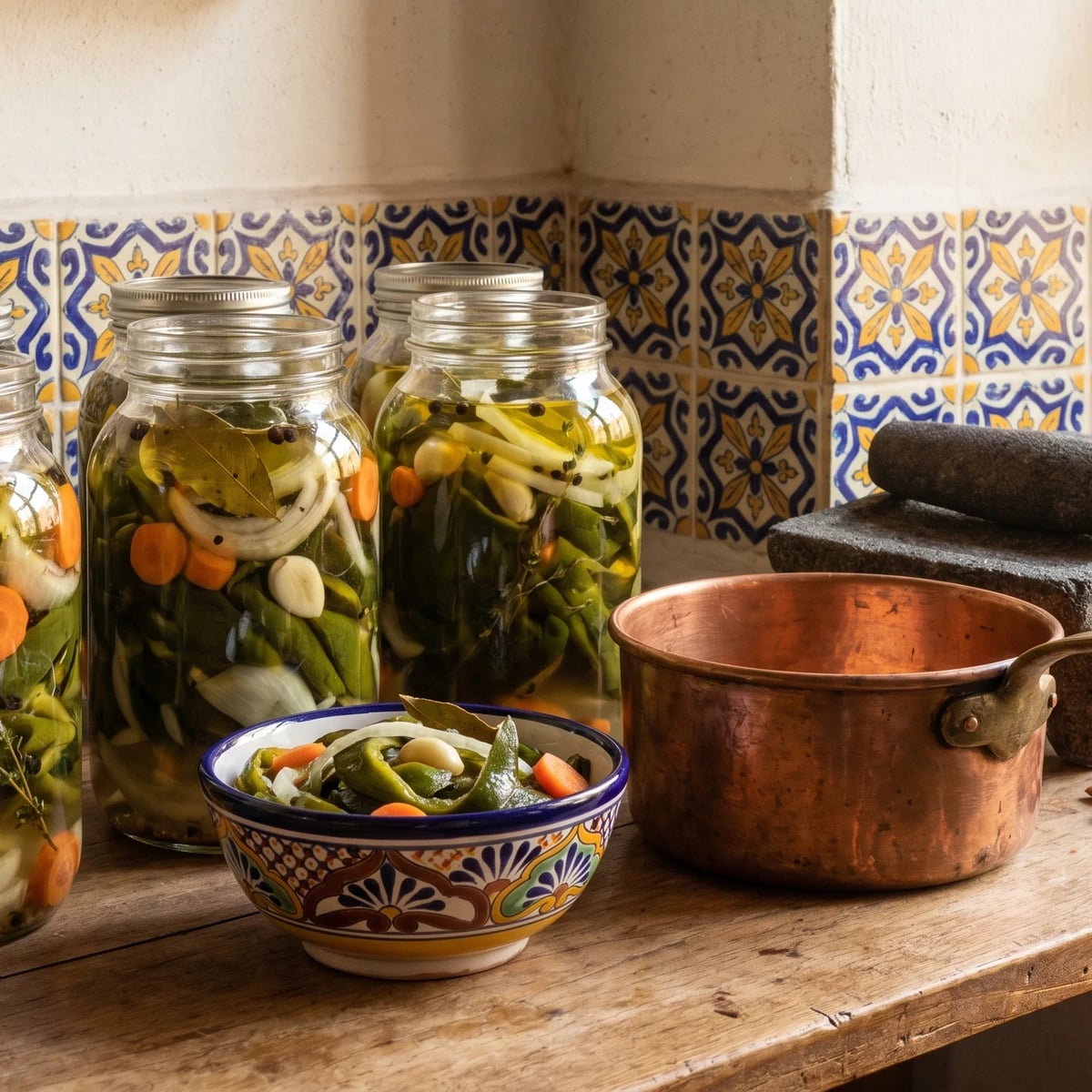
Escabeche Poblano Conventual
Created by Chef Lupita
Puebla's convent escabeche for roasted chiles poblanos, built with olive oil, vinegar, white onion, garlic, bay, thyme, marjoram, and peppercorns for the holiday table.
Puebla de los Angeles owns this escabeche, from the convent kitchens where New World chiles met Spanish vinegar, olive oil, bay, pepper, and herbs. This is not a salsa. It is a preserve, a brine with manners, made to dress roasted chiles poblanos and wait patiently in glass jars until the Easter or holiday table needs it.
The chile is poblano, roasted over fire or on a dry comal until the skin blisters, then peeled and cut into rajas. Do not use bell peppers. Do not use canned chiles. The poblano gives you green flesh, a little bitterness, and that smell of the market in Puebla when the vendors are turning sacks of chiles beside piles of white onion and garlic.
I first studied this style in Puebla with cooks who spoke of Santa Rosa's tiled kitchen the way other people speak of cathedrals. Blue and yellow talavera on the walls, copper cazos, stone metates, glass jars lined on shelves. The convents made architecture out of preservation: vinegar to keep, oil to soften, herbs to perfume, onion and garlic to make the chile useful for more than one meal. La cocina no es decoración, es trabajo.
Make it at least one day ahead. The first hour tastes sharp. The next day tastes finished. Cada estado, su propia cocina, and Puebla's convent table knew how to make even a pickle carry discipline.
Ingredients
fresh chile poblano
Quantity
10
roasted, peeled, seeded, and cut into wide rajas
extra-virgin olive oil
Quantity
1/2 cup
white onions
Quantity
2 large
sliced into thick half-moons
| Ingredient | Quantity |
|---|---|
| fresh chile poblanoroasted, peeled, seeded, and cut into wide rajas | 10 |
| extra-virgin olive oil | 1/2 cup |
| white onionssliced into thick half-moons | 2 large |
Where cooking meets culture.
Culinary guides, cultural storytelling, and the editorial depth that makes cooking meaningful.
Discover Culinary Explorer