Chef Jeong-sun
Amjuk (Dried-Grain Weaning Porridge)
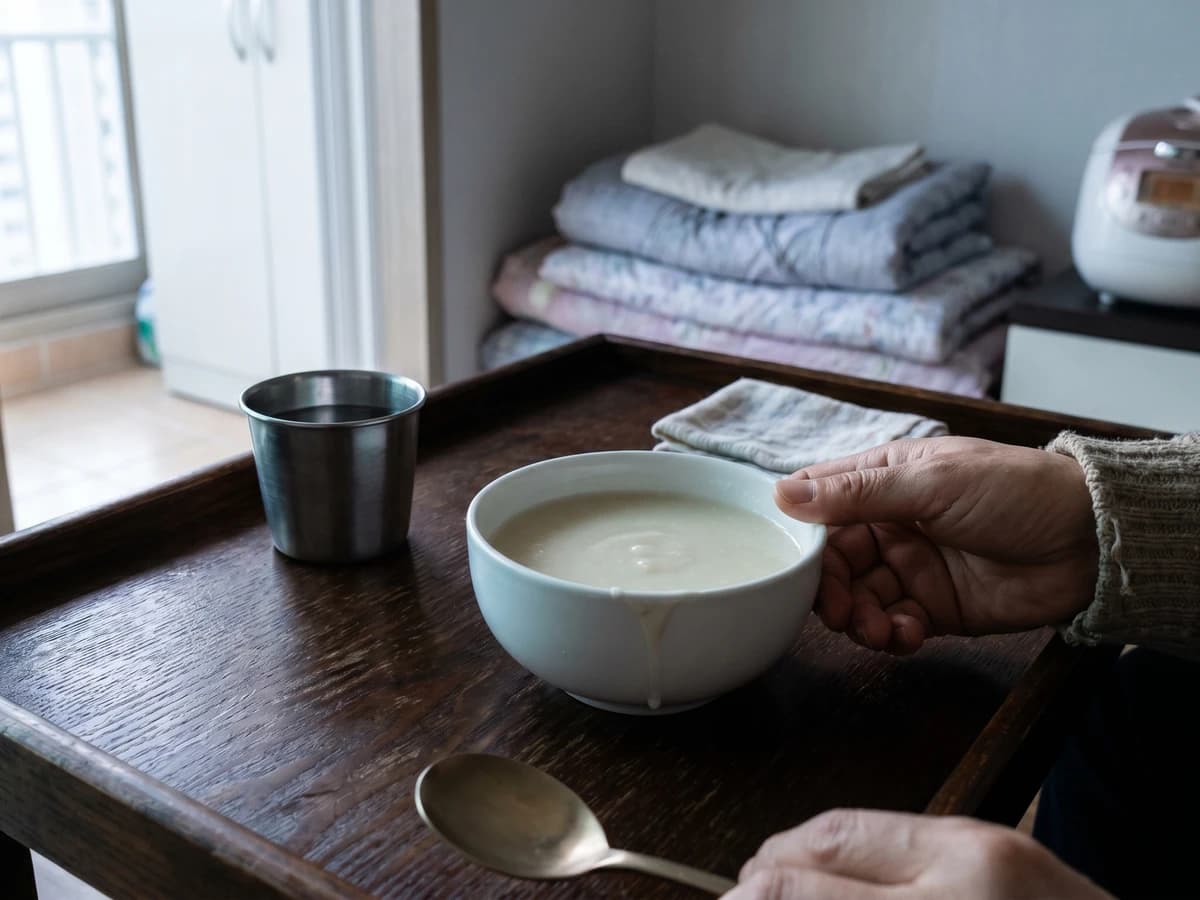
Powdered rice or dried baekseolgi cooked thin in cloudy rice water, an old Korean first-spoon porridge that asks for patience at the sieve and gentleness at the stove.
A cooking platform built around craft, culture, and the stories behind what we eat.

Created by
Freshwater fish simmered until the flesh slips from the bone, strained clean, then returned to the pot with rice, doenjang, gochujang, perilla, and scallion for a riverside bowl that feeds gently.
Eo-juk begins at a river market, not at a polished breakfast counter. In summer and early autumn the baskets hold small carp, crucian carp, catfish, chub, and whatever the stream gave honestly that morning. They are bony fish, not polite fish. That is why this porridge exists.
The work tonight is patient, and I won't call it quick. You simmer the fish until the flesh lets go, then keep every bone out of the pot. Skip that and you have danger, not porridge. Do it properly and the rice thickens a broth that tastes of the river without tasting muddy.
Notebook 31, written after a Geum River lesson, says two pastes only: doenjang to steady the fish, gochujang for warmth, neither enough to cover the broth. People bury river fish because they are afraid of it. Better to clean it well, simmer it gently, and season with restraint. Let it taste like itself.
This is comfort food for a morning table after hard work, a bowl with kimchi and a bronze spoon, not a grand dish. The safe corner to cut is the vessel: a stockpot is fine. The corner you cannot cut is the sieving. Write it down. Memory is a borrowed bowl.
Eo-juk is river-country food, strongly associated with Chungcheong-do and the Geum River basin, where small freshwater fish such as carp, crucian carp, catfish, and chub were common but too bony to serve neatly. The method is the history in the pot: simmer the catch, press it through a sieve, and thicken the broth with rice so a small river harvest feeds more people. It belongs to fishing trips, markets, and riverside restaurants rather than court records, and regional bowls differ most in the balance of doenjang, gochujang, perilla, and noodles or rice.
Quantity
1 cup (200g)
rinsed until the water runs mostly clear
Quantity
900g
scaled, gutted, and gills removed
Quantity
10 cups
Quantity
1 piece, about 4 inches square
Quantity
200g
peeled and cut into 1-inch chunks
Quantity
1/2 medium
halved
Quantity
4 thin slices
Quantity
5 cloves
3 crushed and 2 minced
Quantity
2 tablespoons
Quantity
2 tablespoons
Quantity
1 tablespoon
Quantity
1 tablespoon
Quantity
1 tablespoon
Quantity
1 medium
diced 1/2 inch
Quantity
3 tablespoons
finely ground
Quantity
2
thinly sliced
Quantity
1
thinly sliced
Quantity
8
thinly sliced
Quantity
1/4 teaspoon, plus up to 1/2 teaspoon more
added in measured 1/4-teaspoon additions
Quantity
1/4 teaspoon
| Ingredient | Quantity |
|---|---|
| short-grain white ricerinsed until the water runs mostly clear | 1 cup (200g) |
| cleaned whole freshwater fish or bone-in piecesscaled, gutted, and gills removed | 900g |
| water | 10 cups |
| dried kelp (dasima) | 1 piece, about 4 inches square |
| Korean radish (mu)peeled and cut into 1-inch chunks | 200g |
| onionhalved | 1/2 medium |
| fresh ginger | 4 thin slices |
| garlic3 crushed and 2 minced | 5 cloves |
| soju or cheongju (optional) | 2 tablespoons |
| doenjang (fermented soybean paste) | 2 tablespoons |
| gochujang (Korean chili paste) | 1 tablespoon |
| gochugaru (Korean chili flakes) | 1 tablespoon |
| guk-ganjang (Korean soup soy sauce) | 1 tablespoon |
| zucchini (aehobak)diced 1/2 inch | 1 medium |
| toasted perilla seed powder (deulkkae-garu) (optional)finely ground | 3 tablespoons |
| scallionsthinly sliced | 2 |
| green chilithinly sliced | 1 |
| perilla leaves (kkaennip)thinly sliced | 8 |
| fine sea saltadded in measured 1/4-teaspoon additions | 1/4 teaspoon, plus up to 1/2 teaspoon more |
| freshly ground black pepper | 1/4 teaspoon |
Put the rinsed rice in a bowl, cover with cool water, and soak 30 minutes. Drain well. The soak lets the grains swell evenly, so they soften into the broth instead of keeping a hard center while the outside breaks apart.
Rinse the fish under cold running water. If the gills are still attached, remove them. Scrape away any dark blood along the backbone with the tip of a spoon, then rinse again and drain. This is not fussiness. Muddy or bitter flavors usually begin with blood and gills left behind.
Put the fish, water, kelp, radish, onion, ginger, crushed garlic, and soju or cheongju if using into a 5 to 6 quart pot. Bring it to a gentle simmer over medium heat. Pull the kelp out as soon as the water reaches a simmer, because kelp left too long turns the broth slick and bitter. Skim the surface, lower the heat, and simmer 35 to 40 minutes, until the flesh slips from the bone and the broth looks lightly cloudy.
Lift the fish and radish onto a tray and strain the broth through a fine-mesh sieve into a large bowl. Discard the onion, ginger, kelp, and crushed garlic. When the fish is cool enough to handle, pick off any large clean pieces of flesh. For small bony fish, press the flesh gently through a medium-mesh sieve with a ladle, scraping the soft fish from the underside of the sieve. Stop before you force white bone splinters through. Measure 7 cups of fish broth and soft flesh together; if you are short, add water to make 7 cups.
Return the measured broth and fish flesh to the pot. In a small bowl, whisk the doenjang, gochujang, gochugaru, and guk-ganjang with 1 cup of hot broth until smooth, then stir it back into the pot. The color should be warm red-brown, not thick and red like tteokbokki sauce. Gochujang gives warmth. It should not bury the fish.
Bring the seasoned broth to a steady simmer and add the drained rice. Cook over medium-low heat for 18 minutes, stirring the bottom every 4 to 5 minutes with a wooden spoon. Porridge catches quietly before it burns loudly. The grains should swell, split at the edges, and begin to thicken the broth.
Add the diced zucchini and minced garlic and simmer 8 to 10 minutes more, stirring often, until the rice is soft and the zucchini is tender but still green. Stir in the perilla seed powder if using, then the scallions, green chili, perilla leaves, black pepper, and 1/4 teaspoon salt. Taste one spoonful after the rice has softened. Add another 1/4 teaspoon salt if it tastes flat, and the final 1/4 teaspoon only if your doenjang is mild. 손맛 is real. I still measure it, so it can be handed on.
Turn off the heat and let the porridge rest 5 minutes. It should be loose enough to move slowly when stirred, not stand stiff like cold rice. If it thickens too far, stir in hot water 1/4 cup at a time. Ladle into deep bowls and serve with well-fermented kimchi or kkakdugi. Check each ladle for stray bones as you serve, especially for children and elders.
1 serving (about 730g)
Culinary guides, cultural storytelling, and the editorial depth that makes cooking meaningful.
Discover Culinary ExplorerChef Jeong-sun
Powdered rice or dried baekseolgi cooked thin in cloudy rice water, an old Korean first-spoon porridge that asks for patience at the sieve and gentleness at the stove.

Chef Jeong-sun
A soft summer rice porridge of kneaded mallow greens, dried shrimp, and careful doenjang broth, plain enough for breakfast and exact enough to keep the grit and bitterness out.
Chef Jeong-sun
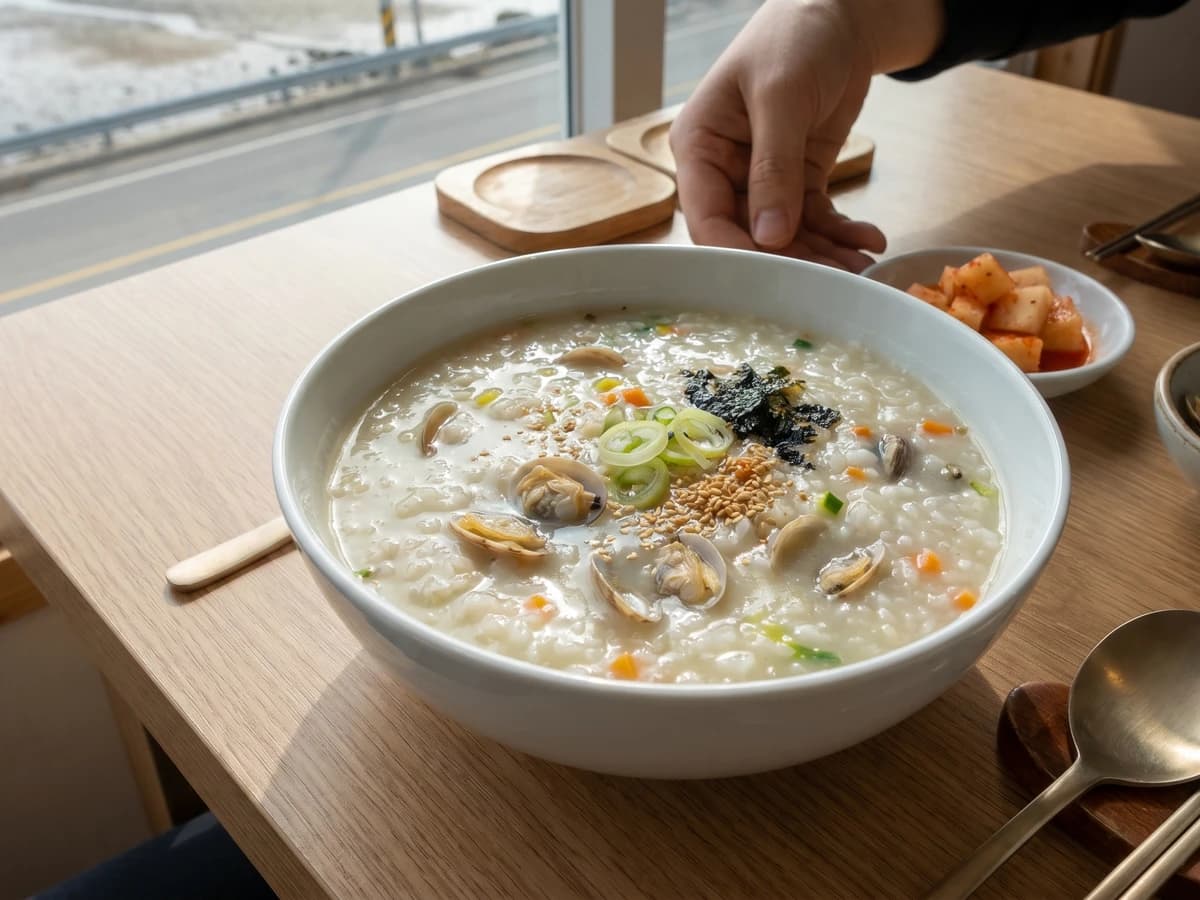
A west-coast clam porridge from Buan's tidal flats: live bajirak opened for their liquor, sesame-slicked rice toasted in the pot, and vegetables cut small enough to comfort without hiding the clams.

Chef Jeong-sun
An autumn juk of boiled chestnuts and soaked short-grain rice, simmered low until smooth and softly sweet, the kind of bowl you set before an elder, a child, or yourself.