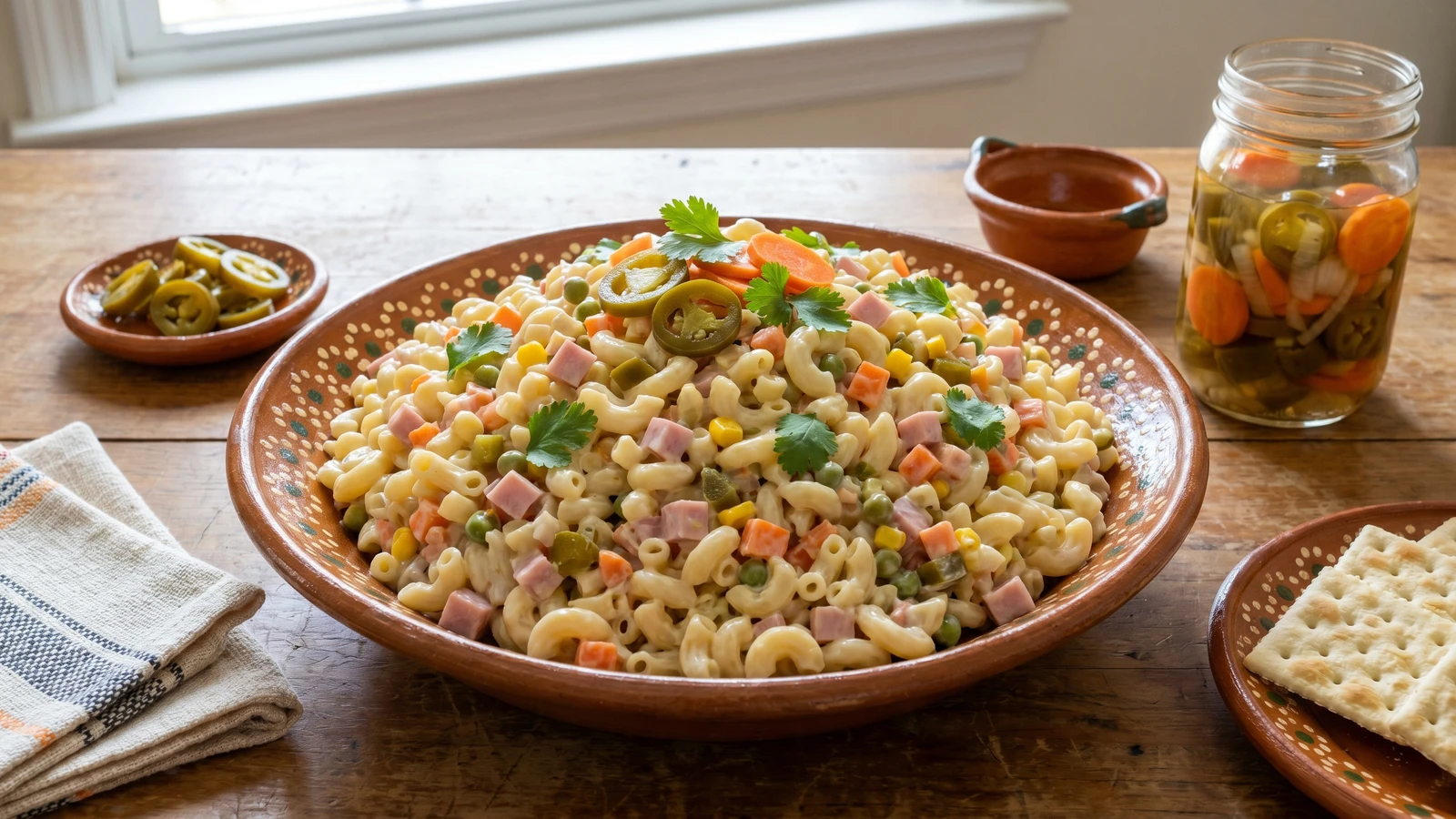
Guadalajara's party-table coditos, cold elbow macaroni bound with crema and mayonnaise, folded with ham, carrot, corn, and sharpened by chile jalapeño en escabeche.
Salads
Mexican
Potluck
Celebration
Make Ahead
20 min
Active Time
10 min cook•1 hr 30 min total
Yield8 servings
Jalisco puts this salad on the celebration table: birthdays in Guadalajara, baptisms in Zapopan, Christmas meals in Los Altos, the plastic-lidded bowl carried to the neighbor's house because somebody has to bring the cold salad. This is not ancient food. Don't pretend it is. It is Mexican home cooking after dry pasta entered the pantry and women made it useful.
The ingredient that makes this version jalisciense is the dairy. Jalisco is ranch country, and good crema matters here. The coditos are cooked until tender, cooled, and bound with crema and a little mayonnaise. Ham, carrot, sweet corn, and chile jalapeño en escabeche give it the party-table flavor every child in the room recognizes. The brine from the jalapeños is not decoration. It cuts the richness so the salad doesn't sit heavy.
My mother made coditos from her Jalisco notebook whenever there were more people than chairs. She wrote one line in the margin: 'mas vinagre de los chiles si esta plano.' More jalapeño brine if it tastes flat. She was right. Saber cocinar es saber vivir, even when the dish comes from a potluck table and not a clay cazuela.
Dry pasta became common in Mexican urban kitchens during the 19th and early 20th centuries through European trade, commercial milling, and the growth of packaged pantry goods. Ensalada de coditos belongs to the 20th-century Mexican celebration table, where imported forms like macaroni were absorbed into local habits with crema, jamon, vegetables, and chiles en escabeche. In Jalisco, the state's strong dairy culture made crema a natural binder, giving the salad a softer, richer character than versions made with mayonnaise alone.
The technique, the tradition, and the story behind every dish.
carrotspeeled, diced small, and cooked until tender
2 medium
corn kernelscooked and cooled
1 cup
peascooked and cooled
1/2 cup
chile jalapeño en escabechefinely chopped
1/3 cup
white onionfinely chopped
2 tablespoons
fresh cilantro (optional)chopped
1/4 cup
extra chile jalapeño en escabeche (optional)
for serving
saltine crackers or tostadas (optional)
for serving
Equipment Needed
•Large stockpot for boiling the coditos
•Colander with small enough holes to hold elbow macaroni
•Wide mixing bowl
•Flexible spatula or wide serving spoon
•Large glazed barro or Tonala-style serving bowl
Instructions
1
Cook the coditos
Bring a large pot of water to a strong boil and salt it well. Add the coditos and cook until tender, not hard in the center. This is a cold Mexican party salad, not an Italian pasta course. If the pasta is too firm, it turns stiff after chilling.
2
Cool the pasta
Drain the coditos and rinse briefly under cool water to stop the cooking and wash off extra surface starch. Shake the colander hard so water doesn't hide inside the elbows. Wet pasta makes watery salad. Spread the coditos on a tray for 10 minutes so they cool evenly.
3
Mix the dressing
In a large bowl, whisk the crema, mayonnaise, jalapeño brine, mustard, salt, and black pepper until smooth. Taste it before the pasta goes in. It should be creamy first, then lightly sharp from the escabeche. If it tastes flat, add another spoonful of brine. My mother was right about that.
4
Fold the salad
Add the cooled coditos, ham, carrot, corn, peas, chopped jalapeño en escabeche, white onion, and cilantro if using. Fold with a wide spoon, slowly, so the pasta stays whole and every elbow gets coated. Do not beat it into paste. La cocina no es decoración, es trabajo, even with coditos.
Dice the ham and carrots small enough to fit inside a spoonful with the pasta. Big chunks make the salad clumsy.
5
Chill and adjust
Cover and refrigerate for at least 1 hour. The pasta will drink some of the dressing as it chills. Before serving, stir once and taste again. If it needs loosening, add a spoonful of crema. If it needs life, add jalapeño brine. Not more mayonnaise. Mayonnaise makes it heavier; brine wakes it up.
6
Serve cold
Spoon the salad into a wide serving bowl and set extra chile jalapeño en escabeche on the side for the people who want more bite. Serve cold with saltines or tostadas. This is food for a crowded table, made ahead, carried across town, and eaten with cousins talking too loudly. Cada estado, su propia cocina.
Chef Tips
•Use Mexican crema, not sour cream. Sour cream is thicker and sharper, and it pulls the dressing in the wrong direction. If you have a Mexican market nearby, ask for crema de rancho.
•The chile is jalapeño en escabeche, not fresh serrano, not canned green chile, not pickled banana pepper. You need the vinegar, carrot, onion, and chile flavor from the jar. That brine is part of the seasoning.
•Do not overcook the vegetables. The carrot should be tender but still hold its cube shape. Mushy carrot disappears into the dressing and makes the salad look tired.
•This salad is served cold, but not icy. Pull it from the refrigerator 10 minutes before serving so the crema softens and coats the pasta properly.
•If you add canned pineapple, you are making another family version. It exists in Mexican kitchens, yes. For this Jalisco party-table version, the bite comes from escabeche, not syrup.
Advance Preparation
•The salad can be made up to 1 day ahead and refrigerated, covered. Stir before serving and adjust with a spoonful of crema or jalapeño brine.
•Cook the carrots, corn, and peas up to 2 days ahead. Keep them chilled and well drained so they do not water down the dressing.
•Do not freeze ensalada de coditos. The crema breaks and the pasta turns soft. Some foods are for the refrigerator, not the freezer. Así se hace y punto.
Frequently Asked Questions
Nutrition Information
1 serving (about 265g)
Calories
445 calories
Total Fat
18 g
Saturated Fat
5 g
Trans Fat
0 g
Unsaturated Fat
12 g
Cholesterol
40 mg
Sodium
930 mg
Total Carbohydrates
52 g
Dietary Fiber
3 g
Sugars
5 g
Protein
16 g
Where cooking meets culture.
Culinary guides, cultural storytelling, and the editorial depth that makes cooking meaningful.