
Chef Lupita
Aporreadillo Michoacano con Huevo
Michoacán's Tierra Caliente almuerzo, where salted beef is softened, pounded, fried in lard, folded with egg and chile perón salsa, then served beside morisqueta like a proper working table.
A cooking platform built around craft, culture, and the stories behind what we eat.
Created by
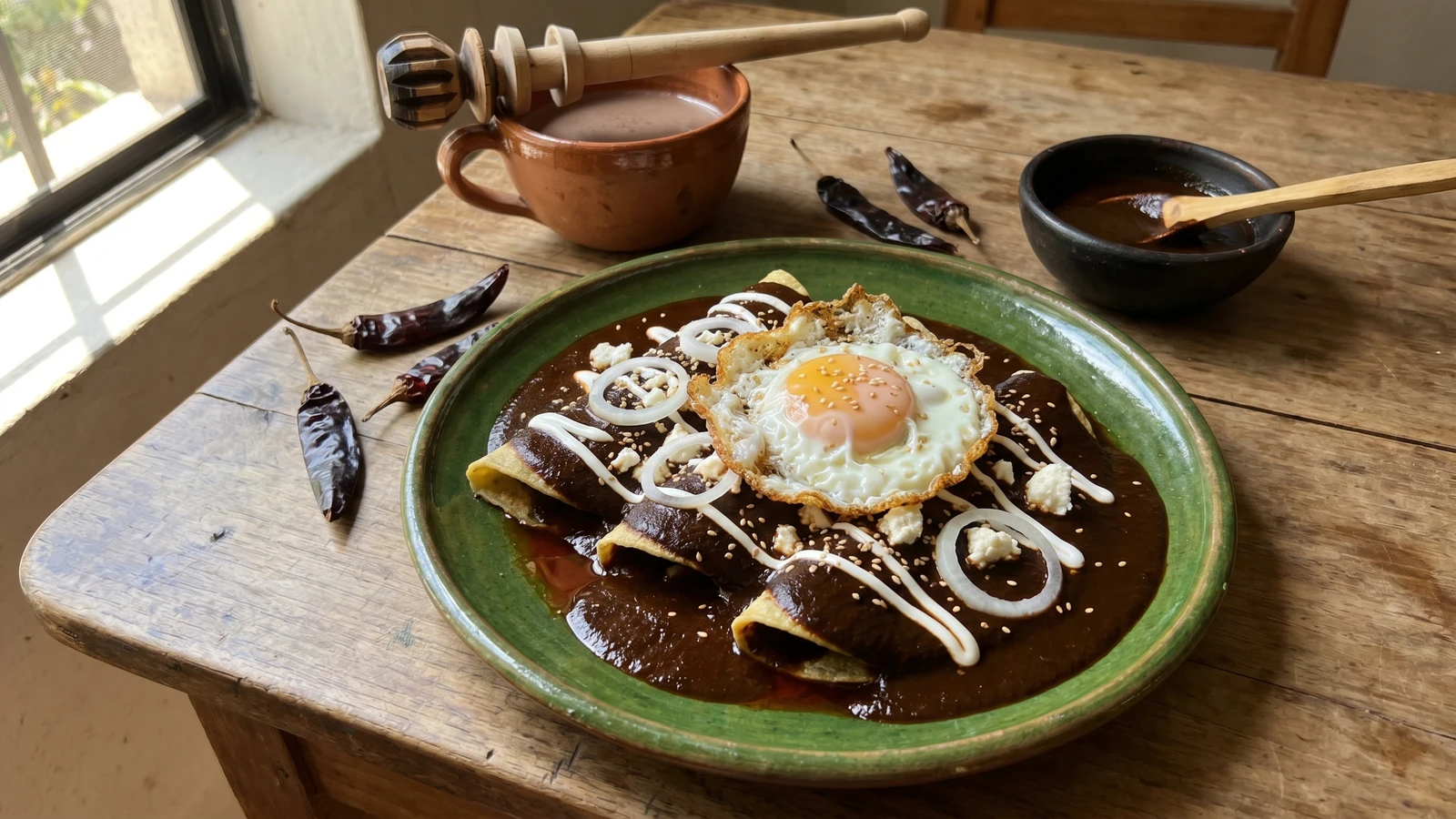
Oaxacan enmoladas built on mole negro, the darkest of the state's seven moles, folded around shredded chicken and crowned with a fried egg, crema, queso fresco, and sesame on a morning plate that earns its place at any table.
This is Oaxaca's breakfast. Not the hotel buffet eggs with bottled salsa. The real one, the one that happens when yesterday's mole negro is sitting in a clay olla on the back of the stove and someone heats tortillas, tears some chicken, and folds the whole thing together before the chocolate de agua is ready.
Enmoladas are not enchiladas with a different name. Enchiladas are dipped in chile sauce. Enmoladas are dipped in mole. In Oaxaca, that means mole negro: chilhuacle negro, pasilla oaxaqueño, mulato, chocolate de metate, charred tortilla, plantain, bread, and enough spices to fill a stall at the Central de Abastos. You don't make mole negro for enmoladas. You make enmoladas because you have mole negro left from yesterday. The mole comes first. It always comes first.
I collected this version from a señora in Etla, in the Valles Centrales, who served me enmoladas at nine in the morning on a green-glazed Atzompa plate with a fried egg on top and a jícara of chocolate de agua frothed with a molinillo on the side. She told me the mole was from two days before. It was better for the wait. She passed each tortilla through asiento before dipping it in the mole, and the flavor of that dark rendered fat underneath the sauce was something I had never tasted in any other state. My mother's notebook had a page on enmoladas, but hers were from Jalisco, made with a simpler mole. When I tasted the Oaxacan version in that kitchen in Etla, I understood why this state claims mole the way Jalisco claims pozole. Cada estado, su propia cocina.
The egg on top is not optional. This is a breakfast dish, and in Oaxaca the fried egg sits right on the mole, the yolk running into the sauce when you cut into it, making the plate richer and messier and better. Saber cocinar es saber vivir.
Enmoladas as a preparation, tortillas dipped in mole and folded around a filling, descend from the Nahuatl tradition of wrapping cooked foods in corn tortillas with sauce, a practice documented in colonial-era texts including Fray Bernardino de Sahagún's 'Historia General de las Cosas de Nueva España.' The word 'enmolada' literally means 'covered in mole,' distinguishing the dish from enchiladas ('covered in chile sauce') in a way that modern menus outside Mexico routinely collapse. Oaxaca's mole negro relies on the chilhuacle negro, an heirloom chile cultivated almost exclusively in the Cañada region of northern Oaxaca since pre-Columbian times and commercially unavailable outside specialized Mexican markets, which is why the sauce cannot be authentically replicated with substitute chiles. The tradition of serving enmoladas as a morning dish is tied to the practical rhythm of Oaxacan household cooking: mole negro takes a full day to prepare and improves overnight, making the following morning the natural moment to use it.
Quantity
8
stemmed and seeded, seeds reserved
Quantity
4
stemmed and seeded, seeds reserved
Quantity
4
stemmed and seeded, seeds reserved
Quantity
from all chiles above
Quantity
2
Quantity
2 medium
Quantity
4
husked and rinsed
Quantity
1/2 medium
left in one piece
Quantity
4 cloves
unpeeled
Quantity
1
peeled and sliced into 1/2-inch rounds
Quantity
3 tablespoons
Quantity
3 tablespoons
Quantity
2 tablespoons
Quantity
1/2 bolillo or 1 slice
Quantity
1 tablet (about 90 grams)
Quantity
3 (for mole), plus 1 for poaching
Quantity
4
Quantity
1
Quantity
6
Quantity
1/4 teaspoon
Quantity
1/2 teaspoon
Quantity
1 tablespoon
grated if using piloncillo
Quantity
4 tablespoons
Quantity
3 to 4 cups
Quantity
to taste
Quantity
1 1/2 pounds
Quantity
1/2 medium
Quantity
2 cloves
Quantity
12 to 16
Quantity
2 tablespoons
Quantity
4 to 6
Quantity
1 tablespoon
Quantity
1/2 cup
Quantity
1/2 cup
crumbled
Quantity
1/4 medium
sliced into thin rings
Quantity
for serving
| Ingredient | Quantity |
|---|---|
| dried chilhuacle negro chilesstemmed and seeded, seeds reserved | 8 |
| dried chile mulatostemmed and seeded, seeds reserved | 4 |
| dried chile pasilla oaxaqueñostemmed and seeded, seeds reserved | 4 |
| reserved chile seeds | from all chiles above |
| corn tortillas for charring | 2 |
| tomatoes | 2 medium |
| tomatilloshusked and rinsed | 4 |
| white onion (for mole)left in one piece | 1/2 medium |
| garlic (for mole)unpeeled | 4 cloves |
| ripe plantainpeeled and sliced into 1/2-inch rounds | 1 |
| raw peanuts | 3 tablespoons |
| sesame seeds (for mole, plus more for garnish) | 3 tablespoons |
| raisins | 2 tablespoons |
| bolillo or stale white bread | 1/2 bolillo or 1 slice |
| chocolate de metate | 1 tablet (about 90 grams) |
| dried avocado leaves (hojas de aguacate) | 3 (for mole), plus 1 for poaching |
| whole cloves | 4 |
| Mexican cinnamon stick (canela) | 1 |
| black peppercorns | 6 |
| cumin seeds | 1/4 teaspoon |
| dried Mexican oregano | 1/2 teaspoon |
| piloncillo or dark brown sugargrated if using piloncillo | 1 tablespoon |
| asiento or manteca de cerdo (for mole) | 4 tablespoons |
| chicken broth | 3 to 4 cups |
| salt | to taste |
| bone-in, skin-on chicken thighs or breast halves | 1 1/2 pounds |
| white onion (for poaching) | 1/2 medium |
| garlic (for poaching) | 2 cloves |
| hand-pressed corn tortillas | 12 to 16 |
| asiento or manteca de cerdo (for passing tortillas) | 2 tablespoons |
| large eggs | 4 to 6 |
| asiento or manteca de cerdo (for frying eggs) | 1 tablespoon |
| crema mexicana | 1/2 cup |
| queso frescocrumbled | 1/2 cup |
| white onion (for garnish)sliced into thin rings | 1/4 medium |
| toasted sesame seeds (for garnish) (optional) | for serving |
Heat a dry comal or cast iron skillet over medium heat. Toast the chilhuacle negro, mulato, and pasilla oaxaqueño chiles one variety at a time, pressing them flat against the hot surface with a spatula for about 20 to 30 seconds per side. The skin will blister and puff. The kitchen will fill with a dark, earthy fragrance that smells like the chile vendors' corridor at the Central de Abastos in Oaxaca. Do not blacken them. A burned chile turns the mole bitter and there is no fixing it. As each chile is toasted, transfer it to a heatproof bowl.
This step is what makes mole negro negro. On the same comal, spread the reserved chile seeds in a single layer. Toast them over medium heat, stirring constantly with a wooden spoon, for 5 to 7 minutes until they are completely black and smoking. They will smell acrid. That is correct. Set them aside. Now take two corn tortillas and char them directly on the comal or over a gas flame, turning with tongs, until they are entirely black and brittle, not just spotted, but burned through. Break them into pieces. These charred seeds and tortillas are the soul of mole negro. They give the sauce its near-black color and a bitter depth that no other mole has.
Cover the toasted chiles with hot water, not boiling. Hot tap water is fine. Let them soak for 20 to 25 minutes until they are soft and pliable. Boiling water cooks the skin and makes the mole taste muddy. The soaking liquid will turn dark. Discard it when you drain the chiles. It carries bitterness you do not want in the sauce.
While the chiles soak, roast the tomatoes, tomatillos, onion half, and unpeeled garlic cloves on the dry comal. Turn them as they blister, letting each side char until softened and dark-spotted on all sides, about 12 to 15 minutes total. The tomatoes and tomatillos will collapse and release juice. The garlic skins will blacken. The onion will go translucent at the edges and char on the flat sides. Peel the garlic when cool enough to handle. Toast the avocado leaves on the comal for just 5 seconds per side until fragrant. Do not burn them. They taste like anise when toasted properly.
In a small skillet, melt 1 tablespoon of the asiento or manteca over medium heat. Fry the plantain slices until golden on both sides, about 2 minutes per side. Remove. In the same fat, toast the peanuts until spotted and fragrant, about 3 minutes. Remove. Toast the sesame seeds until golden, about 1 minute, shaking the pan constantly. Remove. Fry the raisins until they puff, about 30 seconds. Remove. Tear the bread into pieces and fry until golden on both sides. Remove. In the dry skillet, briefly toast the cloves, cinnamon stick, peppercorns, and cumin seeds until fragrant, about 30 seconds. Each ingredient goes in separately because each one burns at a different speed. No me vengas con atajos.
Work in batches. Combine the drained chiles, charred seeds, charred tortilla pieces, roasted vegetables, toasted plantain, peanuts, sesame seeds, raisins, bread, all the spices, the avocado leaves, the oregano, and the chocolate de metate broken into pieces in a blender. Add about 1 cup of chicken broth to start. Blend on high until completely smooth, scraping down the sides as needed. You may need 2 or 3 batches depending on your blender. Add more broth as needed to keep things moving, but use as little as possible. You want a thick, smooth paste, not a soup. The color should be very dark, nearly black, with a reddish undertone when you hold it to the light.
Heat 3 tablespoons of asiento or manteca in a heavy pot or clay cazuela over medium heat. When the fat shimmers, pour in the blended mole paste. It will sputter and pop. Stand back but keep stirring. Fry the paste for 8 to 10 minutes, stirring constantly, until it darkens further, the fat begins to separate at the edges, and the raw smell of the chiles cooks out. You will know because the aroma shifts from sharp to deep. Add 2 cups of chicken broth, the grated piloncillo, and salt to taste. Stir to combine. Reduce the heat to low, partially cover, and simmer for 45 minutes to 1 hour, stirring every 10 minutes so the bottom does not scorch. The mole will thicken as it cooks. If it gets too thick, add more broth a quarter cup at a time. The finished mole should coat the back of a wooden spoon and slide off slowly. La manteca es el sabor.
While the mole simmers, place the chicken pieces in a medium saucepan. Cover with cold water by one inch. Add the onion half, garlic cloves, avocado leaf, and a generous pinch of salt. Bring to a gentle simmer over medium heat. Skim the foam that rises in the first few minutes. Cook at a lazy simmer for 25 to 30 minutes until the chicken is cooked through and tender. Remove the chicken and let it cool enough to handle. Shred the meat into generous pieces, discarding the skin and bones. Save the poaching broth. You can use it to thin the mole if needed.
Heat 2 tablespoons of asiento or manteca in a wide skillet over medium heat. One at a time, pass each corn tortilla through the hot fat for about 5 seconds per side, just long enough to soften and absorb a little of that flavor. The tortilla should be pliable, not crisp. Stack them on a plate and cover with a clean towel to keep them warm. This step is not optional. A dry tortilla will crack when you fold it and it will not absorb the mole properly. The asiento underneath the mole is a layer of flavor you can taste in every bite. That is how the señoras in the Valles Centrales do it.
Warm the mole if it has cooled, thinning it with a splash of broth if needed. It should be the consistency of a thick cream sauce, loose enough to coat but not so thin that it runs off the tortilla. Take each softened tortilla, dip it briefly in the warm mole negro to coat both sides, lay it flat, place a generous line of shredded chicken down the center, and fold the tortilla in half. Arrange 3 folded enmoladas on each plate, slightly overlapping. Ladle two or three spoonfuls of mole negro over the top, making sure the sauce pools generously around the base and blankets the tortillas. The plate should look dark, rich, and abundant. This is not a garnish of mole. The mole is the dish.
Heat 1 tablespoon of asiento or manteca in a nonstick skillet or well-seasoned comal over medium heat. Crack the eggs into the fat and fry until the whites are set and the edges are lacy but the yolks are still liquid, about 2 to 3 minutes. Do not flip them. Place one fried egg on top of each plate of enmoladas, right on the mole. Drizzle crema mexicana across the plate in thin lines. Scatter crumbled queso fresco, thin rings of white onion, and a generous pinch of toasted sesame seeds over everything. The yolk will break when the diner cuts into it and run into the mole. That is the point. Recetas probadas y garantizadas.
1 serving (about 450g)
Culinary guides, cultural storytelling, and the editorial depth that makes cooking meaningful.
Discover Culinary ExplorerChef Lupita
Michoacán's Tierra Caliente almuerzo, where salted beef is softened, pounded, fried in lard, folded with egg and chile perón salsa, then served beside morisqueta like a proper working table.

Chef Lupita
Guerrero's Costa Grande aporreado is salted cecina pounded soft, scrambled with egg, and finished in a red guajillo and chile de árbol salsa loud with garlic and cilantro.

Chef Lupita
Los Altos de Chiapas turns two-night fermented white corn into a tart-sweet atole, cooked with canela and piloncillo, then poured hot into jícaras for desayuno.

Chef Lupita
Oaxaca's Mixteca region ferments nixtamalized masa for days until it turns tart and alive, then simmers it with piloncillo and canela into a thick, warm atole served at first light in clay.