
Chef Lupita
Besitos Yucatecos
Mérida's pale egg-yolk-and-vanilla kisses, tiny cookies built on eight yolks and a perfume of orange blossom, sandwiched with guava paste and dusted heavy with powdered sugar.
A cooking platform built around craft, culture, and the stories behind what we eat.
Created by
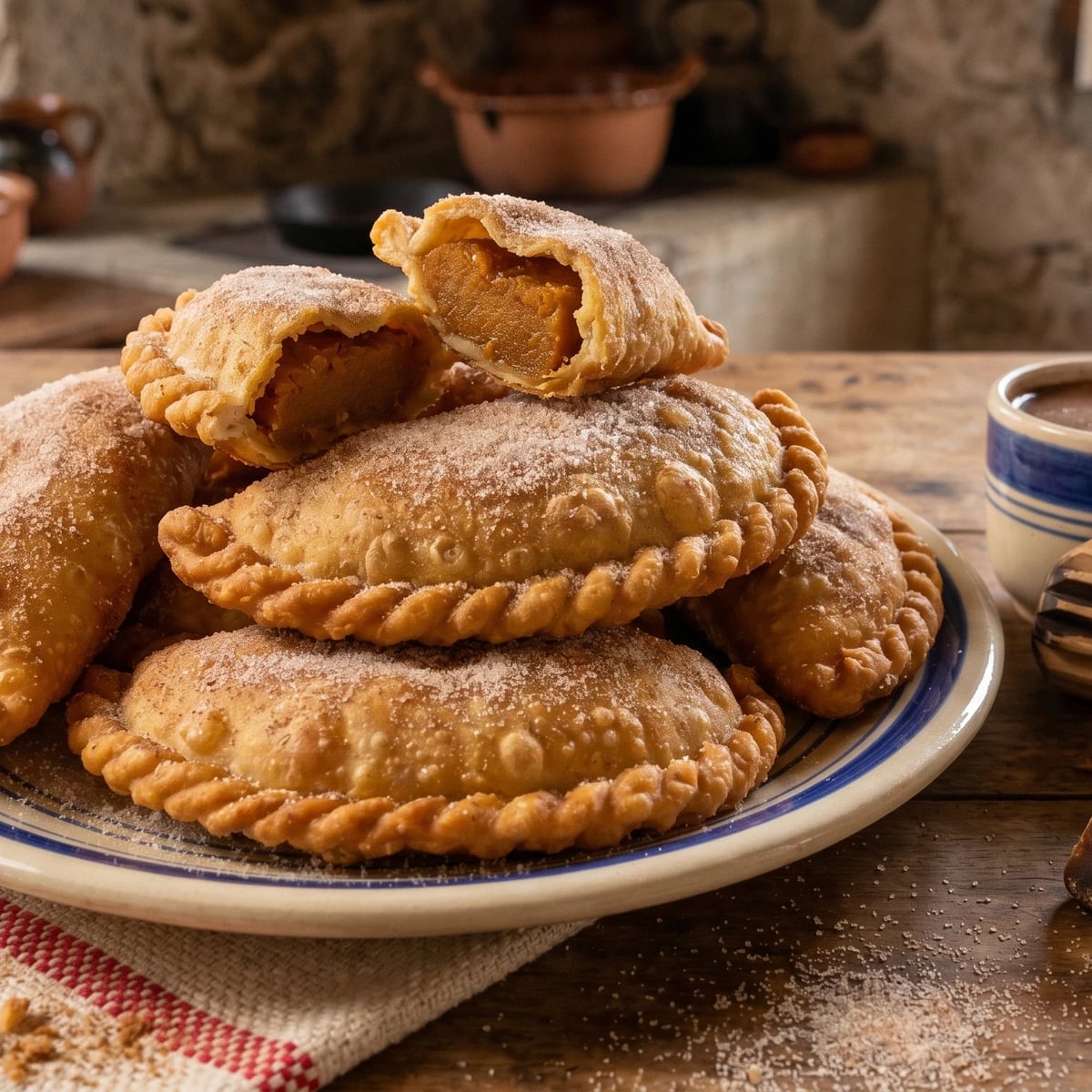
Yucatán's conventual fried empanadas, wheat dough enriched with lard and sherry, filled with piloncillo-sweetened camote and rolled in cinnamon sugar. A recipe carried down from the Conceptionist nuns of 16th-century Mérida.
This is a Yucatán dish, and more specifically a Mérida dish. It came out of the Convento de la Concepción, the Conceptionist convent founded in 1596, where the cloistered nuns turned wheat, lard, sugar, and what the criollo households brought them into a tradition of conventual sweets that fed the city's holiday tables for centuries.
These are not the savory empanadas of the north. They are not the meat picadillos of Hidalgo or the cazón empanadas of the Campeche street vendors. Estas son de dulce, fried in lard until the shell blisters, filled with manjar blanco or piloncillo-sweetened camote, and rolled in cinnamon sugar while still warm. Wheat, not corn, because the convents were Spanish institutions and wheat was what they grew, milled, and taught. Lard, not butter, because Yucatán's kitchens have always been lard kitchens. Canela de Ceylan, not cassia, because Mérida was a port city on the Caribbean trade routes and the true cinnamon from Sri Lanka arrived here long before it arrived in the interior.
I collected this version from a señora in the Barrio de Santiago who learned it from her great-aunt, a woman who in turn had worked in the kitchens of one of the old Mérida families that received the nuns' sweets every feast day. She wrote nothing down. I sat at her table for three afternoons with my notebook until I had the proportions right and she nodded. My mother kept a similar dough recipe in her notebook, brought from Jalisco, but the Yucatecan version is its own creature: more sherry, more lard, the canela softer. Cada estado, su propia cocina. Saber cocinar es saber vivir.
The Convento de la Concepción de Nuestra Señora was founded in Mérida in 1596 by Conceptionist nuns who arrived from Mexico City to establish the first female religious house in the Yucatán peninsula. Conventual cuisine across colonial Mexico developed as a sophisticated craft because the nuns received dowries, endowments, and constant gifts of ingredients from criollo families, and they returned the favor with elaborate sweets, breads, and preserves prepared for feast days, weddings, and political gestures; the recipes were guarded inside the cloister and transmitted only in handwritten libros de cocina. Yucatán's conventual sweets carry the unmistakable mark of the peninsula's Caribbean trade orientation: Ceylon cinnamon, sherry, and citrus peel appear in proportions that would seem extravagant in interior Mexico, where cassia and aguardiente de caña were the more common substitutes.
Quantity
4 cups, plus more for rolling
Quantity
1 cup
cold and cut into small pieces
Quantity
1/2 cup
Quantity
1 teaspoon
Quantity
2
Quantity
1/2 cup
Quantity
1/2 cup, plus more as needed
cold
Quantity
1 pound
peeled and cut into chunks
Quantity
1
Quantity
3/4 cup
chopped
Quantity
1
no pith
Quantity
1 tablespoon
Quantity
4 cups
Quantity
1 cup
Quantity
2 teaspoons
| Ingredient | Quantity |
|---|---|
| all-purpose wheat flour | 4 cups, plus more for rolling |
| pork lard (manteca de cerdo)cold and cut into small pieces | 1 cup |
| granulated sugar | 1/2 cup |
| fine sea salt | 1 teaspoon |
| large egg yolks | 2 |
| dry sherry or aguardiente de caña | 1/2 cup |
| whole milkcold | 1/2 cup, plus more as needed |
| camote amarillo (yellow sweet potato)peeled and cut into chunks | 1 pound |
| cinnamon stick (canela de Ceylan) | 1 |
| piloncillo or dark brown sugarchopped | 3/4 cup |
| strip of orange peelno pith | 1 |
| manteca de cerdo, for the filling | 1 tablespoon |
| pork lard, for frying | 4 cups |
| granulated sugar, for dusting | 1 cup |
| ground Ceylon cinnamon, for dusting | 2 teaspoons |
Place the sweet potato chunks in a heavy pot with the cinnamon stick, piloncillo, orange peel, and just enough water to barely cover. Bring to a gentle simmer over medium heat. Cook uncovered for 25 to 30 minutes, until the camote is fork-tender and the liquid has reduced to a thick syrup that coats the back of a spoon. The kitchen will smell like the sweet stalls in the Mercado Lucas de Galvez in Mérida. That smell is the piloncillo caramelizing against the canela.
Fish out the cinnamon stick and the orange peel. Stir in the tablespoon of manteca while the camote is still hot. Mash by hand with a fork or a wooden bean masher until smooth but with a little texture. Do not use a blender. You want body, not baby food. Let the filling cool completely. Warm filling tears cold dough. No me vengas con atajos.
In a wide bowl, whisk together the flour, sugar, and salt. Add the cold lard pieces and work them in with your fingertips until the mixture looks like coarse cornmeal with a few pea-sized bits of fat still visible. Those bits of lard are what make the dough flaky when it fries. La manteca es el sabor.
Whisk the egg yolks with the sherry and cold milk. Pour into the flour mixture and work it together with a wooden spoon, then your hands, until a soft dough forms. If it feels dry, add cold milk one tablespoon at a time. The dough should be smooth and pliable, not sticky. Knead briefly on a floured surface for 30 seconds, just to bring it together. Wrap in a clean cloth and rest at room temperature for 30 minutes.
On a lightly floured surface, divide the dough in half. Roll one half at a time to about 1/8 inch thick. Cut rounds with a 4-inch cutter or the rim of a small bowl. Re-roll the scraps once, no more. Each disc should be thin enough to crisp but sturdy enough to hold the filling without splitting at the seam.
Place a heaping tablespoon of the cooled camote filling on one side of each disc, leaving a half-inch border. Lightly moisten the edge with water. Fold the dough over to form a half-moon. Press the edges with the tines of a fork or twist them into the repulgue, the rope-edge crimp the Yucatecan cooks use. Seal them tight. A weak seal will burst in the lard and you will lose the filling to the oil.
In a heavy, wide pot or cazuela, melt the four cups of lard over medium-high heat. Bring it to 350°F. Test with a small scrap of dough: it should sizzle steadily on contact and float to the surface within seconds. If it sinks and sits, the lard is too cold and the empanadas will absorb fat. If it browns instantly, the lard is too hot and the inside will be raw. Watch the surface for a faint shimmer across the fat. That is the sign.
Slide the empanadas into the lard three or four at a time, never crowding the pot. Fry for two to three minutes per side, turning once with a slotted spoon, until they are deep gold and blistered. Lift them out and let them drain on a wire rack set over a sheet pan. Lard cooled by the meat means greasy empanadas. Hot lard means crisp ones. Así se hace y punto.
While the empanadas are still warm, mix the cup of granulated sugar with the ground Ceylon cinnamon in a shallow bowl. Roll each empanada in the cinnamon sugar to coat. Eat them within the hour, while the shell is still crisp and the filling is still warm. They are at their best with a small cup of chocolate caliente or a coffee with a little anise.
1 serving (about 90g)
Culinary guides, cultural storytelling, and the editorial depth that makes cooking meaningful.
Discover Culinary Explorer
Chef Lupita
Mérida's pale egg-yolk-and-vanilla kisses, tiny cookies built on eight yolks and a perfume of orange blossom, sandwiched with guava paste and dusted heavy with powdered sugar.

Chef Lupita
Yucatán's twice-baked rusks, half finished with sugar and half with flaky salt, built to drink coffee or hot chocolate with at any hour of the day.

Chef Lupita
Mérida's lard-enriched bizcochos, denser and crumblier than their agua cousins, the kind of pastry that appears at breakfast, at merienda, and on the table whenever family walks through the door.

Chef Lupita
Yucatán's flaky puff pastry balls, filled with sweetened cream cheese kissed with lima dulce, baked until the layers shatter under the sugar coat. The pan dulce of every Mérida baptism and birthday.