
Chef Lupita
Almendrados Conventuales Poblanos
Puebla's convent almond cookies, made from blanched almonds, sugar syrup, egg yolks, canela, and patient hands, the kind of sweet that belongs beside coffee in talavera, not in a plastic bakery box.
A cooking platform built around craft, culture, and the stories behind what we eat.
Created by
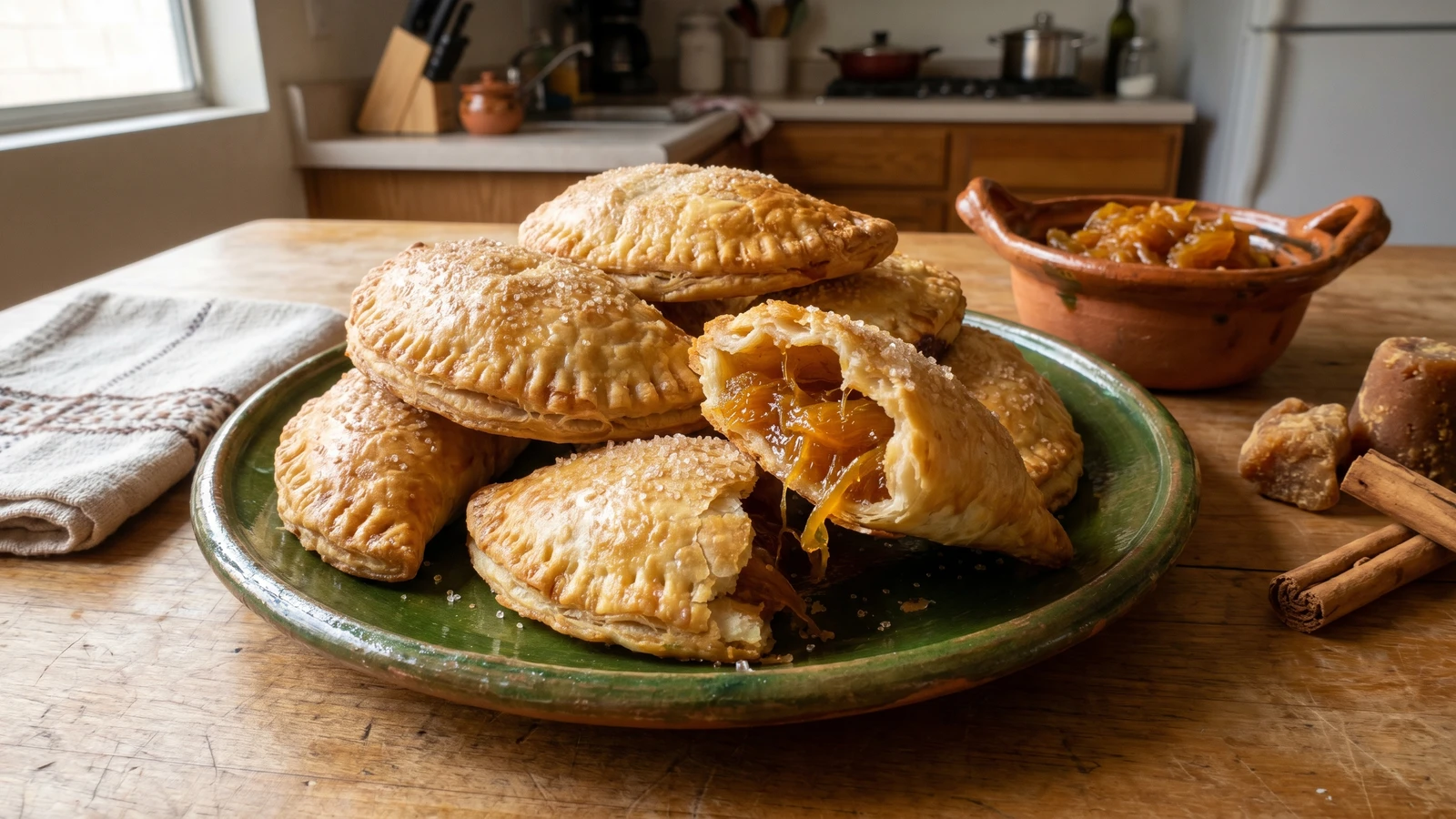
Michoacan's Purépecha sweet empanadas, filled with stringy chilacayote cooked down in piloncillo and warm spices, then sealed in a lard dough that bakes crisp at the edge and tender inside.
Michoacan, especially the Purépecha plateau around Patzcuaro, Tzintzuntzan, and the market roads toward Uruapan, is where these empanadas make sense. They belong on a wooden table with a green-glazed barro plate from Capula, coffee in clay cups, and a tray of pan dulce set out for family during holidays, velorios, and the days around Noche de Muertos.
The filling is chilacayote, not pumpkin and not zucchini. Chilacayote is a pale, hard-skinned squash whose flesh separates into threads when cooked, almost like cabello de angel. You cook it with piloncillo, canela de Ceylan, clavo de olor, and orange peel until the syrup grabs the strands and turns them amber. That texture is the point. If you puree it, you have ruined the work.
The dough takes manteca de cerdo. Not butter. Not shortening. La manteca es el sabor, and in these empanadas it gives the edge that clean bite and the middle that soft crumb. The women who taught me this in Michoacan did not measure with pastry school language. They pressed the dough between two fingers, listened to it, and knew. I give you measurements because recipes must travel. But the hand still has to learn.
This is not food from a single Mexico. This is Michoacan's kitchen, where fruit pastes, piloncillo sweets, wheat breads, and clay ovens sit beside corn, beans, and chile. Cada estado, su propia cocina.
Chilacayote, Cucurbita ficifolia, is a pre-Columbian squash grown in highland regions of Mexico and Central America, valued because its hard rind allows it to store for months after harvest. In Michoacan, especially in Purépecha communities, sweet preparations of squash cooked with piloncillo became tied to Catholic holiday breads and home baking after wheat flour, sugar refining, and clay bread ovens spread during the colonial period. The empanada form reflects that meeting: an older Mexican squash preserved in piloncillo, enclosed in a wheat and lard dough introduced through Spanish baking traditions.
Quantity
2 1/2 pounds
peeled, seeded, and cut into 1-inch chunks
Quantity
12 ounces
chopped
Quantity
1 cup
Quantity
1
Quantity
3
Quantity
2 wide strips
with little white pith
Quantity
1/4 teaspoon
Quantity
4 cups
plus more for rolling
Quantity
1/2 cup
Quantity
1 teaspoon
Quantity
1/2 teaspoon
Quantity
1 cup
chilled and cut into spoonfuls
Quantity
2
Quantity
1/3 cup
cold, plus more if needed
Quantity
1 egg beaten with 1 tablespoon milk
for brushing
Quantity
2 tablespoons
for sprinkling
| Ingredient | Quantity |
|---|---|
| fresh chilacayote squashpeeled, seeded, and cut into 1-inch chunks | 2 1/2 pounds |
| piloncillochopped | 12 ounces |
| water | 1 cup |
| Mexican cinnamon stick (canela de Ceylan) | 1 |
| whole cloves (clavo de olor) | 3 |
| orange peelwith little white pith | 2 wide strips |
| kosher salt for filling | 1/4 teaspoon |
| all-purpose flourplus more for rolling | 4 cups |
| granulated sugar for dough | 1/2 cup |
| baking powder | 1 teaspoon |
| kosher salt for dough | 1/2 teaspoon |
| pork lard (manteca de cerdo)chilled and cut into spoonfuls | 1 cup |
| large eggs | 2 |
| whole milkcold, plus more if needed | 1/3 cup |
| egg washfor brushing | 1 egg beaten with 1 tablespoon milk |
| granulated sugar for toppingfor sprinkling | 2 tablespoons |
Put the piloncillo, water, canela, cloves, orange peel, and salt in a wide clay cazuela or heavy pot. Set it over medium heat and stir until the piloncillo dissolves into a dark syrup. The smell should be deep and warm, not sharp. If the syrup boils hard, lower the heat. Piloncillo burns quickly once it thickens.
Add the chilacayote chunks and stir so every piece is coated. Cover and cook over medium-low heat for 35 to 45 minutes, stirring every ten minutes, until the squash softens and begins to separate into threads. Do not mash it. The strands are what make this filling chilacayote and not generic squash paste.
Uncover the pot and continue cooking for 20 to 30 minutes, stirring more often now, until the liquid reduces and the chilacayote looks glossy, amber, and thick enough to mound on a spoon. Pull out the cinnamon stick, cloves, and orange peel. Spread the filling on a tray and let it cool completely. Warm filling melts the lard in the dough and makes the empanadas leak. No me vengas con atajos.
Whisk the flour, sugar, baking powder, and salt in a large bowl. Add the chilled manteca and rub it into the flour with your fingertips until the mixture looks like coarse crumbs with a few pea-sized pieces of fat. Those pieces make the dough tender. If you work the lard until it disappears, the pastry bakes flat and tired.
Beat the eggs with the cold milk, then pour them into the flour mixture. Mix with your hand until a soft dough forms. If dry flour remains at the bottom, add milk one teaspoon at a time. The dough should hold together without sticking to your fingers. Knead it only four or five times, just enough to make it smooth.
Divide the dough in half, flatten each piece into a disk, wrap, and refrigerate for 30 minutes. Resting lets the flour hydrate and keeps the empanadas from shrinking in the oven. This is not wasted time. The dough is doing its work while you clean the table.
Heat the oven to 375F. Line two baking sheets with parchment. On a lightly floured table, roll one dough disk to about 1/8 inch thick. Cut 5-inch circles with a bowl, cutter, or the lid of a clean jar. Michoacan kitchens are practical. Use what gives you an even circle.
Place 1 generous tablespoon of cooled chilacayote filling slightly off center on each circle. Fold the dough over into a half-moon and press the edges closed with your fingers, then crimp with a fork or twist a small repulgue along the edge. Do not overfill them. A greedy empanada opens in the oven and makes a mess.
Set the empanadas on the prepared sheets with space between them. Brush lightly with egg wash and sprinkle with sugar. Bake for 22 to 28 minutes, rotating the pans halfway through, until the tops are golden and the crimped edges are deeper brown. The filling may bubble at one or two seams. That is fine. A tray with no marks looks like nobody cooked.
Let the empanadas cool on the baking sheet for 10 minutes, then move them to a rack. Eat warm or at room temperature with cafe de olla. The filling settles as it cools and the lard crust firms into the right bite. Recetas probadas y garantizadas.
1 serving (about 92g)
Culinary guides, cultural storytelling, and the editorial depth that makes cooking meaningful.
Discover Culinary ExplorerChef Lupita
Puebla's convent almond cookies, made from blanched almonds, sugar syrup, egg yolks, canela, and patient hands, the kind of sweet that belongs beside coffee in talavera, not in a plastic bakery box.

Chef Lupita
Ciudad de Mexico's panaderia banderillas are long sticks of hojaldre pressed with sugar, baked until amber, and finished with a hard glaze for coffee at the kitchen table.

Chef Lupita
Mérida's pale egg-yolk-and-vanilla kisses, tiny cookies built on eight yolks and a perfume of orange blossom, sandwiched with guava paste and dusted heavy with powdered sugar.

Chef Lupita
Hidalgo's bisquet de nata carries Pachuca's mining history into the breakfast table: a Cornish-style bread softened by Mexican nata, split warm and eaten with café de olla.