
Chef Lupita
Almendrados Conventuales Poblanos
Puebla's convent almond cookies, made from blanched almonds, sugar syrup, egg yolks, canela, and patient hands, the kind of sweet that belongs beside coffee in talavera, not in a plastic bakery box.
A cooking platform built around craft, culture, and the stories behind what we eat.
Created by
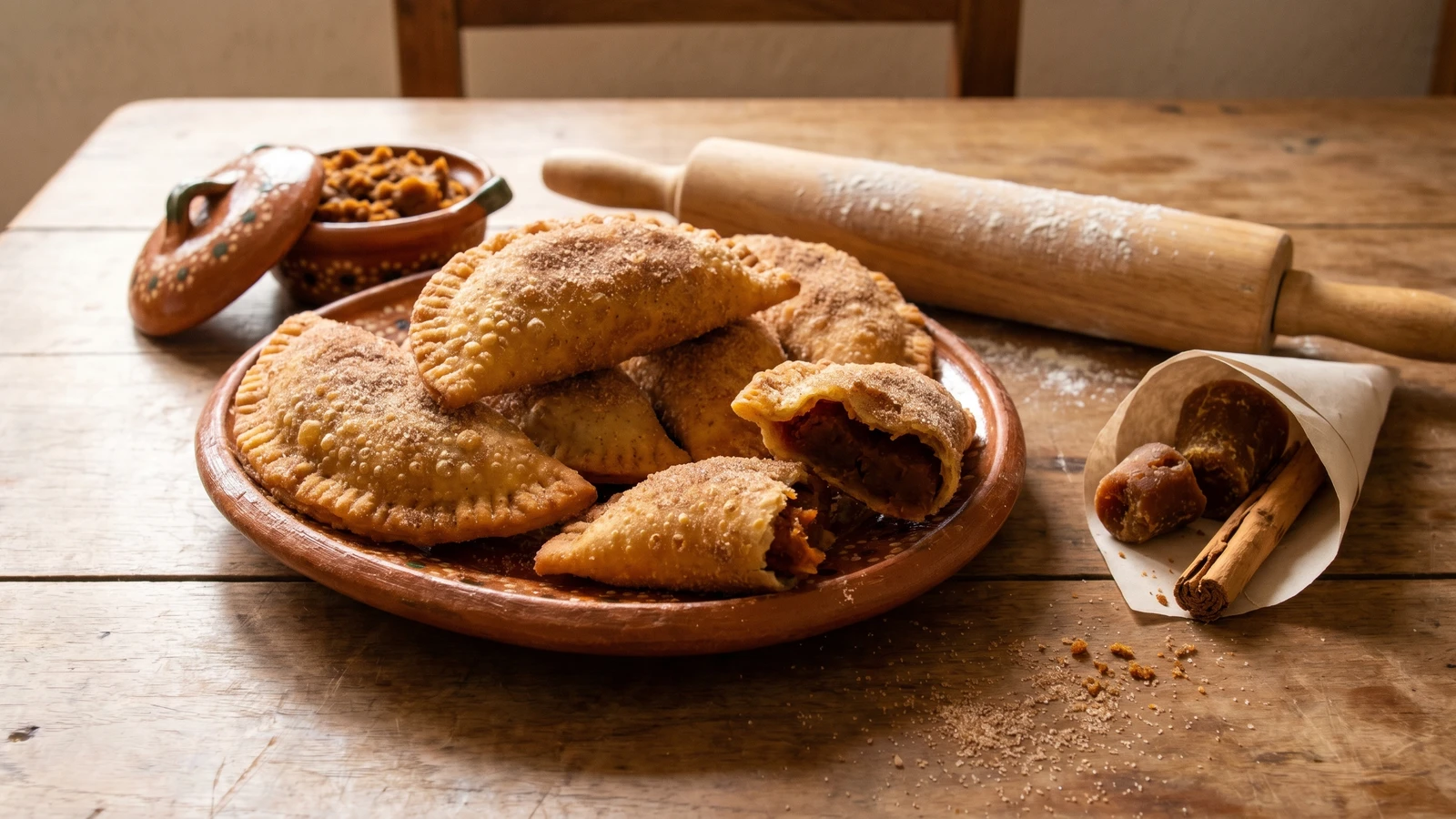
Guerrero's Chilapa market sweet, camote cooked down with piloncillo and canela, folded into an anise-scented dough, then fried until the edges blister and turn golden.
Guerrero, especially Chilapa de Álvarez in the Centro-Montaña corridor, knows these empanadas as market food, feast food, and comfort food that does not need a speech to defend itself. You see them stacked in trays near the pan dulce, golden half-moons with sugar clinging to the edges, sold by women who can seal a dozen before you finish asking the price.
The filling is camote cooked down with piloncillo and canela until it becomes thick enough to stay inside the dough. That matters. Watery filling leaks, burns in the fat, and makes the pastry heavy. The dough carries anise seed and manteca de cerdo. Not butter. Not a perfume bottle of vanilla trying to act Mexican. Anise and lard. Así se hace y punto.
I learned this version from a señora in Chilapa who rolled the circles with a glass bottle because her rolling pin had cracked years before. Her empanadas were exact, not because she measured like a pastry chef, but because she understood the dough. Guerrero cooking has that discipline: coastal fish, mountain moles, market sweets, each one with its own rules. Cada estado, su propia cocina.
This is not a chile dish, and it doesn't need to be. Not all Mexican food is hot. Some of it is camote, piloncillo, anise, and a pot of clean fat. Saber cocinar es saber vivir.
Empanadas entered Mexico through Spanish colonial baking traditions, but regional cooks quickly filled them with local ingredients, including camote, a crop cultivated in Mesoamerica before the conquest. Guerrero's sweet versions are strongly tied to town markets and holiday tables in places such as Chilapa, Tixtla, and Chilpancingo, where piloncillo and canela appear in many low-cost sweets built for feeding families. Unlike northern baked empanadas made with wheat and fruit preserves, these Guerrerense empanadas are commonly fried, a market technique that gives them their blistered shell and immediate freshness.
Quantity
1 1/2 pounds
scrubbed
Quantity
8 ounces
chopped
Quantity
1/2 cup
Quantity
1
Quantity
1/4 teaspoon
Quantity
1 teaspoon
Quantity
3 cups, plus more for rolling
Quantity
1 tablespoon
Quantity
1 teaspoon
Quantity
1/2 teaspoon
Quantity
1 1/2 teaspoons
lightly crushed
Quantity
6 tablespoons
room temperature
Quantity
3/4 cup, plus 2 tablespoons more if needed
Quantity
2 pounds lard or 6 cups oil
for frying
Quantity
1/2 cup
Quantity
1 teaspoon
| Ingredient | Quantity |
|---|---|
| orange sweet potatoes or Mexican camotescrubbed | 1 1/2 pounds |
| piloncillochopped | 8 ounces |
| water for the filling | 1/2 cup |
| Mexican cinnamon stick (canela) | 1 |
| fine sea salt for the filling | 1/4 teaspoon |
| fresh lime juice | 1 teaspoon |
| all-purpose flour | 3 cups, plus more for rolling |
| granulated sugar for the dough | 1 tablespoon |
| baking powder | 1 teaspoon |
| fine sea salt for the dough | 1/2 teaspoon |
| anise seedlightly crushed | 1 1/2 teaspoons |
| fresh pork lard (manteca de cerdo)room temperature | 6 tablespoons |
| warm water for the dough | 3/4 cup, plus 2 tablespoons more if needed |
| fresh pork lard or neutral frying oilfor frying | 2 pounds lard or 6 cups oil |
| granulated sugar for coating | 1/2 cup |
| ground Mexican cinnamon for coating | 1 teaspoon |
Put the scrubbed camotes in a pot and cover with cold water by one inch. Bring to a steady simmer and cook until a knife slides through the center without resistance, 30 to 40 minutes depending on their size. Drain them and let them cool just until you can handle them. Peel while warm. Warm camote mashes cleanly. Cold camote fights you.
In a wide saucepan, combine the piloncillo, 1/2 cup water, canela, and 1/4 teaspoon salt. Simmer over medium heat until the piloncillo dissolves and the syrup smells dark and mineral, 8 to 10 minutes. Do not replace piloncillo with white sugar and pretend nothing changed. Piloncillo carries cane flavor. That is the point.
Mash the peeled camote into the piloncillo syrup. Cook over medium-low heat, stirring with a wooden spoon, until the mixture thickens enough to hold a path when you drag the spoon across the bottom of the pan, 12 to 15 minutes. Stir in the lime juice. Remove the canela and cool the filling completely. If it goes into the dough warm, it will soften the pastry and leak in the lard.
In a large bowl, whisk the flour, sugar, baking powder, 1/2 teaspoon salt, and crushed anise seed. Rub in the manteca with your fingers until the flour looks sandy and holds together when squeezed. Add 3/4 cup warm water and knead just until a smooth, firm dough forms, 3 to 4 minutes. Add the extra water only if dry flour remains. The dough should feel like a soft earlobe, not bread dough.
Cover the dough with a clean kitchen towel and rest it for 25 minutes. This lets the flour hydrate and makes rolling easier. Women in the Chilapa market do this without naming the science. They know the dough behaves better after it sits. That is knowledge too.
Divide the dough into 18 balls. Roll each one on a lightly floured surface into a 5-inch circle. Place 1 heaping tablespoon of cooled camote filling slightly off center. Fold into a half-moon and press the edges firmly. Seal with the tines of a fork or twist the edge into a simple repulgue. Do not overfill them. A burst empanada wastes good camote and dirties the fat.
Heat the lard or oil in a heavy pot to 350F. The fat should be deep enough for the empanadas to float, about 2 inches. Fresh lard gives the cleanest Guerrero market flavor. If you use oil, use a neutral one and understand the compromise. La manteca es el sabor.
Fry 3 or 4 empanadas at a time, turning once, until golden with small blisters across the surface, 3 to 4 minutes total. Keep the fat between 340F and 355F. Too cool and the pastry drinks grease. Too hot and the outside browns before the edge cooks through. Drain on a rack, not paper towels, so the bottoms stay crisp.
Mix the sugar and ground canela in a shallow bowl. While the empanadas are still warm, toss them gently in the cinnamon sugar. Serve them piled on a clay platter with coffee de olla or atole. They are best the day they are fried, when the shell still gives under your teeth and the camote inside is soft and dark with piloncillo.
1 serving (about 85g)
Culinary guides, cultural storytelling, and the editorial depth that makes cooking meaningful.
Discover Culinary ExplorerChef Lupita
Puebla's convent almond cookies, made from blanched almonds, sugar syrup, egg yolks, canela, and patient hands, the kind of sweet that belongs beside coffee in talavera, not in a plastic bakery box.

Chef Lupita
Ciudad de Mexico's panaderia banderillas are long sticks of hojaldre pressed with sugar, baked until amber, and finished with a hard glaze for coffee at the kitchen table.

Chef Lupita
Mérida's pale egg-yolk-and-vanilla kisses, tiny cookies built on eight yolks and a perfume of orange blossom, sandwiched with guava paste and dusted heavy with powdered sugar.

Chef Lupita
Hidalgo's bisquet de nata carries Pachuca's mining history into the breakfast table: a Cornish-style bread softened by Mexican nata, split warm and eaten with café de olla.