Shrimp Empanadas, Veracruz Style (Empanadas de Camarón)
Created by
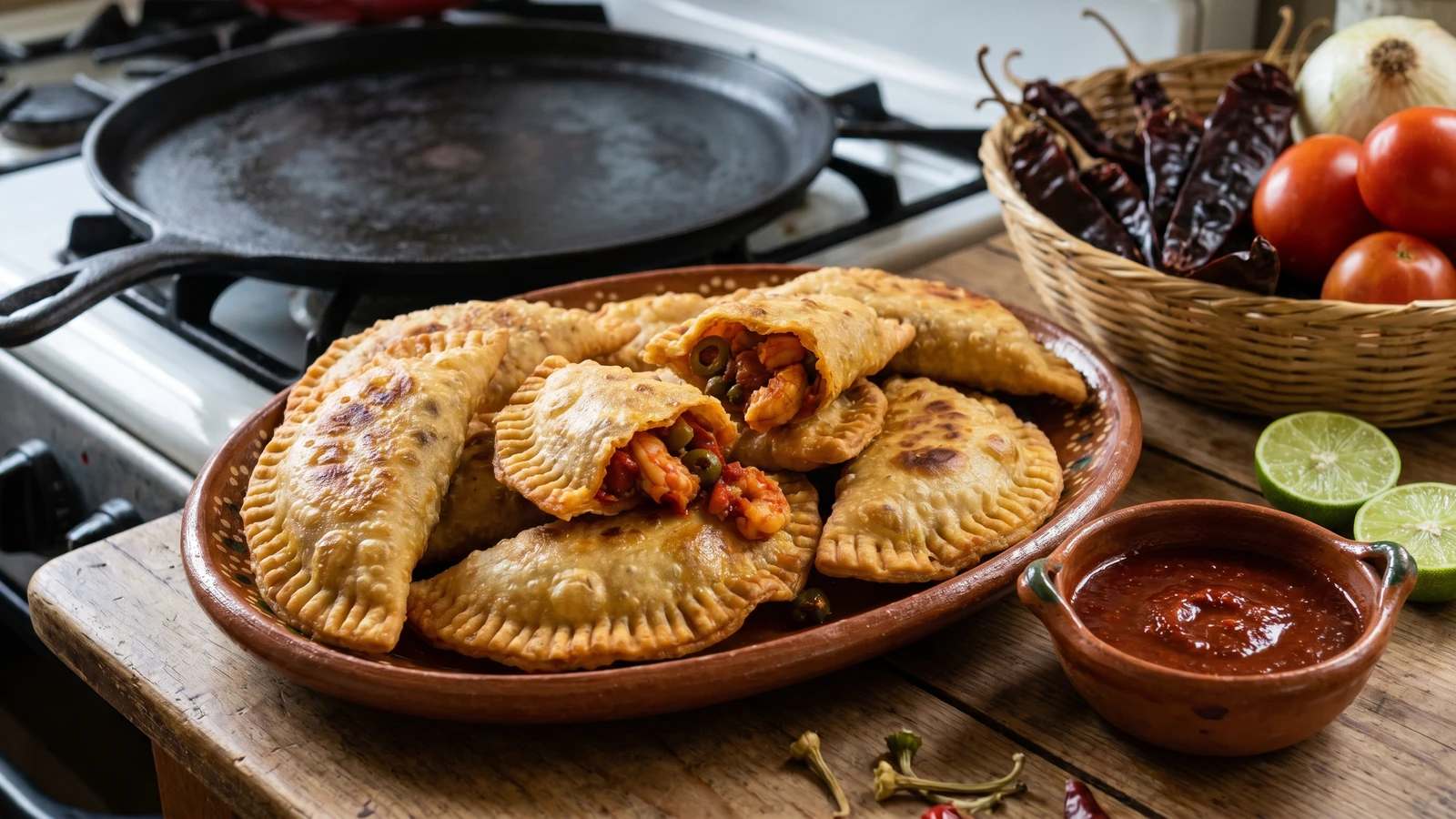
Veracruz's Gulf coast empanadas fold corn masa around shrimp guisado stained red with guajillo and jitomate, then fry in lard until the edges turn crisp and golden.
Appetizers & Snacks
Mexican
Dinner Party
Special Occasion
Celebration
45 min
Active Time
50 min cook•1 hr 35 min total
Yield12 empanadas, 6 appetizer servings
Veracruz, the Gulf coast from the port to Boca del Río and Alvarado, is where these empanadas live. Not in a flour tortilla. Flour belongs to the north. Here the shell is corn masa, pressed thin, folded around shrimp guisado, and fried until the edge snaps under your teeth.
The filling tells you where you are: Gulf shrimp, jitomate, chile guajillo, garlic, a little olive and caper from the old port kitchen, and epazote because seafood and corn need something green and sharp to keep them awake. Guajillo is not there to punish anybody. It gives color, clean red fruit, and body. Not all Mexican food is trying to burn you. That lazy idea has ruined enough recipes.
I learned a version near Mercado Hidalgo in Veracruz, from a woman who chopped the shrimp smaller than I expected and laughed when I asked why. She told me, para que alcance y para que no rompa la masa. So it stretches and so it doesn't tear the dough. There is the economy of the market in one sentence.
The rule is plain and strict: the guisado must be thick, the masa must be hydrated, and the manteca de cerdo must be hot before the empanadas go in. No me vengas con atajos. Fried masa forgives many things, but not wet filling or cold fat. Cada estado, su propia cocina.
Veracruz's port was founded as Villa Rica de la Vera Cruz in 1519, and for centuries it was one of New Spain's main doors for olive oil, olives, capers, and spices coming from Spain and the Caribbean. The state's corn-masa empanadas show the older maize base of Gulf cooking absorbing colonial port ingredients rather than replacing itself with wheat pastry. Along the coast, cooks debate whether shrimp fillings should carry epazote, hoja santa, or only Mexican oregano, but the Sotavento version keeps the wrapper corn-based and fries it crisp for market eating.
The technique, the tradition, and the story behind every dish.
peeled and deveined, shells reserved and shrimp chopped
water
Quantity
1 1/2 cups
bay leaf
Quantity
1
dried chile guajillo
Quantity
5
stemmed, seeded, and wiped clean
Roma tomatoes (jitomates)
Quantity
3 ripe
roasted
white onion
Quantity
1/2 medium
roasted
garlic cloves
Quantity
3
roasted in their skins and peeled
olive oil
Quantity
2 tablespoons
dried Mexican oregano
Quantity
1/2 teaspoon
crumbled
manzanilla green olives
Quantity
1/4 cup
chopped
capers
Quantity
1 tablespoon
rinsed and chopped
fresh epazote leaves
Quantity
2 tablespoons
chopped
freshly ground black pepper
Quantity
1/4 teaspoon
kosher salt
Quantity
1 1/2 teaspoons, divided, plus more to taste
masa harina para tortillas
Quantity
3 cups
warm water
Quantity
2 1/3 cups, plus more as needed
pork lard (manteca de cerdo), for the masa
Quantity
3 tablespoons
melted
pork lard (manteca de cerdo), for frying
Quantity
2 pounds
lime wedges (optional)
Quantity
for serving
salsa roja de chile seco (optional)
Quantity
for serving
Ingredient
Quantity
shell-on medium Gulf shrimppeeled and deveined, shells reserved and shrimp chopped
1 1/4 pounds
water
1 1/2 cups
bay leaf
1
dried chile guajillostemmed, seeded, and wiped clean
5
Roma tomatoes (jitomates)roasted
3 ripe
white onionroasted
1/2 medium
garlic clovesroasted in their skins and peeled
3
olive oil
2 tablespoons
dried Mexican oreganocrumbled
1/2 teaspoon
manzanilla green oliveschopped
1/4 cup
capersrinsed and chopped
1 tablespoon
fresh epazote leaveschopped
2 tablespoons
freshly ground black pepper
1/4 teaspoon
kosher salt
1 1/2 teaspoons, divided, plus more to taste
masa harina para tortillas
3 cups
warm water
2 1/3 cups, plus more as needed
pork lard (manteca de cerdo), for the masamelted
3 tablespoons
pork lard (manteca de cerdo), for frying
2 pounds
lime wedges (optional)
for serving
salsa roja de chile seco (optional)
for serving
Equipment Needed
•Cast iron comal or heavy skillet for toasting chiles and roasting jitomates
•Tortilla press lined with two sheets of plastic
•Blender and fine-mesh strainer
•Wide 12-inch clay cazuela or heavy Dutch oven for frying
•Kitchen spider or slotted spoon and wire rack
Instructions
1
Make shrimp broth
Keep the chopped shrimp cold while you work. Put the reserved shrimp shells in a small saucepan with the water and bay leaf. Bring to a gentle simmer and cook for 8 minutes, just long enough for the water to taste like the Gulf. Strain and discard the shells and bay leaf. You should have about 1 cup of quick shrimp broth.
2
Toast the guajillo
Heat a dry comal over medium. Toast the chile guajillo one at a time, about 20 seconds per side, until the skin darkens slightly and the chile smells fruity and deep. Do not blacken them. Put the toasted chiles in a bowl and cover with the hot shrimp broth for 15 minutes.
Guajillo gives color and clean red flavor. It is not there to punish anybody. Burn it and you get bitterness, not character.
3
Blend the sauce
On the same comal, roast the jitomates, onion, and garlic until they have blackened spots and soften at the edges. Peel the garlic. Blend the soaked guajillo, roasted jitomates, onion, garlic, 3/4 cup of the shrimp broth, 1/2 teaspoon of the salt, and the black pepper until completely smooth. Strain through a fine-mesh sieve. Guajillo skins can be stubborn. A smooth sauce makes a clean filling.
4
Cook the guisado
Heat the olive oil in a clay cazuela or heavy skillet over medium. Add the strained sauce and fry it for 6 to 8 minutes, stirring often, until it turns brick red and the oil gathers at the edges. Stir in the Mexican oregano, olives, and capers. Add the chopped shrimp and epazote and cook 60 to 90 seconds, only until the shrimp starts turning pink. The filling must be thick, not soupy. It will finish in the fryer. Spread it on a plate and cool completely.
Wet filling breaks empanadas. If the spoon leaves a clean trail across the pan, you are ready. If liquid runs back into the trail, keep cooking.
5
Prepare the masa
Mix the masa harina with the remaining 1 teaspoon salt in a large bowl. Add the warm water and melted manteca de cerdo. Knead for 3 minutes until the masa feels soft and alive, like an earlobe, and does not crack when pressed. Cover with a damp towel and rest 20 minutes. Masa harina is thirsty. If the edges crack, knead in water 1 tablespoon at a time.
6
Press and fill
Divide the masa into 12 balls. Line a tortilla press with two pieces of plastic from a clean produce bag. Press one ball into a 5 1/2-inch round, not paper thin. Spoon about 2 tablespoons of cold shrimp guisado onto one half, leaving a clean border. Use the plastic to fold the masa over the filling, then press the edge firmly with your fingers to seal. Do not overfill. The señora at Mercado Hidalgo who taught me this chopped the shrimp small for a reason: para que alcance y para que no rompa la masa.
7
Fry in manteca
Melt the frying lard in a wide heavy pot or cazuela to a depth of about 1 1/2 inches and heat to 350F. Fry 2 or 3 empanadas at a time, turning once, until deep golden with darker freckles, about 2 to 3 minutes per side. La manteca es el sabor, and it gives fried masa the clean crisp edge you are after. Let the lard come back to temperature between batches.
Cold fat makes greasy empanadas. Crowding the pot drops the temperature. No me vengas con atajos.
8
Serve immediately
Drain the empanadas on a wire rack, not a stack of paper towels where they soften underneath. Pile them on a warm red clay platter and serve with lime wedges and salsa roja de chile seco. They should be crisp at the rim, tender where the masa meets the filling, and red inside from guajillo and jitomate. Recetas probadas y garantizadas.
Chef Tips
•Buy shell-on shrimp if you can. The shells give you the quick broth that makes the guajillo sauce taste like seafood instead of plain tomato. Peeled shrimp saves time and costs you flavor.
•Good chile guajillo should be pliable, shiny, and smell faintly of dried fruit. If it is dusty and brittle, it is old. Pregúntale a las señoras del mercado before you buy.
•Olive oil in the guisado is Veracruz port cooking. Manteca de cerdo in the masa and fryer is market empanada cooking. Both belong here. This is a 32-state cuisine, not one rule for every pot.
•Fresh nixtamalized masa from a tortillería is better than masa harina. Use 2 pounds fresh masa and knead in the lard and salt, skipping the masa harina and water. Masa harina works, but it is a compromise, not an upgrade.
•The filling must be cool before you fold the empanadas. Hot filling sweats, softens the masa, and opens the seam in the fryer. La cocina no es decoración, es trabajo.
Advance Preparation
•The shrimp guisado can be made 1 day ahead and refrigerated. Bring it close to room temperature before filling so it spreads without tearing the masa.
•The masa is best mixed the day you fry. If it sits too long, it dries at the edges and cracks when folded.
•Unfried empanadas can be formed up to 2 hours ahead, covered with a damp towel, and refrigerated. Let them stand 15 minutes before frying.
•Fried empanadas are best immediately. If you must reheat them, use a 375F oven for 8 to 10 minutes. Do not microwave them unless you enjoy ruining your own work.
Frequently Asked Questions
Nutrition Information
1 serving (about 250g)
Calories
590 calories
Total Fat
33 g
Saturated Fat
11 g
Trans Fat
0 g
Unsaturated Fat
20 g
Cholesterol
155 mg
Sodium
900 mg
Total Carbohydrates
54 g
Dietary Fiber
6 g
Sugars
3 g
Protein
21 g
Where cooking meets culture.
Culinary guides, cultural storytelling, and the editorial depth that makes cooking meaningful.