
Chef Lupita
Almendrados Conventuales Poblanos
Puebla's convent almond cookies, made from blanched almonds, sugar syrup, egg yolks, canela, and patient hands, the kind of sweet that belongs beside coffee in talavera, not in a plastic bakery box.
A cooking platform built around craft, culture, and the stories behind what we eat.
Created by
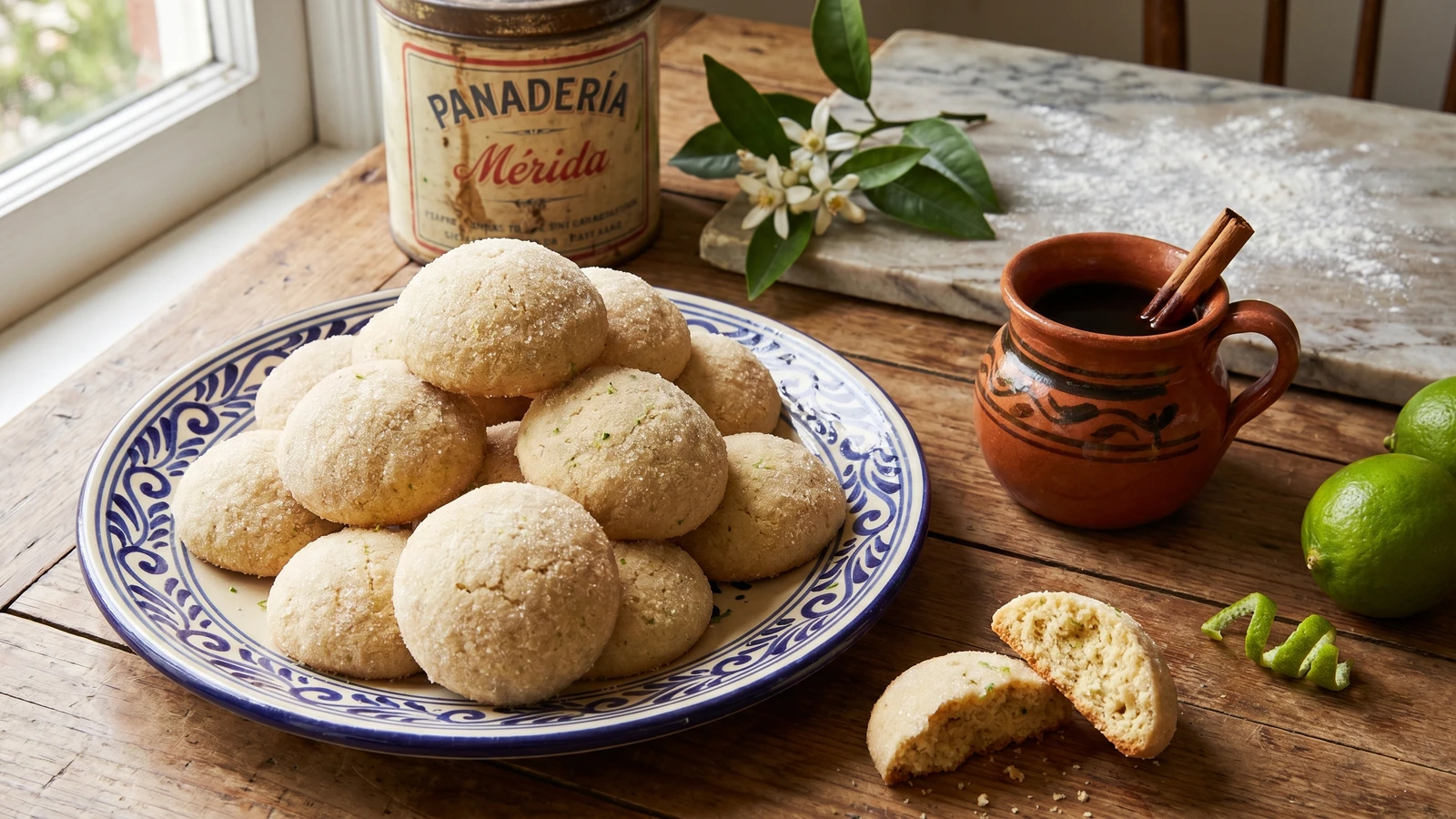
Yucatan's buttery sugar-dusted cookie from Pan Elena Vales, Merida's oldest panaderia. Lard, orange flower water, lime zest, and a recipe the family has guarded since 1865.
This cookie is from Merida. Specifically from Pan Elena Vales, the panaderia on Calle 65 in the centro historico that has been baking the same recipe since 1865. Yucatan has a baking tradition that has nothing to do with the rest of Mexico, and the elenita is the proof.
The Yucatan peninsula sits across the gulf from Cuba and across the sea from Lebanon and Syria, and Merida is closer to Havana than to Mexico City. The families who arrived from the Levant in the late 19th century brought orange flower water and almond. The Spanish brought butter and powdered sugar. The Maya cooks who ran the kitchens used lard, because that is what was rendered fresh every morning from the family pig. The elenita is what happens when those three traditions meet on the same counter. Cada estado, su propia cocina, and this one belongs to Yucatan.
The recipe at Pan Elena Vales is not written down. I sat in the back of that bakery one afternoon in 2017 with a notebook and watched the granddaughter of Elena Vales work, measuring nothing, weighing nothing, the dough coming together by feel after a hundred and fifty years of family memory. She would not give me the recipe and I did not ask. What you have here is mine, reconstructed from what I saw, from what I tasted, and from three other Merida panaderas who were willing to talk. It is faithful to the cookie. It is not the original. Recetas probadas y garantizadas.
The lard is not optional. The orange flower water is not optional. The two coats of powdered sugar are not optional. Skip any of them and you have made a butter cookie. Make all three and you have made an elenita.
Pan Elena Vales was founded in 1865 in Merida by the Vales family during the height of the henequen boom that transformed Yucatan into one of the wealthiest regions of Mexico, and the bakery has operated continuously through five generations, the Caste War, the Mexican Revolution, and the collapse of the henequen industry. The elenita reflects Yucatan's distinctive culinary genealogy, a peninsula that received Lebanese, Syrian, and French immigration in the late 19th century and that historically traded more with Havana, New Orleans, and Europe than with central Mexico, producing a regional cuisine in which orange flower water, almond, and European baking techniques are as native as achiote and sour orange. The cookie's name honors Elena Vales, the family matriarch credited with codifying the recipe, and the Merida tradition of naming pan dulce after the women who shaped them remains active in the panaderias of the centro historico to this day.
Quantity
2 cups
sifted
Quantity
1/2 cup
Quantity
1/2 teaspoon
Quantity
1 cup
at room temperature but still cool
Quantity
1/4 cup
at room temperature
Quantity
3/4 cup
sifted, plus more for dusting
Quantity
2
at room temperature
Quantity
1 teaspoon
Quantity
1 tablespoon
Quantity
from 1 lime
finely grated
Quantity
1 cup
| Ingredient | Quantity |
|---|---|
| all-purpose floursifted | 2 cups |
| cornstarch | 1/2 cup |
| fine sea salt | 1/2 teaspoon |
| unsalted butterat room temperature but still cool | 1 cup |
| manteca de cerdo (pork lard)at room temperature | 1/4 cup |
| powdered sugarsifted, plus more for dusting | 3/4 cup |
| large egg yolksat room temperature | 2 |
| pure vanilla extract | 1 teaspoon |
| orange flower water (agua de azahar) | 1 tablespoon |
| Persian lime zestfinely grated | from 1 lime |
| powdered sugar for dusting | 1 cup |
Sift the flour and cornstarch together into a bowl. Add the salt and whisk to combine. The cornstarch is not a substitute for flour. It is what gives the elenita its powdery, sandy crumb that dissolves on the tongue. Skip it and you have made a different cookie.
In the bowl of a stand mixer with the paddle attachment, beat the butter and lard together on medium speed for about three minutes, until pale and creamy. The lard is not negotiable. La manteca es el sabor. Butter alone gives you a French sable. Butter with a quarter cup of lard gives you an elenita, with the slight savoriness and the longer shelf life that defined this cookie when it traveled by horse cart from Merida to the henequen haciendas in the 1800s.
Add the powdered sugar in two additions, beating on low until just incorporated between each. Stop the mixer, scrape the bowl, and add the egg yolks one at a time. Beat just until the yolks disappear into the cream. Add the vanilla, the orange flower water, and the lime zest. The orange flower water is the Yucateca signature, the Lebanese inheritance carried into Merida by the families who arrived in the late 19th century. Without it, the cookie is plain. With it, the cookie smells like a Merida bakery on Sunday morning.
With the mixer on the lowest speed, add the dry ingredients in three additions. Stop the mixer the moment the flour disappears. Overworking this dough develops gluten and ruins the crumb. The dough should look shaggy and soft, not smooth. Turn it out onto a clean counter and press it together with your hands two or three times. That is all. No me vengas con atajos. Do not knead it.
Divide the dough in two, flatten each half into a disk, wrap in plastic, and refrigerate for at least 90 minutes and up to two days. The chill is not optional. Warm dough spreads in the oven and the elenita is supposed to hold its round shape with a slight dome on top, not flatten into a wafer.
Heat the oven to 325F. Line two heavy sheet pans with parchment. Working with one disk at a time and keeping the other refrigerated, scoop level tablespoons of dough and roll each one between your palms into a smooth ball. Place them on the sheet pans about an inch and a half apart. Do not flatten them. The dome is the shape of the elenita.
Bake for 14 to 16 minutes, rotating the pans halfway through. The cookies are ready when the bottoms are very pale gold and the tops are still nearly white. They should look underbaked. They are not. The elenita is meant to be tender and crumbly, never browned. A browned elenita is a ruined elenita. The cookies will continue to firm up as they cool.
Let the cookies rest on the sheet pan for five minutes. While they are still warm but cool enough to handle, sift powdered sugar generously over them. The warmth melts the first layer of sugar onto the surface, creating the bond. Once the cookies are completely cool, sift a second heavy layer of powdered sugar over them. Two coats is the Pan Elena Vales standard. Anything less and the elenita looks naked. Asi se hace y punto.
1 serving (about 22g)
Culinary guides, cultural storytelling, and the editorial depth that makes cooking meaningful.
Discover Culinary ExplorerChef Lupita
Puebla's convent almond cookies, made from blanched almonds, sugar syrup, egg yolks, canela, and patient hands, the kind of sweet that belongs beside coffee in talavera, not in a plastic bakery box.

Chef Lupita
Ciudad de Mexico's panaderia banderillas are long sticks of hojaldre pressed with sugar, baked until amber, and finished with a hard glaze for coffee at the kitchen table.

Chef Lupita
Mérida's pale egg-yolk-and-vanilla kisses, tiny cookies built on eight yolks and a perfume of orange blossom, sandwiched with guava paste and dusted heavy with powdered sugar.

Chef Lupita
Hidalgo's bisquet de nata carries Pachuca's mining history into the breakfast table: a Cornish-style bread softened by Mexican nata, split warm and eaten with café de olla.